By Dr. Shabbir H. Gheewala, Kobboon Kaewpila, and Sumonrat Chairat
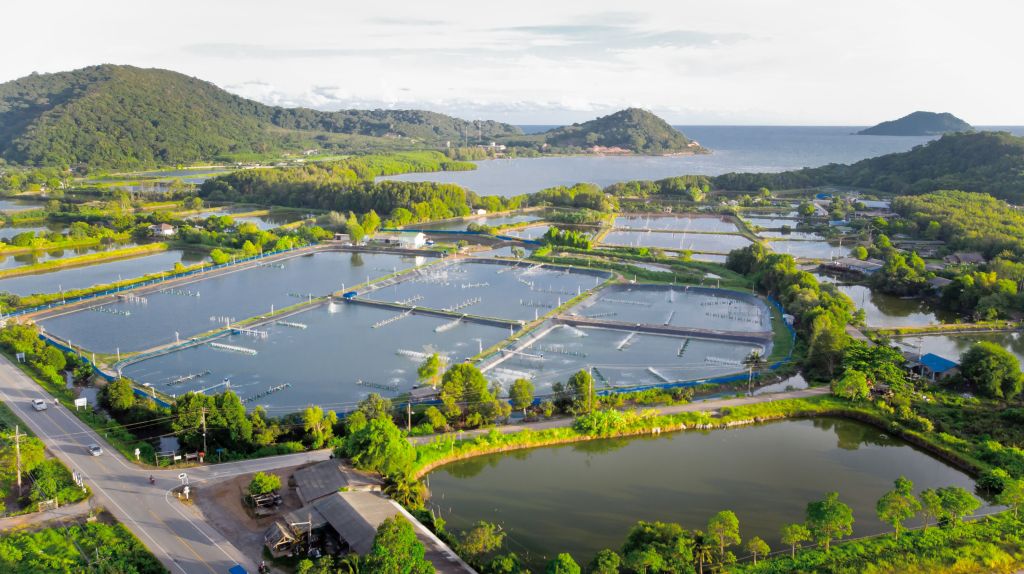
Aquaculture possesses significant advantages over terrestrial livestock production. These include higher protein production, lower environmental impacts, and lower feed conversion ratios (FCR) (Bourne 2014; Fry 2018). This makes aquaculture a valuable alternative supply of global food. However, climate change causes substantial additional risks to aquaculture production due to rising water temperatures, flooding, acidification, and eutrophication. Furthermore, increasing concerns about greenhouse gas (GHG) emissions necessitate mitigation strategies within the aquaculture sector to achieve carbon neutrality and net-zero emission targets by 2050 in Thailand (NXPO 2022).
Life Cycle Assessment (LCA) provides a critical tool in support of these goals. It systematically analyzes the environmental impacts throughout aquaculture’s processes, using data-driven evaluation and decision-making. LCA’s ultimate goals are to optimize feed production, enhance energy efficiency, and improve waste management practices. This approach is essential for a sustainable and climate-resilient aquaculture that protects ecosystem services and meets sustainable development goals (SDGs).
Life Cycle Assessment (LCA): A Short Guide
Life Cycle Assessment (LCA) serves a function like financial accounting, but instead of quantifying monetary flows, it tracks resource inputs and outputs throughout a product’s or service’s lifespan. Data on materials, resource utilization, energy consumption, and GHG emissions are investigated by LCA. Analysis of these data reveals the environmental impacts associated with each production stage. It can identify hotspots or processes with the greatest environmental burdens, and thus guide optimization strategies. For instance, if product packaging generates environmental impacts, this information can drive innovation like reducing or redesigning packaging solutions.
LCA comprises four stages.
Stage 1 Goal and Scope Definition: This stage defines the study objectives and product or service boundaries, from resource extraction to manufacturing, distribution, use, and end-of-life disposal or recycling.
Stage 2 Inventory Analysis: This stage quantifies inputs (resources) and outputs (products, waste) within the defined scope.
Stage 3 Impact Assessment: This stage translates inventory data into environmental impact categories, such as climate change, resource depletion, and land use.
Stage 4 Interpretation: This stage identifies hotspots and suggests targeted improvements.
The results of Stage 4 can inform decision-making across sectors. For example, an LCA of textiles revealed high energy-consumption at the consumer-use phase (washing and ironing). This encouraged the development of eco-friendly clothes such as non-iron or easy wash and dry clothes (Laursen 2007). Beyond industry, LCA enables policymaking for governments and persuades consumers to make eco-friendly choices aligned with sustainability goals. The comprehensive framework offered by LCA about the environmental implications of actions will drive systemic change towards a more sustainable future.
Some Aquaculture Approaches of Interest
The demands for sustainability and global food security, along with the challenges of climate change, are major concerns for the aquaculture industry. They necessitate the study and evaluation of alternative aquaculture approaches that can address these challenges. Examples of practices that may be of interest are discussed below (Ahmed 2019).
Integrated Aquaculture Systems (IAS): Rice-fish or mangrove-shrimp IAS establish synergistic production cycles. Mangroves enhance productivity, while sequestering substantial amounts of carbon (blue carbon) and supporting coastal defenses from storm surge. The closed-system approach maximizes resource utilization, enhances natural pest management in the system, and increases overall productivity. Furthermore, case studies in Bangladesh illustrate climate resilience, via the use of infrastructure (water pumps, embankments) within integrated farms to prevent flooding and salinity.
Polyculture: The cultivation of multiple species of aquatic animals has interdependent benefits. This approach increases productivity, reduces reliance on external feed, and promotes a more sustainable aquatic environment.
Recirculating Aquaculture Systems (RAS): Land-based RAS provides controlled environments for high-density production through mechanical and biological water filtration and reuse. This method minimizes environmental impacts.
Mariculture Aquaculture: Mariculture, including cage culture and seaweed farming, provides ample opportunity for utilizing the marine environment. This strategy increases seafood production, reduces impacts on terrestrial resources and marine species, and exhibits climate adaptability. Seaweed cultivation provides carbon sequestration (blue carbon).
The environmental impacts, effectiveness, and optimization of these alternative approaches may be further enhanced by the application of LCA to elucidate the tradeoffs and synergies of these approaches.
LCA Applied to Aquaculture
LCA applications in aquaculture have two primary goals: (1) to identify areas of significant environmental impact within the aquaculture value chain; and (2) to conduct comparative assessments of environmental performance between conventional and alternative aquaculture practices.
To achieve these goals, it is essential to outline system boundaries and identify stakeholders at each stage, for example feed production, grow-out, distribution, and processing. Input and output data must then be collected within these boundaries. Subsequently, these data are translated into specific environmental impact categories, such as feed production, energy use, and waste management. This systematic approach enables a comprehensive comparison of environmental impacts between conventional and alternative aquaculture models.
Benefits of LCA
By examining the life cycle of aquaculture processes, LCA can identify the specific processes in which there is room for improvement. This examination evaluates the environmental impacts of feed production, energy use on the farm, water pollution, and GHG emissions from the transport of products to consumers.
LCA’s results provide benefits to different stakeholders in the aquaculture industry. For example, farmers gain an insight on how to improve their hatchery and grow-out operation in terms of energy usage and GHG mitigation. Downstream stakeholders, such as distributors and processing factories, gain more carbon credits by the reduction of GHG emissions from their processes. Policymakers such as the Department of Fisheries (DOF) can use these data to support alternative aquaculture practices and encourage farmers to improve or optimize their practices.
Challenges to LCA
While LCA offers significant value in aquaculture, its implementation faces some important challenges. A primary limitation is data quality and availability. Comprehensive assessment of environmental impacts necessitates detailed data on inputs and outputs throughout the aquaculture value chain. This data can be difficult to obtain, particularly in small-scale farming operations, where record-keeping may be less common. Additionally, seasonal variations, climatic fluctuations such as drought or rainfall patterns, and regional differences in aquaculture practices and climate conditions, further complicate data collection and interpretation.
Conclusion
Aquaculture provides a promising pathway to food security. Yet its sustainability is threatened by climate change and demands to reduce greenhouse gas (GHG) emissions. Some alternative aquaculture practices of interest, such as Integrated Aquaculture Systems (IAS), polyculture, Recirculating Aquaculture Systems (RAS), and mariculture show promise. Life Cycle Assessment (LCA) offers a critical tool to analyze the positives and negatives of these aquaculture processes. It could identify environmental hotspots and potential improvements by optimizing feed production, energy use, and waste management towards a more sustainable approach. However, data availability and fluctuation present a challenge to the collection of reliable data.
The future of sustainable aquaculture depends on the awareness of stakeholders (farmers, distributors, suppliers) regarding climate change impacts and GHG emissions. These concerns may motivate them to mitigate the environmental footprint of their operations. Emerging concepts like carbon credits could accelerate this shift, driving improvements and market access for eco-friendly products. Nature-based solutions will play a crucial role in aquaculture, offering climate-resilient practices with the potential for the provision of carbon sequestration and ecosystem services.
LCA, in combination with additional sustainability assessment tools, will be essential to guide these transformations and inform policymakers about the selection of suitable alternative approaches. Adoption of environmentally friendly aquaculture will be an important contribution to a sustainable food system in a future, changing climate.
 AQUADAPT