By Dr. Suchart Ingthamjitr
Thai aquaculture developed around 100 years ago. The current widely practiced intensive system, however, was only developed about 50 years ago (Patmasiriwat 1998). The success of hatchery-bred seed alongside the development of commercial pellet feed are the key factors that have supported the development of intensive aquaculture.
Thai aquaculture is diversified, both in terms of geography (inland and coastal areas) and aquatic animal species (fish, crabs, mollusks, and shrimps). The popularity of the cultured species depends on market demand, which can be divided into local and export markets. Among the economically important species, white leg shrimp and Nile tilapia are the two most productive species (DOF 2022). For the years 2004-2012, Thailand was ranked as a top ten world aquaculture producer with a production of over 1 million tonnes (FAO 2006, 2010, 2012). Aquaculture plays an important role in food security, as well as in the social and economic development of the country. However, production has drastically decreased (<1 million tonnes) since 2013, although it climbed up to about 1 million tonnes in 2020-2022, which is still far below from that achieved during 2004-2012 (DOF 2022).
Aquaculture and the Environment
The country’s development has caused environmental alterations in general, and water pollution in particular. All sectors, including aquaculture, are producing more to meet the demands of an increasing population. Wastes generated from production processes have gradually increased proportionally with production enhancement. Aquaculture has contributed to environmental degradation, such as habitat destruction, water pollution, and ecological damage (Sampantamit 2020). Proliferation of water hyacinth in freshwater and more frequent occurrences of red tide (plankton bloom) around the Inner Gulf coastal waters are two consequences of nutrient enrichment in public waters.
Intensive marine shrimp culture, in its early development, relied mostly on pond water exchange with public water (open system), as neither water storage nor water treatment were available on site. Although, many farms later changed to closed systems, the majority, especially the small-scale farms, still practice open systems. Public water quality in the last 40-50 years was generally in good condition and did not create problems for aquaculture. However, more recently, inland and coastal water quality has deteriorated. Expansion of marine shrimp farms along coastal areas resulted in diminishing mangrove areas (Patmasiriwat 1998), and thus the capability of nutrient uptake was reduced. Organic substances and nutrients discharged from marine shrimp farms have contributed to environmental deterioration.
Tilapia cage culture relies on the water current to move out wastes from the culture unit into the surroundings or the downstream waterway. Therefore, cage culture continuously releases wastes into public waters during the culture cycle. Cage culture also stocks at high densities, and thus potentially contributes to high levels of organic substances and nutrient loads being released into public waters. These, in turn, can lead to disease outbreaks when production exceeds the carrying capacity of the waters.
For aquaculture to be sustainable in the long term, current practices need to be improved and better alternatives adopted. Closed aquaculture systems appear to have great potential for intensive aquaculture’s future.
Biofloc Technology
Biofloc system differs from the traditional green water systems that rely on phytoplankton which are photoautotrophs. Instead, it uses chemoheterotrophs to control water quality (Avnimelech 2015). In biofloc systems, chemoheterotrophs are enhanced to become the predominant microorganism by adding carbohydrate (molasses or sugar) to increase the carbon to nitrogen ratio (C/N ratio >10-20) of the culture medium. In addition, because a biofloc system is a closed aquaculture system, the water treatment can be managed within the culture unit. Thus, less investment for land, construction, and facilities for water treatment are required in comparison with Recirculating Aquaculture System (RAS). In addition, biofloc systems can be applied to either large-scale or small-scale aquaculture farms.
Instead of releasing wastes into the environment, a biofloc system retains waste in the culture unit and changes it into high protein settleable solids. This is a crucial advantage of the system. It protects the environment and, to some extent, simultaneously reduces the amount of commercial pellet feed needed. Chemoheterotrophs form porous settleable solids with other suspended materials such as algae, carcass, feces, uneaten feed, and other microorganisms. The so called “biofloc” ranges in size from 0.1-3 mm (Avnimelech 2015), big enough for white leg shrimp and Nile tilapia to feed upon.
The year-round warm temperature of Thailand is an ideal condition for chemoheterotrophs’ proliferation. Whereas the absence of sunlight due to cloudy days during the rainy season or self-shading due to over population limit the growth of the photoautotrophs found in typical aquaculture ponds, these events are not a concern for the growth of chemoheterotrophs in biofloc systems. Chemoheterotrophs replicate 24-hours a day given warm media temperatures and abundant organic matter.
Thus, biofloc system is an environmentally friendly technology for intensive aquaculture systems.
A Brief History of Biofloc Technology in Thailand
The first introduction of a biofloc system in a marine shrimp farm is unknown. But the concept of increasing the C/N ratio was applied probably sometime after disease outbreaks with Tiger shrimp. An early and prominent example of a biofloc system application in Thailand is at a private tilapia farm, King Fish Group Co. Ltd. in Chiang Mai Province around the early 2010s. Kasetsart University’s Faculty of Fisheries Alumni Association, in collaboration with the Faculty of Fisheries, organized a 2-day biofloc technology workshop in March 2016. Professor Yoram Avnimelech, a well-known biofloc technology expert, was involved in the workshop as a lecturer and adviser. This workshop possibly played a significant role in raising an awareness of biofloc technology in Thailand, since a number of reports on biofloc research were published soon thereafter.
Some Practical Guidelines for the Application of Biofloc Technology
Monitor Water Quality: It is important to regularly monitor water quality to ensure a good performance of the biofloc system. Dissolved Oxygen (DO), pH, and total ammonia nitrogen need to be monitored daily, while settleable solids (biofloc) and alkalinity should be monitored periodically.
Apply Aeration: Both the cultured species and the chemoheterotrophs need sufficient DO to support their growth. DO must be maintained well above 4 milligrams per liter. Another benefit of aeration is the movement of water, which circulates the biofloc in suspension. A stable electricity supply is crucial to ensure continued aeration.
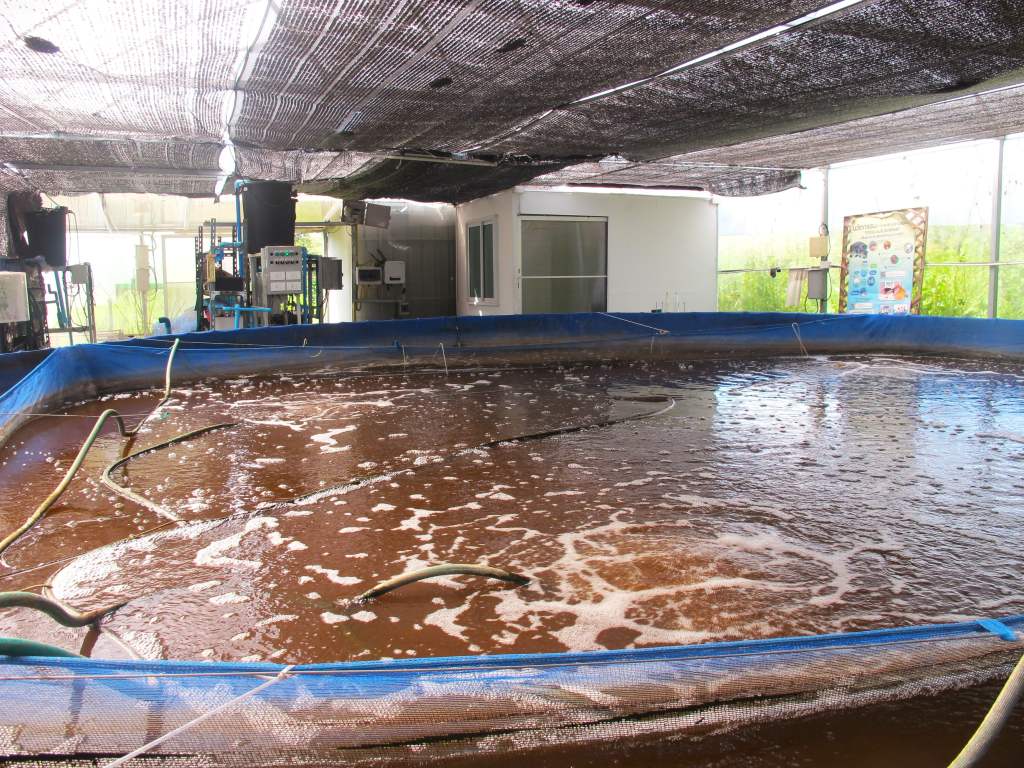
Remove Foam: Foaming at the water surface is a normal feature of intensive culture under a biofloc system. The accumulation of dissolved organic wastes in a biofloc system causes the viscosity of the culture medium to increase. Thus, long lasting air bubbles at the water surface appear as foam. The smaller the air bubbles, the better is the removal of dissolved organics from the culture medium. Microbubbles and nanobubbles potentially help in the removal of ammonia nitrogen. Foam at the water’s surface should be removed periodically.
Add Carbohydrate: Aquatic animal excrete 80-90% of their nitrogenous waste as ammonia nitrogen via their gills. In general, a chemoheterotroph utilizes organic matter for its energy and carbon source, and takes up ammonia nitrogen in the culture medium for reproduction. Ammonia nitrogen should be regularly monitored once a day, ensuring that the concentration does not exceed 2 milligrams per liter. An application of carbohydrate is necessary when the concentration of ammonia nitrogen approaches 2 milligrams per liter. An amount of 20 milligrams of carbohydrate per liter of culture medium is needed to reduce the concentration of ammonia nitrogen by 1 milligram per liter.
Add Lime: The reproduction of chemoheterotrophs decreases the pH and alkalinity of the culture medium. Periodically adding lime is suggested to maintain the pH and alkalinity at favorable levels.
Monitor Floc Volume: It is necessary to control the settleable solids at an optimal level. The more settleable solids, the greater the unnecessary consumption of oxygen. The volume of settleable solids (floc volume) should be determined periodically with a conical vessel (Imhoff cone). Sample one liter of culture medium and place it on a Imhoff cone rack for about 15 minutes or until settleable solids are completely settled. Read the scale of the floc volume. A floc volume of 15-20 milliliter per liter of culture medium is recommended. Excessive settleable solids can be removed by simple filtration techniques, such as by sediment filter fiber.
Reduce Feed: The normal feed rate for food fish cultured with commercial pellets is 3-5% of body weight. However, in biofloc systems, much less feed is needed because some of the natural floc is eaten as feed. Thus, the feed should be reduced by around 1%, to 2-4% of body weight.
Add Water: The loss of culture medium via evaporation and settleable solids removal during the culture cycle must be compensated for by adding water periodically.
Use Polyethylene (PE) Sheets: Line earthen ponds with polyethylene (PE) sheets to prevent contamination by diseases, organic substances, nutrients and chemical substances that otherwise may infiltrate through the earthen pond’s bottom. Moreover, paving ponds with PE reduces the time required for pond preparation, in particular for the drying process. Hence, more culture cycles are possible.
Remove Excessive Floc: Biofloc systems continuously generate large amounts of settleable solids that must be removed periodically from the culture unit. Efficient equipment for removing the settleable solids, as well as practical means for adding value to the solid wastes, should be further developed. The settleable solids are high in protein and minerals, and thus have potential to be used as an animal feed and as a plant fertilizer ingredient.
These guidelines and considerations focus on adjustments to the traditional pond design, which consists mostly of square earthen ponds without central drainage systems. However, a circular pond or tank with a central drainage system is preferable, as it facilitates better water movement, while settleable solids concentrated at the middle can be easily removed through a central drainage system.
Limitations of Biofloc Technology
Electricity Supply: Dissolved oxygen content and water movement by aeration are very crucial for biofloc systems. Therefore, the stability of the electricity supply is crucial to ensure an effective operation. Having a back-up generator would further reduce risks.
Capital Investment: Both the equipment and the operational costs of the aeration systems are possibly higher than those of traditional culture practices. However, biofloc technology promises the sustainable production of a premium high quality product.
Anaerobic Condition: Lack of dissolved oxygen in biofloc systems can generate nitrite nitrogen, a toxic gas for aquatic animals. This anaerobic condition caused by the accumulation of settleable solids at the pond’s bottom can be avoided by proper design of the aeration system. Generally, the smaller the size of the culture unit, the easier it is to avoid anaerobic conditions.
Conclusion
Poor management of intensive aquaculture is associated with increased disease outbreaks and environmental degradation. Sustainable intensification is possible with the implementation of appropriate technologies and strategies. In this respect, biofloc technology, an environmentally friendly aquaculture system, is well worth a consideration.
 AQUADAPT