By Dr. Praneet Ngamsnae
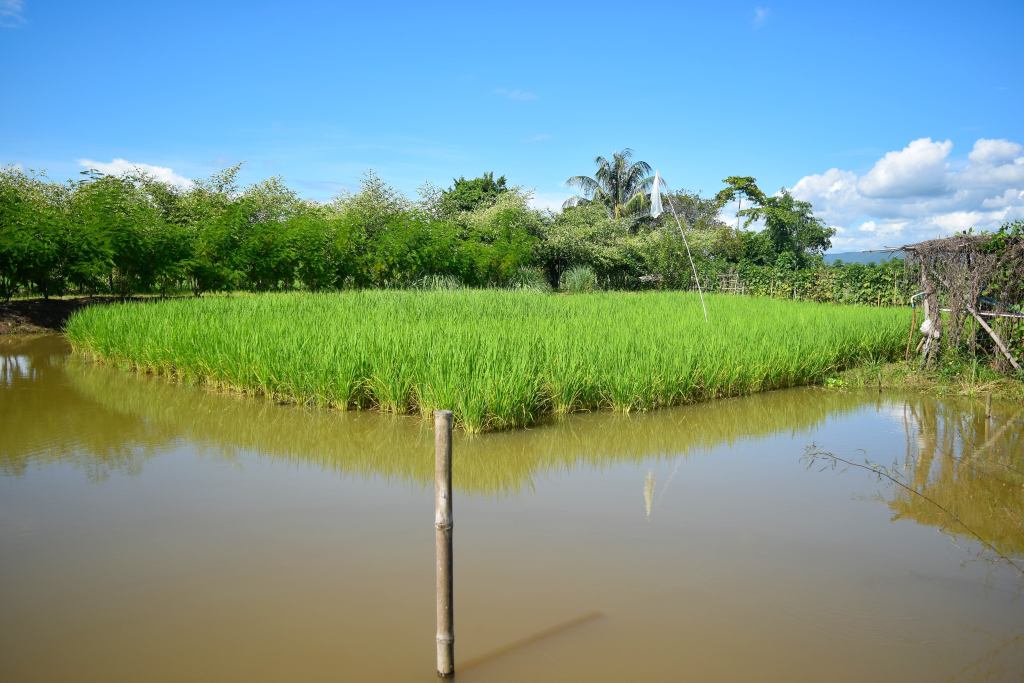
Earthen Pond-based Floating Beds (EPFB) offer an innovative approach to rice-fish co-culture, merging aquaculture and agricultural practices to enhance productivity and environmental sustainability. This integrated farming method draws inspiration from traditional agricultural techniques prevalent in Asian regions, where rice and fish cultivation have long been interconnected.
By creating symbiotic environments within pond systems, this sophisticated agricultural strategy not only maximizes land use and water resource utilization, but also promotes ecological balance, as fish waste provides essential nutrients for rice plants (Ngamsnae 2024).
Recently, by introducing floating bed technologies, particularly in earthen pond-based systems, farmers have modernized this traditional practice, enabling more sophisticated and efficient resource management. The floating beds provide a stable platform for rice cultivation while allowing fish to swim freely below, promoting a symbiotic relationship. This integration leads to increased yields of both rice and fish, improving food security and farmer income. This article explores the principles, implementations, and impacts of these innovative systems, offering a resilient solution that adapts to changing environmental conditions while maximizing productivity.
Structural Design of Floating Beds for Rice-Fish Co-Culture
The structural components of earthen pond-based floating beds in rice-fish co-culture are designed to optimize both aquatic and agricultural productivity. These systems integrate various elements that enhance nutrient cycling, water quality, and overall ecosystem health. The following sections outline the key structural components involved.
Floating beds are commonly used in agriculture for growing crops in waterlogged conditions and are constructed from materials that provide buoyancy and stability. Bamboo, valued for its lightweight strength and natural buoyancy, is often used to frame these beds, whereas certain types of water-resistant wood enhance durability. Repurposed plastic containers or barrels filled with air are frequently utilized for floatation, along with foam or Styrofoam, which are lightweight and resistant to water absorption. Additionally, netting or mesh fabric is employed as a surface layer to support plant growth and allow drainage of excess water. Together, these materials create a stable and effective growing medium for plants in wetland environments.
For water management, dredging is provided to reduce sediment accumulation at the bottom of the pond. This helps improve water quality by removing waste. Additionally, floating beds for aquatic plants are strategically placed to help treat the water and support microbial communities that are crucial for maintaining the aquatic ecosystem balance (Jiang 2024).
Comparison of Nutrient Retention in EPFB Systems and Traditional Rice Farming
Earthen Pond-based Floating Beds (EPFB) enhance beneficial microbial populations, promoting nitrogen and phosphorus cycling. This process improves nutrient retention for both rice and fish, and thus leads to improved water and nutrient use efficiency. The integration of fish and rice creates a symbiotic relationship, where fish excreta serve as natural fertilizers, boosting overall productivity (Goda 2024; Jiang 2024).
| Aspect | Earthen Pond-based Floating Beds (EPFB) | Traditional Rice Farming (TRF) |
|---|---|---|
| Nitrogen Retention | High retention rate of 70.22% | Lower nitrogen retention, with significant losses due to runoff and leaching |
| Phosphorus Retention | 30.68% higher total phosphorus retention compared to TRF | Lower phosphorus retention, prone to losses through surface runoff |
| Nutrient Recycling | Lower need for fertilizers thanks to integration with aquaculture | High reliance on chemical fertilizers, which increase nutrient waste |
| Harmful Nitrogen Compounds | Lower levels of NH4+-N, NO2−-N, NO3−-N in water, promoting healthier ecosystems | Higher levels of harmful nitrogen compounds due to inefficient nutrient use |
This highlights the superior nutrient retention efficiency of EPFB systems compared to traditional rice farming. EPFB demonstrate higher nitrogen (70.22%) and phosphorus retention (30.68% increase) while integrating aquaculture to recycle nutrients and reduce fertilizer dependency (Goda 2024). Additionally, EPFB lower harmful nitrogen compounds in water, improving ecosystem health (Jiang 2024).
In contrast, traditional rice farming relies heavily on chemical fertilizers, leading to significant nutrient losses and environmental risks. Overall, the EPFB approach presents a more sustainable alternative, promoting both agricultural productivity and ecological health.
Comparison of Economic Viability of EPFB Systems and Traditional Rice Farming
The economic viability of Earthen Pond-based Floating Beds (EPFB) presents a compelling alternative to conventional agricultural practices. EPFB systems demonstrate enhanced nutrient utilization and water efficiency, leading to competitive yields and profitability. The following sections outline the key aspects of this comparison.
| Aspect | Earthen Pond-Based Floating Beds (EPFB) | Traditional Rice Farming (TRF) |
|---|---|---|
| Yield Comparison | Slightly lower rice yields (1.02 kg/m2), but superior nutrient retention | Higher rice yields (1.05 kg/m2), but inefficient nutrient use |
| Profitability | Net income is 5.45 times higher than traditional practices | Lower profitability due to dependency on chemical fertilizers and higher input costs |
| Benefit-Cost Ratio (BCR) | Higher BCR of 2.55 for earthen ponds compared to concrete tanks (1.89) | Generally lower BCR due to higher operational costs and environmental risks |
| Sustainability | Natural processes are used to recycle nutrients, reducing environmental impact | Chemical inputs are relied upon heavily, leading to greater environmental degradation |
| Resource Efficiency | Better water retention, reduced pH fluctuations, and improved pond health | Lower water efficiency and higher risks of soil and water degradation |
While conventional agricultural practices may yield slightly higher outputs, EPFB systems are significantly more profitable (5.45 times higher net income) and sustainable, with better resource efficiency and environmental performance. The higher Benefit-Cost Ratio (2.55) and reduced reliance on chemical inputs make EPFB systems an economically viable and environmentally friendly alternative.
EPFBs as Environmentally Sustainable Systems
Earthen Pond-based Floating Beds (EPFB) play a vital role in promoting the environmental sustainability of farms by enhancing nutrient management, improving water quality, and fostering biodiversity. These systems integrate aquaculture and agriculture, enabling efficient resource utilization while reducing environmental impacts.
In terms of nutrient management, EPFB systems significantly improve the efficiency of nitrogen and phosphorus use. Studies have reported total nitrogen retention gains of 70.22% and phosphorus retention gains of 30.68% in rice and fish co-culture systems (Goda 2024). Additionally, artificial floating islands constructed from low-cost materials can purify water, achieving nitrogen and phosphorus reduction rates of 60.1% and 54.9%, respectively (Chang 2017).
Regarding water quality, floating beds help regulate nutrient levels and minimize harmful cyanobacteria blooms in aquaculture ponds. Significant reductions in total phosphorus and chemical oxygen demand have been observed in these systems. Furthermore, integrating floating cultivation techniques in wetlands allows for crop production without the use of chemical fertilizers, thereby preserving water quality (Islam 2007).
A study by Goda (2024) demonstrated EPFB system’s capability to increase fish production, support rapid growth, improve feed efficiency, and generate significant economic benefits, making it an interesting approach for integrated aquaculture.
EPFBs’ Role in Climate Change Adaptation
An EPFB system enhances water use efficiency, nitrogen use efficiency, and phosphorus use efficiency. By integrating rice and fish farming, it optimizes the use of water and nutrients, which is crucial in the face of changing precipitation patterns and water scarcity due to climate change (Goda 2024). Moreover, the system allows for the recycling of nutrients through the excretion of fish, which in turn can meet the nutrient requirements of rice. This reduces the need for chemical fertilizers, thereby minimizing environmental impact and promoting sustainability. This is particularly important as climate change can exacerbate the negative impacts of agricultural practices on ecosystems.
By diversifying production through the integration of fish and rice, EPFB can provide a buffer against crop failures due to extreme weather events. The presence of fish can also enhance the overall productivity of the system, making it more resilient to climate variability. In addition, EPFB has been shown to increase net income significantly compared to traditional rice cultivation. This economic benefit could encourage farmers to adopt more sustainable practices that are better suited to cope with the challenges posed by climate change.
Overall, EPFB represents a sustainable agricultural practice that not only enhances productivity, but also mitigates the adverse effects of climate change on food production systems.
Successful Implementations of EPFB
Earthen Pond-based Floating Beds (EPFB) for rice-fish co-culture have shown promising results. Two successful implementations highlight the effectiveness of this system in enhancing agricultural productivity and sustainability.
Goda (2024) Model: EPFB showed remarkable results in both crop and fish production. Rice yields reached 1.02 kg/m2 at 30 plants/m2, while fish production achieved 1,010.16 kg per 400 m3 pond (556.87 kg tilapia, 453.29 kg catfish). The system demonstrated superior efficiency with an FCR of 1.15 versus 1.80 in traditional systems, and exceptional growth rates (tilapia at 238.52% and catfish at 127.03%). Total nitrogen retention reached 70.22%, highlighting the system’s sustainability.
Jiang (2024) Model: EPFB enhanced water quality by reducing total phosphorus and harmful nitrogen compounds compared to control ponds, benefiting fish health. The integration of rice cultivation with aquaculture improved production, particularly for Mandarin fish (Siniperca chuatsi) farming. EPFB also altered microbial communities, increasing beneficial Proteobacteria while decreasing bacteria associated with carbon, nitrogen, and phosphorus metabolism (e.g. Rhodobacter, Rhizorhapis, and Chryseomicrobium).
Challenges to EPFB Adoption by Farmers
Farmers may lack awareness or understanding of the EPFB systems and its benefits. Providing training and educational resources on the technology, its implementation, and management practices is essential for successful adoption. In some regions, traditional farming practices are deeply rooted. Overcoming resistance to change and promoting the benefits of EPFB systems through community engagement and success stories can help shift perceptions.
Moreover, continuous technical assistance is crucial for farmers to effectively manage the EPFB systems. Establishing support networks or partnerships with agricultural extension services can help farmers troubleshoot issues and optimize their practices.
The setting up of EPFB systems may require significant initial investment in materials and infrastructure. Financial support, subsidies, or low-interest loans could help alleviate this barrier for farmers. Ensuring that farmers have access to markets for their rice and fish products is important for economic viability. Developing market linkages and providing information on market demand can encourage adoption.
Efficient water management is vital for the success of EPFB systems. Farmers may need guidance on how to manage water resources effectively, especially in regions facing water scarcity. Addressing potential environmental impacts and ensuring that the system does not negatively affect local ecosystems is crucial. Farmers need to be informed about sustainable practices and the ecological benefits of EPFB.
By addressing these challenges, stakeholders can facilitate the adoption of earthen pond-based floating beds, leading to improved agricultural productivity and sustainability in rice-fish co-culture systems.
Conclusion
Earthen Pond-based Floating Beds (EPFB) represent a transformative approach to sustainable agriculture, integrating rice cultivation with aquaculture to optimize resource use and enhance productivity. These systems provide significant environmental benefits, including improved nutrient management, enhanced water quality, and greater biodiversity. The adoption of EPFB has demonstrated superior nutrient retention, with total nitrogen and phosphorus retention gains significantly exceeding those of conventional methods. Furthermore, the system supports ecological farming practices by reducing dependency on chemical fertilizers and by mitigating environmental risks.
Economically, EPFB systems offer compelling advantages, achieving higher profitability and a more favorable benefit-cost ratio compared to traditional farming practices. Although the rice yields may be marginally lower, the system’s integration with aquaculture compensates for the lower yields by improving overall returns, making it a viable alternative for sustainable agriculture.
Despite its numerous advantages, challenges such as initial investment costs, water management, and cultural acceptance remain barriers to widespread adoption. Addressing these challenges through education, financial support, and community engagement can pave the way for broader implementation of this innovative farming practice.
In short, EPFB systems hold immense potential for fostering agricultural resilience and promoting sustainability in the face of global environmental challenges. They are an innovative and economically viable option for eco-friendly aquaculture.
 AQUADAPT