By Dr. Chanagun Chitmanat
Aquatic animal farming has become one of the fastest-growing sectors in global food production. In 2022, global aquaculture production reached 130.9 million tons, valued at USD 312.8 billion (FAO 2024). With this rapid expansion, however, comes the increasing risk of disease outbreaks, which can lead to severe economic losses and environmental damage. Traditional approaches to disease management in aquaculture often rely on antibiotics and chemicals. However, these efforts are not only costly but can also have adverse effects on the environment, deposit undesirable residues, and contribute to antimicrobial resistance. As a result, there has been a growing interest in integrating Nature-based Solutions (NbS) into aquaculture to help mitigate disease and promote sustainability.
What are Nature-based Solutions?
Nature-based Solutions involve using natural processes and ecosystems to address societal challenges, such as disease control, climate change, and water purification. In aquaculture, NbS leverage the self-regulating capabilities of ecosystems to enhance fish health, improve water quality, and reduce the impact of diseases without relying heavily on chemical interventions. These solutions can work alongside traditional aquaculture practices, creating more resilient and sustainable farming systems.
How Nature-based Solutions Mitigate Disease in Aquaculture
One of the most effective Nature-based Solutions to mitigate disease is to use Integrated Multi-Trophic Aquaculture (IMTA) systems. In IMTA, multiple species, such as fish, shellfish, and seaweed, are farmed together in a single ecosystem. This mimics natural food webs and enhances biodiversity, which can help stabilize the farm’s environment. For example, silver and bighead carp polyculture could control cyanobacterial blooms, which are of great significance for aquaculture, and thus prevent pollution in natural waters (Tang 2024). Shellfish like oysters and mussels filter plankton and organic matter from the water, improving water quality and reducing harmful algae blooms. Seaweed can absorb excess nutrients like nitrogen and phosphorus, which are common contributors to disease outbreaks when they accumulate in the water. By promoting biodiversity, IMTA systems naturally reduce the risk of disease by creating a balanced, healthier aquatic environment.
Constructed wetlands or natural wetland areas can be incorporated into aquaculture systems to serve as buffers and filtration systems. Wetlands act as natural biofilters, removing excess nutrients, organic matter, and pathogens from the water before it reaches aquaculture ponds or cages. This reduces the concentration of disease-causing agents and maintains better water quality. Li (2021) reported on a six-year experiment in which the building of constructed wetlands in a Blunt Snout Bream (Megalobrama amblycepala) experimental farm removed total phosphorus by 21.4-47.2% and total nitrogen by 17.7-53.5%. Although nitrogen and phosphorus are essential nutrients in the aquaculture ecosystem, they can cause eutrophication and deteriorate water quality if they exceed the carrying capacity of the pond. Moreover, wetlands enhance microbial diversity, which helps prevent the proliferation of harmful pathogens while fostering beneficial microorganisms that support the immune system of farmed fish.
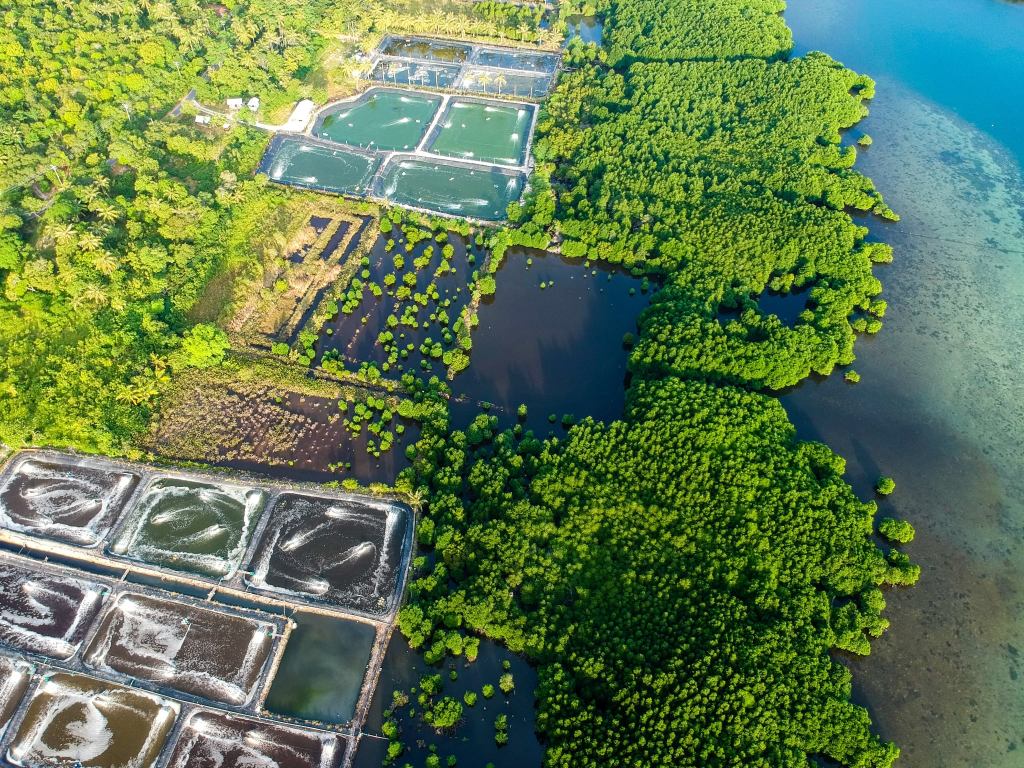
Mangroves provide essential ecosystem services, including water filtration, habitat for marine species, carbon sequestration, and shoreline protection (Trégarot 2021). The microbial communities of mangroves improve nutrient availability, support the growth of vegetation, and provide protection from pathogenic bacteria, thereby positively impacting species diversity (Fusi 2022). Mangrove roots trap sediments and filter pollutants, preventing harmful substances from entering the water. Furthermore, mangrove ecosystems support a diverse array of beneficial species that can help control disease-causing organisms. The complex food webs in mangroves foster populations of predators that naturally control the numbers of harmful pathogens.
Seagrass meadows are another vital component of Nature-based Solutions in aquaculture. These underwater grasslands act as natural water purifiers by trapping nutrients and filtering out pollutants. Seagrasses also provide shelter and food for various marine species, promoting biodiversity and supporting the overall health of aquaculture systems. Seagrass meadows are particularly effective in mitigating eutrophication, a process in which excess nutrients in the water lead to algal blooms that can harbor disease-causing microorganisms. Where seagrass meadows were present, there was a 50% reduction in the relative abundance of potential bacterial pathogens capable of causing diseases in humans and marine organisms (Lamb 2017).
Harnessing natural microbial communities can also be a powerful way to mitigate disease in aquaculture. Probiotics, beneficial bacteria and microorganisms that naturally occur in aquatic environments, can be introduced into aquaculture systems to outcompete harmful pathogens. Probiotics provide several beneficial effects to hosts, including digestion enhancement, growth promotion, immunity modulation, pathogen protection, water quality improvement, and can be an alternative to antibiotics (Banerjee 2017). They generate an environment where disease-causing microorganisms are less likely to thrive. Nature-based Solutions that focus on enhancing microbial diversity in the aquaculture system can therefore act as a biological control method for disease management.
Stress is a major contributing factor to disease outbreaks in aquaculture. Fish raised in overly controlled environments or confined spaces are more vulnerable to infections. Fish welfare practices in farming generally seek to provide a better environment, that in turn cuts down stress and improves the quality and sustainability of the final product at market. By integrating natural habitat elements such as submerged plants, rocks, and shelters, aquaculture farms can reduce the stress that fish experience. These natural elements provide the fish with places to hide, breed, and forage, which enhances their well-being and reduces their susceptibility to diseases. Water hyacinth, shelters, and amino acid supplements can reduce stress and aggressiveness among farmed Nile tilapia (Neto 2020). This approach mimics natural ecosystems, fostering healthier fish and minimizing disease risks.
Some Additional Benefits of Nature-based Solutions
The integration of NbS into aquaculture offers several key benefits beyond disease mitigation. For instance, NbS often require fewer chemical inputs, such as antibiotics or disinfectants, thereby reducing the environmental pollution associated with aquaculture. While implementing NbS can require initial investment in infrastructure like wetlands or IMTA systems, the long-term benefits, such as reduced disease incidence and lower dependence on chemicals, make these solutions cost-effective. Many NbS, such as mangrove restoration and seagrass meadow conservation, also enhance the resilience of aquaculture systems to climate-related stressors, such as sea-level rise and temperature fluctuations. Moreover, Nature-based Solutions foster a diverse ecosystem, which is crucial not only for controlling disease but also for maintaining the ecological integrity of the surrounding environment.
Challenges and Considerations
While Nature-based Solutions hold great promise, their implementation does not come without challenges. For instance, the restoration of mangroves or wetlands requires careful planning and long-term management. Additionally, balancing the need for human intervention with the preservation of natural ecosystems can be complex, as over-exploitation of certain species may harm the very system that NbS aims to protect. Collaboration between aquaculture producers, environmental scientists, and local communities is essential to ensure the success of these solutions.
Recommendations
The following are recommendations for the different stakeholders involved in aquaculture wishing to apply Nature-based Solutions to mitigate diseases.
Fish farmers could implement Integrated Multi-Trophic Aquaculture (IMTA), where different species (e.g. fish, shellfish, and seaweed) are cultivated together. IMTA can help control disease outbreaks in fish by diversifying the ecosystem. Within an IMTA project, seaweed and shellfish can absorb excess nutrients, reducing eutrophication, which is a major contributor to disease outbreaks in aquaculture.
Governments could fund research to evaluate the effectiveness of Nature-based Solutions in disease mitigation in aquaculture. This research includes the study of ecosystem services provided by coastal habitats, such as mangroves, wetlands, and seagrasses, as well as the role of biodiversity in disease resilience. Governments should also promote awareness and training for aquaculture operators about NbS.
Environmental scientists could collaborate with aquaculture farms in the restoration and conservation of key ecosystems, such as mangroves, seagrass meadows, and wetlands, which help mitigate disease outbreaks by maintaining water quality and promoting biodiversity. In addition, scientists can educate the public and aquaculture stakeholders about the importance of NbS in disease mitigation, showing how healthy ecosystems not only support biodiversity but also contribute to healthier aquaculture operations.
Communities living near aquaculture operations can play an important role in supporting NbS by participating in local conservation and restoration projects (e.g. mangrove planting). This can help safeguard natural habitats that act as buffers against diseases.
Conclusion
Nature-based Solutions provide a holistic and sustainable approach to mitigating disease in aquaculture. By working with natural processes, NbS can help create healthier, more resilient farming systems while reducing the need for harmful chemicals and antibiotics. As the aquaculture industry continues to grow, industry endorsement of Nature-based Solutions will be a key strategy to ensure long-term sustainability and to minimize the ecological footprint of fish farming.
 AQUADAPT