By Dr. Chanagun Chitmanat
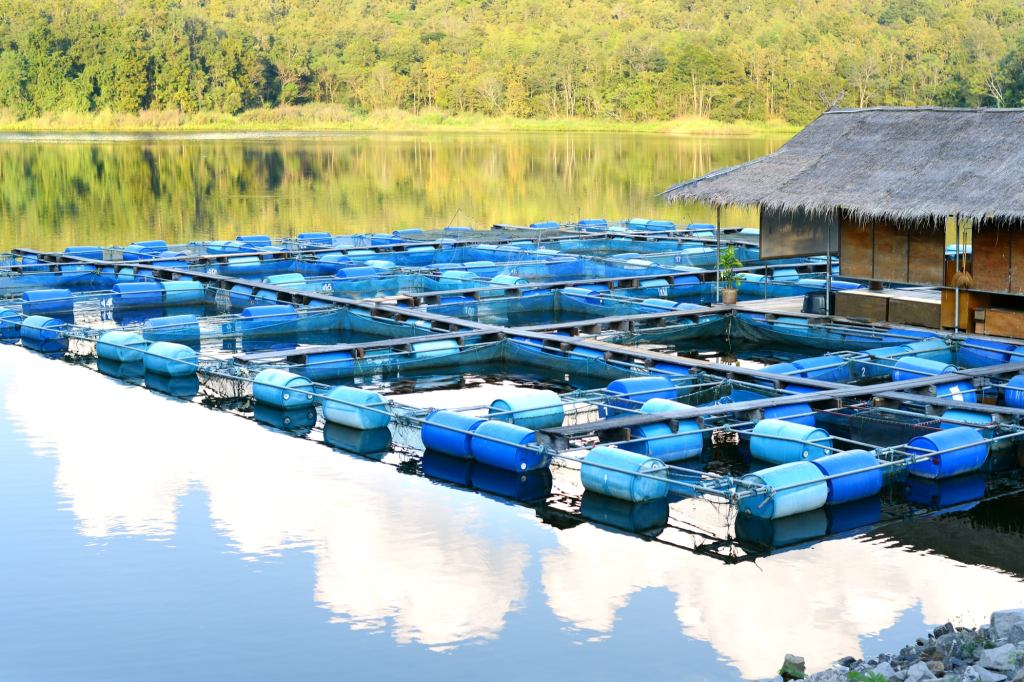
Aquaculture plays a critical role in ensuring food security and supporting rural livelihoods across Southeast Asia. Among various aquaculture systems, inland cage culture, particularly in rivers, lakes, and reservoirs, has expanded rapidly over the past two decades due to its low land requirements and high productivity. Traditionally practiced using wooden or bamboo cages, often placed in inland and coastal water bodies, this method relies intensively on the use of wild-caught low-value or “trash” fish as feed. The practice is believed to have originated in Cambodia and continues to be widespread in countries such as Indonesia, Lao PDR, Thailand, and Vietnam (Edwards 2009). These systems offer an affordable entry point for small-scale farmers, providing a source of income and protein with a relatively low capital investment.
However, the intensification of cage culture without appropriate regulation has brought about environmental and social concerns. The discharge of organic waste, overuse of wild feed fish, and overcrowding can lead to water quality degradation, fish disease outbreaks, and resource-use conflicts with other water users (Liu 2024). Moreover, despite its socio-economic potential, inland cage aquaculture often mirrors existing gender disparities and social exclusion, limiting the participation and contribution of women, youth, ethnic minorities, and other marginalized groups (Njogu 2024).
In response, there is growing recognition of the need to integrate Nature-based Solutions (NbS) and inclusive governance models to promote sustainable and equitable aquaculture systems. These approaches not only aim to restore ecological balance but also enhance the participation of underrepresented groups, particularly women, in decision-making, resource access, and benefit sharing. Embedding Gender Equality and Social Inclusion (GESI) principles into the development of inland cage culture is therefore essential to achieve an aquaculture that is not only economically viable and environmentally sound but also socially just and resilient.
Nature-based Approaches in Inland Cage Aquaculture
Nature-based aquaculture incorporates ecological processes to minimize environmental impact and increase resilience. In inland cage systems, this involves the following.
Low Impact Species and Feed: Utilize native or low feed input cultured species like tilapia and include alternative feeds such as fermented rice bran (El-Dein 2025) and insect protein (Khan 2025). Encourage use of natural feed sources and low-density stocking practices.
Zoning and Site Rotation: Determine suitable locations based on carrying capacity to prevent overloading of ecosystems. In addition, enhance disease prevention by supporting efficient surveillance and monitoring (Banini 2024).
Gender Equality and Social Inclusion (GESI) in Inland Cage Aquaculture
The expansion of inland cage aquaculture in Southeast Asia presents significant opportunities for improving food security and rural livelihoods. However, its development has often overlooked social equity, particularly the roles and rights of women and marginalized groups. Women contribute substantially to aquaculture across the value chain, engaging in activities such as cage maintenance, feeding, harvesting, processing, and marketing, yet they remain under-recognized in formal statistics and decision-making processes (Parrao 2021). Similarly, youth, ethnic minorities, people with disabilities, and low-income households frequently face systemic barriers to participation, including limited access to land, credit, training, and aquaculture technology.
Integrating Gender Equality and Social Inclusion (GESI) into inland cage aquaculture is essential to ensure that benefits are equitably shared and that the sector contributes to sustainable development as well as to economic growth. GESI provides a framework for identifying and addressing the structural inequalities that prevent full and fair participation of all individuals, regardless of gender, ethnicity, or socio-economic status. When properly implemented, GESI approaches lead to more inclusive governance, more efficient resource use, and enhanced community resilience.
A GESI-responsive approach acknowledges that women and marginalized groups often have distinct knowledge, needs, and constraints. For example, women may prefer working closer to home due to caregiving responsibilities or may require targeted financial products and training to engage fully in aquaculture enterprises. Moreover, prevailing gender norms can limit women’s ability to access and control productive resources or participate in producer organizations and policy forums (Githukia 2020).
By embedding GESI principles into project design, policy frameworks, and local governance structures, inland cage aquaculture can evolve into a socially transformative sector. This goal requires: creating inclusive institutions and cooperatives that ensure equitable representation; supporting gender-responsive extension services and technologies; promoting equal access to financial and natural resources; and collecting and using sex, age, and disability disaggregated data (SADDD) to inform policies and measure impact.
Ultimately, addressing GESI in inland cage culture enhances not only social justice but also the overall effectiveness and sustainability of the aquaculture sector. Inclusive systems are more likely to achieve long-term success by harnessing the full potential of all community members, reducing conflict, and ensuring that aquaculture contributes to both environmental sustainability and human development.
Case Studies
Sirindhorn Dam, Thailand: Community-based cage culture of tilapia suffered from overstocking until local authorities and farmer groups co-developed guidelines for cage density and site rotation. Among the assessed activities, feed provision and vaccination accounted for the highest greenhouse gas (GHG) emissions, with an average of 2.17 tCO2eq per farm (Sutthiphapa 2022). This was primarily attributable to the large volume of feed used, which required substantial fuel consumption. A reduction in daily feeding rates could therefore contribute to lower GHG emissions. In comparison, the procurement of feed ingredients resulted in considerably lower emissions, averaging 0.03 tCO2eq per farm. The Department of Fisheries, through the Ubon Ratchathani Provincial Fisheries Office, has promoted the use of local aquatic resources for high-value product development by women’s groups around Sirindhorn Dam (Khaosod 2025). These initiatives highlight community identity, support tourism, and create added economic value for local small-scale fish processing communities.
Mekong Delta, Vietnam: In An Giang Province, pangasius cage farmers adopted sediment traps and improved feeds after years of nutrient loading (Anh 2010; De Silva 2010). Women were trained in environmental monitoring, contributing to more sustainable practices (FAO 2017).
Nam Ngum Reservoir, Lao PDR: Cage culture of tilapia and snakehead is well-established at Nam Ngum Reservoir, Lao PDR, and women actively participate in fisheries committees and fish-processing activities (Hortle 2014). Meanwhile, comparable integrated systems, such as rice-fish farming, have proven effective in delivering food, income, and ecological resilience in other parts of Laos (Samaddar 2024). These findings suggest strong potential for women-led cooperatives to adopt integrated approaches to enhance nutrient cycling and biodiversity in Nam Ngum.
Challenges and Pathways for Sustainable Inland Cage Aquaculture
There are three main challenges for inland cage culture. Environmentally, the accumulation of organic waste, unintentional fish escapes, eutrophication resulting in algal blooms, and heightened risks of disease outbreaks pose significant threats to aquatic ecosystems and production sustainability. Socially, gender inequality remains a persistent barrier, with women’s contributions across the aquaculture value chain often under-recognized in formal decision-making and extension services. Furthermore, unresolved conflicts over land and water use, alongside limited engagement of youth and marginalized populations, impede the sector’s inclusivity. Economically, producers, particularly small-scale farmers, face constrained access to markets, fluctuating feed costs, and a general lack of aquaculture-specific financial safety nets such as insurance schemes.
Addressing these multiple challenges requires an integrated set of policy, technological, and governance interventions. Policymakers should prioritize the establishment and enforcement of reservoir zoning regulations and ecological carrying capacity assessments to mitigate environmental degradation. Incentivizing eco-certification schemes, such as the ASEAN Good Aquaculture Practices (ASEAN GAP) or the Aquaculture Stewardship Council (ASC) standards, should further promote responsible production, especially among smallholders. Inclusive governance structures must be strengthened by ensuring the active participation of women, youth, and marginalized communities in aquaculture planning and policy formulation. Their informal roles should be formally recognized in statistical databases and extension programs.
Technological innovations tailored to the needs and capacities of small-scale operators, such as solar-powered aerators and nature-based solutions like floating wetlands, can enhance operational efficiency and environmental performance. These should be complemented by participatory training initiatives focusing on disease prevention, feed optimization, and ecosystem-based management. Finally, aligning inland cage aquaculture development with national climate adaptation and biodiversity conservation strategies will be critical to building long-term resilience in the face of increasing environmental variability.
Conclusion
The use of low-impact cultured species, eco-friendly feeds, zoning regulations, and vegetative biofilters exemplifies how nature-based solutions (NbS) can mitigate environmental risks while maintaining productivity. Simultaneously, recognizing and supporting the critical roles of women and marginalized groups, through inclusive governance, access to resources, and gender-responsive capacity building, ensures that the benefits of aquaculture development are equitably shared.
Case studies from Thailand, Vietnam, and Lao PDR demonstrate that when environmental sustainability is coupled with inclusive approaches, communities are better equipped to manage risks, innovate, and adapt to changing socio-ecological conditions. These experiences underline the importance of context-specific, participatory approaches supported by coherent policy frameworks and targeted investment.
Moving forward, policymakers, practitioners, and researchers must prioritize the integration of NbS and GESI in aquaculture development strategies. Doing so will not only advance progress toward the Sustainable Development Goals, particularly SDGs 2 (Zero Hunger), 5 (Gender Equality), 13 (Climate Action), and 14 (Life Below Water), but also foster aquaculture systems that are just, resilient, and truly sustainable.
 AQUADAPT