By Dr. Nguyen Van Bao
Disability inclusion, as argued in this essay, should be understood as a core element of nature-based aquaculture systems, rather than as an external or supplementary concern. The essay advances a reframing in which the meaningful participation of persons with disabilities strengthens, rather than constrains, the effectiveness, equity, and long-term resilience of Nature-based Solutions (NbS) in aquaculture across Vietnam and the wider Southeast Asian context.
NbS have become a central pillar in global strategies for climate change mitigation and adaptation (Seddon 2020). In aquaculture, NbS approaches, such as mangrove-shrimp systems, rice-fish farming, and lagoon co-management, are increasingly promoted as low-impact alternatives to intensive, technology-driven production models (Miralles-Wilhelm 2021). These systems are particularly relevant for countries like Vietnam, where aquaculture is deeply embedded in rural livelihoods and highly exposed to climate risks. However, while NbS in aquaculture is often framed as socially inclusive and community-based, one group remains largely invisible in both policy and practice: persons with disabilities.
Disability inclusion has traditionally been treated as a social protection or welfare issue, rather than as an integral component of environmental governance and productive systems (Bickenbach 2011). In Vietnam, people with disabilities, who account for approximately 6.11% of the population according to national estimates, are disproportionately concentrated in rural and coastal areas, where aquaculture and natural resource-based livelihoods are most prevalent (NSO 2025).
Notably, the Mekong River Delta, the country’s largest aquaculture region with more than 70% of the national aquaculture area and output, also records the highest number of persons with disabilities among all regions in Vietnam. Despite this spatial overlap between disability prevalence and aquaculture production, national aquaculture strategies, climate adaptation plans, and NbS frameworks rarely acknowledge disability as a dimension of vulnerability, capacity, or agency. This omission is not merely a technical oversight; rather, it reflects deeper conceptual assumptions about disability, productivity, ability, and who is recognized as a legitimate actor in environmental management.
Reframing Disability Beyond Welfare: A Socio-Ecological Perspective
Disability policy has historically been dominated by the medical model, which conceptualizes disability as an individual impairment requiring treatment, care, or rehabilitation. While Vietnam has made progress toward a rights-based approach, particularly following its ratification of the UN Convention on the Rights of Persons with Disabilities, disability continues to be framed largely as a matter of social protection and individual welfare. This framing has important implications. By situating disability primarily within social assistance systems, it implicitly excludes persons with disabilities from being recognized as active participants in productive sectors such as agriculture and aquaculture, where participation is often equated with physical strength, mobility, and endurance.
Recent scholarship challenges this narrow framing by advancing a socio-ecological understanding of disability, in which disability is understood to arise from interactions between individual people, lived environments, and institutional arrangements, rather than from impairment alone. Disability thus becomes a social construct. In nature-based contexts, accessibility is shaped not only by physical infrastructure but also by terrain, hydrology, seasonal variability, governance rules, and underlying power relations.
From this perspective, exclusion is often driven less by bodily limitations than by what are described as “invisible institutional barriers,” such as planning norms, risk management practices, and governance assumptions that implicitly privilege able-bodied users (Aguilar Carrasco 2025). These insights are particularly relevant for nature-based systems, where environmental variability is sometimes invoked to legitimize exclusion, rather than to encourage adaptive and inclusive design.
When applied to aquaculture, this socio-ecological lens exposes a critical limitation in prevailing NbS narratives. Nature-based aquaculture systems are often assumed to be inherently inclusive simply because they are community-based or rely on natural processes. In practice, however, without intentional design and governance choices, NbS in aquaculture can reproduce the same patterns of exclusion found in conventional systems, particularly for people with mobility, sensory, or cognitive disabilities. Barriers to participation are embedded not only in physical landscapes but also in institutional rules that define who is considered capable of managing risk, labor, and productivity. Reframing disability inclusion within NbS in aquaculture therefore requires treating accessibility, participation, and agency as questions of environmental governance rather than as matters of charitable accommodation.
Disability and Aquaculture in Vietnam
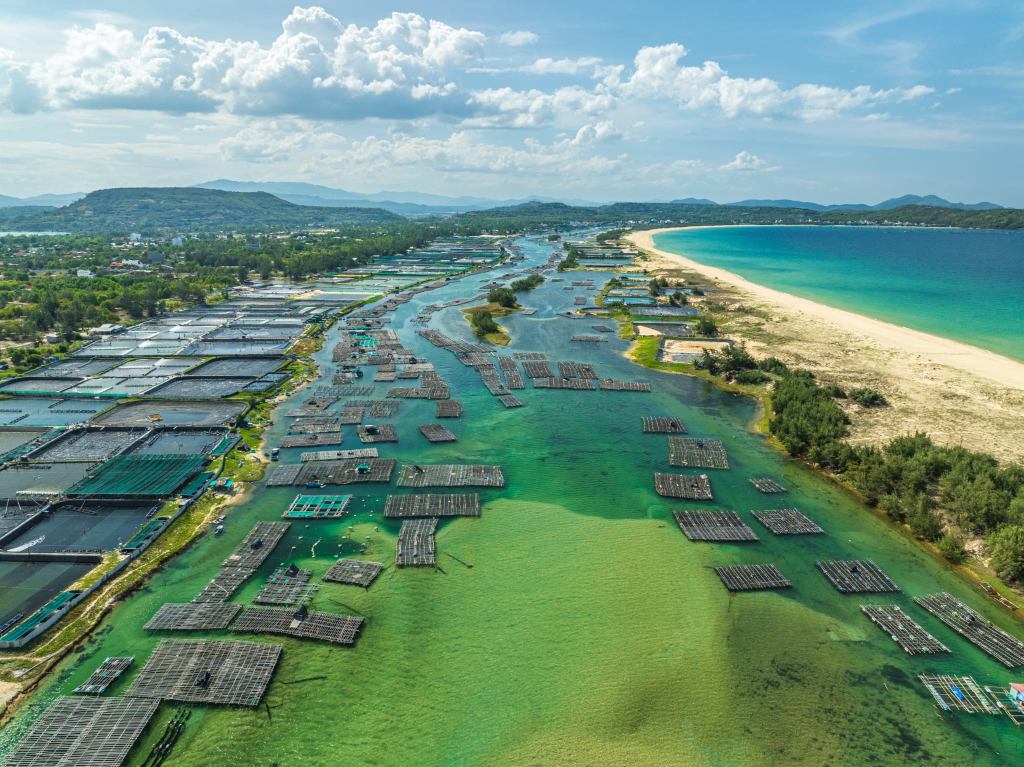
Vietnam’s aquaculture sector employs millions of smallholders across the Mekong Delta, the Red River Delta, and central coastal lagoon systems (NSO 2025). These same regions also exhibit higher-than-average rates of disability, shaped by population aging, war legacies, occupational hazards, and increasing climate-related health risks. Despite this clear spatial and social overlap, persons with disabilities remain largely absent from dominant narratives of aquaculture development and sustainability in Vietnam.
At the physical level, aquacultural landscapes present tangible challenges. Earthen ponds, narrow dikes, muddy pathways, and tidal zones can be difficult to navigate for individuals with limited mobility. Mangrove-shrimp systems, frequently highlighted as flagship NbS models, often require movement across uneven terrain and prolonged exposure to waterlogged environments (Berkes 2017). Yet such a sole focus on physical barriers risks obscuring deeper forms of exclusion. More pervasive are social norms that equate aquaculture work with full physical capacity, reinforcing assumptions that persons with disabilities are inherently “unfit” for productive roles within farming households or community-based systems (Shakespeare 2013).
At the economic level, exclusion further intensifies these constraints. Households that include persons with disabilities tend to have lower average incomes and higher health-related expenditures, reducing their capacity to invest in aquaculture inputs or absorb production risks (Bickenbach 2011). Existing credit schemes, subsidies, and incentive programs rarely account for disability-related constraints, while extension services are commonly delivered through modalities, such as field demonstrations, group meetings, or labor-intensive training, that are not designed with accessibility in mind. As a result, persons with disabilities are systematically excluded from the knowledge, finance, and innovation pathways that underpin nature-based aquaculture transitions.
At the institutional level, disability remains largely invisible within aquaculture’s governance frameworks. Vietnam’s Fisheries Law and national aquaculture strategies emphasize productivity, environmental sustainability, and export competitiveness, but inclusion is typically addressed only through broad references to “vulnerable groups,” without explicit recognition of disability. Conversely, disability policies focus predominantly on social assistance, formal employment quotas, and health care, with limited attention to informal, natural resource-based livelihoods. This policy separation underlines a structural shortcoming in which persons with disabilities fall between social and environmental policy domains, rendering their roles, capacities, and contributions to NbS in aquaculture effectively unseen.
How Disability Inclusion Strengthens Nature-Based Aquaculture
Integrating disability inclusion into NbS is often perceived as costly or technically complex. However, evidence from socio-ecological governance research suggests the opposite: inclusive systems tend to be more resilient, adaptive, and socially legitimate (Berkes 2017). NbS in aquaculture relies on ecological processes, local knowledge, and diversified roles, creating natural entry points for inclusive participation.
Unlike highly mechanized systems, NbS in aquaculture involves a range of activities with varying physical demands. Tasks such as seed sorting, water quality monitoring, feeding management, record-keeping, processing, and marketing can be adapted to different abilities. In rice-fish or mangrove-shrimp systems, productivity depends as much on observation, timing, and ecological understanding as on physical labor. Persons with disabilities, particularly those with long-term attachment to place, often possess deep local knowledge that enhances system management (Berkes 2017).
From a governance perspective, inclusion strengthens stewardship. Research on community-based natural resource management shows that diversified participation improves rule compliance, conflict resolution, and adaptive capacity (Kiss 2022). Inclusive governance arrangements tend to produce rules that are perceived as fairer and more legitimate, which in turn encourages broader community buy-in and long-term sustainability. When persons with disabilities are meaningfully included in decision-making processes, nature-based aquaculture initiatives benefit from expanded perspectives, locally grounded knowledge, and more socially responsive management practices.
Their participation can help identify overlooked risks, practical constraints, and adaptive strategies that may otherwise remain invisible in technocratic planning processes. As a result, nature-based aquaculture initiatives gain greater social legitimacy and trust at the community level, reducing the likelihood of elite capture, exclusionary practices, or uneven benefit distribution. In this sense, disability inclusion is not only a matter of equity but also a governance strategy that strengthens the resilience and effectiveness of nature-based aquaculture systems.
Disability inclusion also aligns closely with principles of climate justice. Evidence consistently shows that climate change disproportionately affects persons with disabilities, who often face heightened exposure to climate risks along with limited access to adaptive resources, information, and decision-making processes (UNDRR 2023). Despite this heightened vulnerability, climate adaptation programs frequently overlook disability as a relevant dimension of inequality. As nature-based aquaculture is increasingly promoted as a climate adaptation strategy, the exclusion of persons with disabilities risks reinforcing existing social and economic disparities. Such exclusion not only undermines equity outcomes but also weakens the ethical foundations of NbS interventions, which are premised on delivering co-benefits for both ecosystems and society.
Shedding Light on Inclusive Design, Governance, and Policy Pathways
Reframing disability inclusion requires moving beyond ad hoc accommodations toward inclusive design embedded within NbS planning processes. Evidence from nature-based recreation and conservation projects shows that accessibility can coexist with ecological objectives when inclusion is considered from the outset (Aguilar Carrasco 2025). Similar principles apply to aquaculture.
However, inclusive design alone is insufficient without accompanying governance reform. At the national level, aquaculture development strategies and climate adaptation plans should explicitly recognize persons with disabilities as stakeholders and agents within NbS systems, rather than treat them solely as beneficiaries of social protection. This recognition can be operationalized by integrating disability-sensitive indicators into NbS planning guidelines, aquaculture zoning regulations, and climate adaptation frameworks. Such integration would also strengthen policy coherence with Vietnam’s international commitments under the UN Convention on the Rights of Persons with Disabilities, a convention which emphasizes full and effective participation in all areas of social and economic life.
At the program level, incentive mechanisms and subsidy schemes that support sustainable and climate-resilient aquaculture should incorporate clear accessibility and inclusion criteria. Rather than viewing inclusion as an additional cost, these schemes can incentivize cooperative arrangements, adaptive roles, and accessible practices that broaden participation. This approach aligns with emerging standards on inclusive climate finance, which stress that mitigation and adaptation investments must explicitly address the needs, capacities, and agency of marginalized groups in order to achieve equitable and durable outcomes. Embedding disability inclusion within nature-based aquaculture finance thus enhances social equity while reinforcing the long-term effectiveness and legitimacy of climate interventions.
Conclusion
Reframing disability inclusion within nature-based aquaculture systems challenges deeply embedded assumptions about productivity, ability, and environmental governance. In Vietnam, where NbS in aquaculture is increasingly positioned as a pathway toward climate resilience and sustainability, an ignorance of disability risks undermining both social equity and ecological effectiveness.
This essay has argued that disability inclusion is not a peripheral concern but a core dimension of socio-ecological resilience. Positioning persons with disabilities as active contributors within nature-based aquaculture systems allows Vietnam to mobilize underutilized local knowledge, reinforce community stewardship, and ensure that the transition toward sustainable aquaculture genuinely leaves no one behind.
 AQUADAPT