By Dr. Praneet Ngamsnae
Inland aquaculture constitutes a fundamental pillar of Thailand’s food system, rural livelihoods, and national food security. The sector encompasses a wide diversity of freshwater production systems, including earthen pond culture, cage culture in reservoirs and rivers, and integrated agro-aquaculture systems such as rice-fish co-culture. Collectively, these systems supply affordable animal protein, generate income for millions of rural households, and contribute significantly to domestic food availability and nutritional security (FAO; Khunthongjan 2022). Beyond its economic importance, inland aquaculture is deeply embedded in local landscapes and cultural practices, particularly in floodplain and rice-based farming systems.
Despite its importance, inland aquaculture in Thailand faces increasingly complex environmental and socio-economic challenges. Intensification and commercialization have led to rising dependence on formulated feeds, exotic species, and chemical inputs, resulting in water pollution, disease outbreaks, biodiversity loss, and heightened vulnerability to climate variability (Chumnongsittathum 2008; Arunrat 2022). Extreme weather events, including floods, droughts, and heat stress, further exacerbate production risks, particularly for small-scale farmers with limited adaptive capacity (IUCN 2022). These challenges underscore the need for approaches that reconcile productivity with ecological integrity and social equity.
In this context, local knowledge and Nature-based Solutions (NbS) have emerged as complementary and mutually reinforcing strategies for enhancing sustainability and resilience in inland aquaculture systems. Local knowledge accumulated through generations of farmer experience, experimentation, and ecological observation offers place-based insights into ecosystem dynamics, resource management, and risk reduction. NbS, as defined by the International Union for Conservation of Nature (IUCN), emphasize the protection, sustainable management, and restoration of ecosystems to address societal challenges while delivering benefits for both people and nature (IUCN 2022). This essay synthesizes empirical studies and policy-relevant literature to examine the roles, values, and limitations of local knowledge and NbS in Thailand’s inland aquaculture. It further discusses governance implications and identifies key research gaps that should guide future scholarly and policy-oriented work.
Conceptual Linkages Between Local Knowledge and NbS
Local knowledge in aquaculture encompasses farmers’ understanding of seasonal hydrology, pond ecology, fish behavior, feeding dynamics, disease risks, and informal institutions governing shared water and land use. Such knowledge is inherently adaptive, context-specific, and embedded within social relations and cultural norms (Chumnongsittathum 2008; Obiero 2023). In many rural settings, aquaculture management decisions are guided not only by technical considerations but also by customary rules, collective experience, and observations accumulated over long temporal scales.
Nature-based Solutions align closely with these characteristics by promoting ecosystem-based approaches that harness biodiversity, ecosystem functions, and natural infrastructure to address challenges such as food production, climate adaptation, and environmental degradation (Cassin 2021; IUCN 2022). In aquaculture, NbS include integrated farming systems, polyculture, restoration of aquatic vegetation, constructed wetlands for effluent treatment, and biodiversity-friendly stocking strategies. These approaches emphasize multifunctionality, low-regret interventions, and co-benefits across ecological and socio-economic domains.
The convergence of local knowledge and NbS is particularly evident in systems that rely on ecological processes rather than external inputs. Rice-fish co-culture, for example, utilizes fish to regulate pests, recycle nutrients, and enhance soil fertility within paddy ecosystems, thereby increasing overall system efficiency and resilience (Arunrat 2022). Similarly, the use of vegetated buffer strips and constructed wetlands mimics natural filtration processes to improve water quality and reduce nutrient discharge from aquaculture operations (Le Gouvello 2022).
For these reasons, NbS are more likely to be socially acceptable, economically feasible, and ecologically effective when grounded in local knowledge.
Historical Evolution of Inland Aquaculture in Thailand
Thailand’s inland aquaculture has evolved through several distinct phases shaped by interactions between traditional practices, state-led modernization, and market forces. Early systems, dating back more than a century, were predominantly small-scale and household-based, relying on natural pond ecology, seasonal flooding, and capture-based enhancement of native species such as walking catfish (Clarias spp.), Pangasius catfish, and freshwater prawns (FAO). These systems were closely integrated with rice farming and floodplain dynamics, reflecting a high degree of ecological embeddedness.
From the mid-twentieth century onward, the Department of Fisheries played a central role in promoting technological modernization through hatchery development, species domestication, extension services, and formulated feeds (Munprasit 2021). During the 1980s and 1990s, rapid expansion and intensification increased production volumes but also generated environmental externalities, including nutrient pollution, disease transmission, and reduced genetic diversity (Chumnongsittathum 2008).
In recent decades, sustainability concerns, coupled with climate change impacts and rural livelihood challenges, have stimulated renewed interest in integrated and community-based systems. Rice-fish farming, polyculture, and community-managed aquaculture have re-emerged as viable alternatives or complements to intensive monoculture, reflecting a hybridization of traditional knowledge and contemporary NbS frameworks (Arunrat 2022; Isoux 2024).
Contributions of Linked Local Knowledge and NbS to Sustainable Aquaculture
The integration of local knowledge and NbS contributes to the sustainability of inland aquaculture across ecological, economic, and social dimensions. Ecologically, integrated and diversified systems enhance biodiversity, regulate nutrient cycles, and improve water quality, thereby increasing system resilience to environmental stressors (IUCN 2022; Le Gouvello 2025). Polyculture systems that combine species with complementary feeding niches reduce feed inputs and lower the risk of disease outbreaks associated with monoculture practices (Khunthongjan 2022).
Economically, NbS informed by local knowledge often reduce production costs by relying on on-farm resources, organic residues, and natural food webs. Diversification of outputs such as fish, rice, and aquatic plants, also buffers households against price volatility and climate-related shocks (Arunrat 2022). These systems are particularly relevant for small-scale farmers with limited access to capital and credit.
Socially, local knowledge underpins communal institutions that facilitate cooperation, knowledge sharing, and collective action. Informal rules governing water allocation, stocking density, and harvesting schedules help prevent conflicts and support equitable resource use (Chumnongsittathum 2008). Such social capital enhances adaptive capacity and aligns closely with NbS principles that emphasize inclusive and participatory governance.
Empirical Examples of Local Knowledge Linked to NbS in Thailand
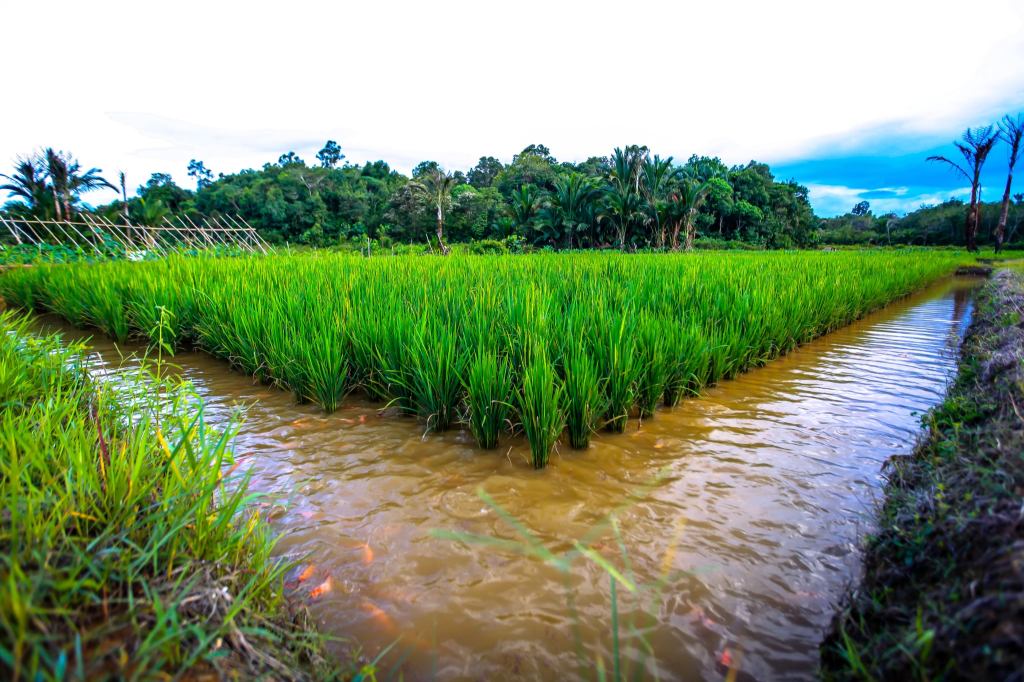
Rice-fish co-culture in Thailand represents one of the most extensively studied examples of NbS grounded in local knowledge. Empirical research demonstrates that rice-fish systems increase total farm productivity, enhance nutrient cycling, and reduce pesticide use through biological pest control, compared with rice monoculture systems (Arunrat 2022). Rice-fish systems also generate multiple ecosystem services, thereby contributing to both food security and environmental sustainability.
Community-managed pond polyculture systems provide another illustrative case. By combining omnivorous, herbivorous, and detritivorous species, farmers exploit trophic complementarities that stabilize yields and reduce dependence on commercial feeds (Khunthongjan 2022). Where communities coordinate stocking and harvesting, ecological carrying capacity is better respected, and resource-use conflicts are minimized (Chumnongsittathum 2008).
NbS-based effluent management has also gained attention in Thailand. Constructed wetlands and vegetated buffer strips using locally available plant species improve water quality, reduce nutrient discharge, and create habitats for beneficial organisms (IUCN 2022; Le Gouvello 2022). Climate-smart adaptations, including shallow refuge channels, riparian vegetation for shading, and solar-powered aeration, further illustrate how traditional knowledge and simple technologies can be combined to enhance resilience under increasing climate variability (Isoux 2024).
Challenges, Governance, and Policies
Despite their demonstrated benefits, the wider adoption of local knowledge-based NbS in Thailand’s inland aquaculture is constrained by multiple interrelated barriers. Economic pressures and market structures often favor standardized, high-volume production systems, disadvantaging diversified and low-input approaches (Arunrat 2022). Land-use change, urban expansion, and infrastructure development further reduce opportunities for integrated farming and disrupt traditional water management networks.
Institutional and regulatory frameworks also present challenges. Aquaculture policies and licensing systems are frequently designed with large-scale or intensive operations in mind and may not adequately recognize community-based management or customary practices (Munprasit 2021). In addition, the erosion of traditional knowledge due to generational change and rural-urban migration threatens the continuity of locally adapted practices (Chumnongsittathum 2008).
Policy support is therefore critical. Key priorities include formal recognition of community-based aquaculture, simplified licensing for smallholders, targeted extension and financial support for integrated systems, and the incorporation of NbS into national climate adaptation strategies (FAO; IUCN 2022). Multi-level governance that links national policy with local institutions is essential to balance production, conservation, and social equity objectives.
Research Gaps and Future Directions
Several research gaps limit the wider acceptance of NbS informed by local knowledge. Quantitative valuation of ecosystem services provided by rice-fish and other integrated systems remains limited, particularly across Thailand’s diverse agro-ecological zones (Arunrat 2022). Further research is also needed on value-chain development, market incentives, and financing mechanisms that enable smallholders to capture economic benefits from sustainable practices (Isoux 2024).
Additional priorities include integrating traditional disease management with modern biosecurity measures, documenting and transmitting local knowledge to younger generations, and developing low-cost monitoring tools tailored to small-scale aquaculture systems (FAO; IUCN 2022).
Conclusion
Local knowledge and Nature-based Solutions constitute mutually reinforcing pillars for sustainable inland aquaculture in Thailand. Traditional, place-based practices enhance ecosystem services and livelihoods, while NbS provide conceptual and technical frameworks to address contemporary challenges such as climate change, pollution, and biodiversity loss. Realizing this potential synergy requires supportive policies, inclusive governance, and interdisciplinary research that values both scientific and local knowledge. With coordinated action, Thailand can strengthen resilient inland aquaculture systems that are ecologically sound, socially inclusive, and economically viable.
 AQUADAPT