By Eung Sea
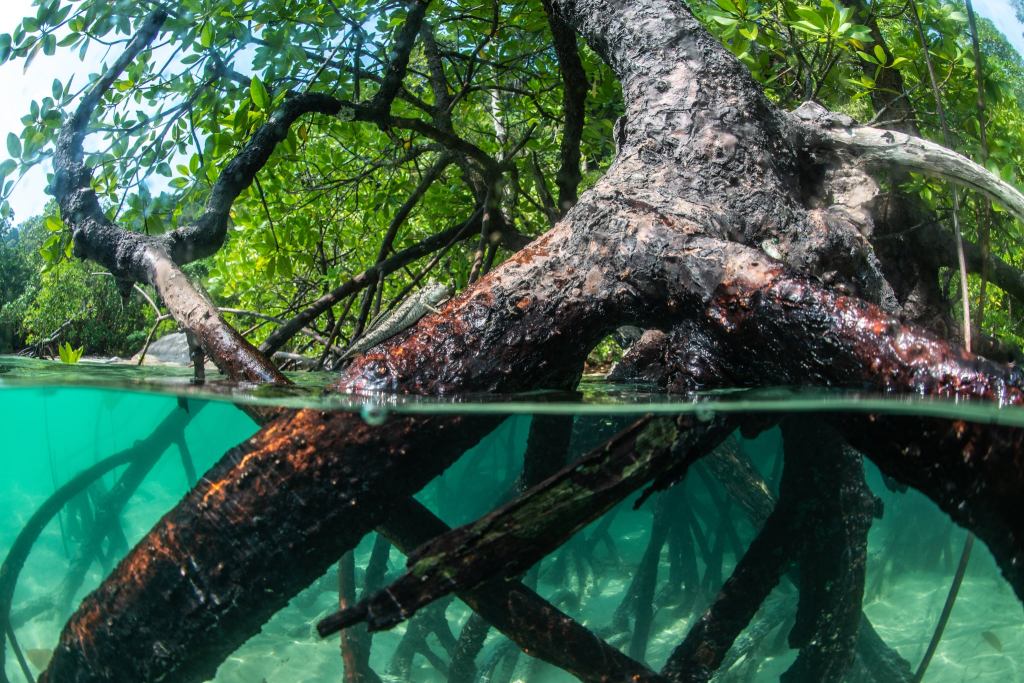
Cambodia, a tropical country of Southeast Asia, rich in natural resources, shares coastal borders with Thailand and Vietnam. Its 435 km coastline which stretches along the northeastern shore of the Gulf of Thailand boasts approximately 85,000 hectares of mangrove forests, with Koh Kong Province holding the largest share at 63,700 hectares. Cambodia’s mangrove forests host diverse species, with Rhizophora apiculata and Nypa fruticans being the most commonly found, as noted in studies from 1997 (Bann 1997). Other species like Bruguiera gymnorrhiza, Bruguiera sexangula, and Ceriops tagal also occur widely in the coastal ecosystems. In fact, recent surveys confirm the presence of up to 74 mangrove tree species in Cambodia, notably in provinces like Koh Kong in the southwest corner (Muñoz 2024).
These coastal ecosystems are vital for aquaculture, which contributes significantly to the national economy through shrimp production, estimated in the 1990s at 731 metric tons annually from 850 hectares. However, environmental pressures have now reduced operational farms to 20% capacity (Song 2004). In fact, intensive shrimp farming has led to mangrove destruction, exacerbated issues like acid sulfate soils and caused national losses of US$28.6 million yearly (Bann 1997).
This article examines some important aspects of mangroves for Cambodia’s aquaculture, such as habitat provision, water quality regulation, coastal protection, and economic benefits, as well as the challenges from deforestation and recommendations for mangrove-friendly practices. The discussion draws on ecological functions, economic data, and policy insights to advocate for integrated management.
Ecological Services of Mangroves to Aquaculture
Mangroves serve as critical nurseries and feeding grounds for juvenile shrimp, crabs, and fish, which are staples of Cambodian aquaculture. Leaf litter from mangroves decomposes into detritus, fueling food chains in estuarine waters and supporting primary productivity through nutrient mineralization. Mangrove roots trap sediments, nitrates, phosphates, excess nutrients, and pollutants from pond effluents, preventing eutrophication and disease outbreaks in aquaculture waters. This natural filtration reduces reliance on chemical treatments, maintaining cleaner conditions for species like shrimp (Do 2022).
Studies indicate that mangrove-adjacent ponds exhibit higher survival rates for shrimp due to stable salinity and reduced disease incidence from natural bioremediation (Song 2004). In addition, when denuded of mangroves, acid sulfate soils in converted areas lead to pond abandonment, as seen in widespread farm failures.
Coastal Protection and Climate Resilience
Cambodia’s low-lying coastlines face intensifying cyclones and sea-level rise, where mangroves act as natural barriers, reducing wave energy and stabilizing sediments. Mangroves colonize mudflats, protecting sea dikes and preventing erosion that could inundate aquaculture ponds.
Restoration efforts, such as those in the Restoration for Sustainable Coastal Ecosystems project (RESCuE) involving Cambodia, Thailand, and Malaysia, demonstrate that replanting mangroves enhances aquaculture resilience by buffering storms and sequestering blue carbon. In Cambodia’s Peam Krasaop Wildlife Sanctuary, mangrove management plans have preserved habitats and ensured sustainable fish stocks for integrated systems (CIRAD 2025). These functions are indispensable as climate projections forecast increased flooding which directly threatens pond infrastructure (Jiang 2025).
Economic and Livelihood Contributions
Nationally, fisheries production, including aquaculture, has reached significant totals, with inland capture supporting rural protein needs while coastal mangroves combat overexploitation. Mangroves bolster aquaculture economics by sustaining wild seed stocks, thus reducing reliance on costly hatchery larvae. In Cambodia, community-dependent coastal livelihoods integrate mangrove fishing with pond culture, where diverse fish species from mangroves supplement farm outputs (Mangroves for the Future 2013). Mangrove-friendly models, like those promoted by the Southeast Asian Fisheries Development Center (SEAFDEC), yield higher long-term profits by avoiding environmental degradation costs, such as necessary pond rehabilitation from soil acidification (Sreymom 2000).
Mangroves lost through pond expansion often retain macroclimatic, environmental, and hydrodynamic conditions suitable for mangrove growth, making them prime restoration sites. Recent studies show mangrove restoration delivers greater carbon benefits than afforestation. Government should prioritize planting in historical mangrove zones and thus provide work contributing to local livelihoods (Beeston 2023).
Social Inclusion and Equitable Benefits
Cambodia’s aquaculture sector offers opportunities to advance social inclusion and gender equity amid its rapid growth.
Youth struggle with education gaps in modern techniques like Integrated Multi-Trophic Aquaculture (IMTA), vital for sustainable practices in mangrove areas such as Koh Kong. Limited vocational training leaves youth reliant on outdated methods, missing out on IMTA’s benefits like nutrient recycling and disease reduction through shrimp-crab-seaweed polycultures within mangroves (Leakhena 2018). However, projects like CzechAid’s 2023-2025 initiative will equip technical high schools with IMTA modules, train teachers and provide hands-on equipment for pond management and processing (PIN 2025). These projects target coastal provinces, aiming to create youth-led enterprises that not only comply with Fisheries Laws designed for mangrove protection but that also boost incomes.
Women contribute 50% of labor in pond management, processing, and marketing, but face barriers like limited access to training, credit, and decision-making due to cultural norms prioritizing household duties. Nevertheless, the Fisheries Administration’s Gender Policy and projects like CAPFISH-Capture promote solutions such as targeted training on Good Aquaculture Practices (GAPs) and supplies of equipment for women-led MSMEs (Micro, Small, and Medium-sized Enterprises), with the goal of achieving 60% female participation (Samruol 2023). Integrating gender into IMTA pilots empowers women and youth as leaders in diversified farming, boosting incomes while preserving mangroves under Fisheries Law regulations (Leakhena 2018).
Linking these outcomes to community goals will ensure an equitable spread of benefits from aquaculture’s expansion.
Mangrove Deforestation and Unsustainable Practices
Aquaculture, particularly shrimp farming, drove significant mangrove deforestation worldwide, converting vast coastal areas into ponds. In Southeast Asia alone, over 100,000 hectares of mangroves were lost between 2000-2012, with aquaculture responsible for about 30% of this change (Richards 2016). Globally, activities like shrimp farming have contributed to the loss of roughly one-third of mangrove forests over the past five decades (Carrión-Mero 2024).
In Cambodia as well, and despite its benefits, aquacultural expansion has deforested mangroves. Intensive shrimp farming in Koh Kong, for example, disregarded guidelines on waste treatment and site selection. There, poor enforcement of waste treatment disposal and site selection rules allowed untreated effluent discharge, degrading water quality and causing disease outbreaks that resulted in substantial economic losses (Richards 2016). In addition, community pressure and population growth in mangrove zones exacerbated conversion, mirroring regional trends where aquaculture ranks among the top drivers of mangrove loss.
This loss reduces biodiversity, eliminates fish nurseries, and weakens coastal protection against storms and erosion. It releases stored blue carbon, thus exacerbating climate change, and harms local communities by destroying livelihoods tied to fisheries and forest resources (Down to Earth 2003).
Mangrove-Friendly Aquaculture Models
Integrated mangrove aquaculture (IMA), also known as silvofisheries, combines low-density shrimp and fish farming with mangrove trees within the same coastal area. In some implementations, existing mangrove forests are partially converted to ponds while retaining trees for ecological benefits; in others, mangroves are planted into previously deforested shrimp pond zones (McSherry 2023).
This approach filters 80-90% of pond pollutants through mangrove roots, enhances water quality, and sustains higher long-term yields compared to intensive monoculture. IMA thus balances aquaculture productivity with mangrove preservation, reducing net deforestation pressure (Earth Overshoot Day).
Similarly to IMA, IMTA by combining shrimp, crabs, fish, and seaweed with mangroves can enhance incomes and reduce pond encroachment, as piloted in Vietnam and adaptable to Cambodia. In Vietnam, integrated mangrove-shrimp systems (similar to IMTA) boosted yields and incomes by combining aquaculture with 20-60% mangrove cover in ponds, facilitating management and diversifying shrimp production with crabs and fish. These systems cut disease risks through natural bioremediation and restored ecosystem services lost to deforestation (McSherry 2023).
Intact mangrove forests deliver critical ecosystem services like coastal protection, carbon sequestration, nutrient cycling, and biodiversity support, primarily in intertidal zones overlapping with shrimp aquaculture sites. Therefore, increased awareness of the benefits which intact mangrove forests provide for human communities, such as coastal protection, carbon storage, and fishery support, has heightened focus on conservation efforts (Ronnback 1999).
These models explore sustainable alternatives to deliver economic revenue and protein for aquaculture-dependent communities. However, while rehabilitation can gradually restore some ecosystem functions, protecting remaining intact habitats from conversion remains the top priority to safeguard their full suite of critical services.
Policy Recommendations
Cambodia’s development programs for mangrove management emphasize multi-stakeholder collaboration to counter aquaculture-driven losses by deforestation. Therefore, strong provincial government support is required to ensure policy enforcement and adequate funding for the monitoring of mangrove protection in hotspots like Koh Kong. Furthermore, this support needs to designate mangrove areas as “important feeding and breeding habitats for aquatic animals and protected inundated areas” (Ratana 2024).
Authorities should also strengthen Fisheries Law application and enforcement by mandating 150m shoreline buffers, effective waste treatment, and satellite monitoring to curb illegal pond expansion (Song 2004).
Training in IMTA (Integrated Multi-Trophic Aquaculture) and GAPs (Good Aquaculture Practices) for youth and women, together with infrastructure upgrades to support better waste treatment and more sustainable ponds, are essential (Leakhena 2018).
Ratana (2024) further noted that the Ministry of Agriculture, the Ministry of Environment, and the National Committee on Coastal Area Management and Development lack adequate funding for mangrove conservation and management. Thus, an increase in well-utilized budget allocations, alongside an exploration of private-sector partnerships and international aid to enhance efforts, is highly recommended.
Conclusion
Mangroves are indispensable for Cambodian aquaculture, delivering ecological, protective, and economic benefits that underpin sustainability. Their decline due to destructive practices imperils food security and livelihoods, but mangrove-friendly innovations and policies offer a path forward. Prioritizing restoration ensures aquaculture thrives amid climate threats, thus securing Cambodia’s coastal future.
 AQUADAPT