By Sothearoth Chea
Cambodia has a long cultural tradition of high fish consumption as it provides up 76% of household protein intake (Sithirith 2024). Fish is the second most consumed food after rice, largely due to the rich productivity of the Tonle Sap Lake and the Mekong River Basin.
However, Cambodia’s wild fish stocks have currently declined to a critical stage due to several intersecting factors that include unsustainable fishing, deforestation, hydropower dams and climate change. Illegal fishing gear is often described by Cambodian officials and researchers as the single greatest internal threat to the country’s food security. Infrastructure development fragments river systems, blocking essential migration routes and altering the natural flow of the Tonle Sap Lake (Linh 2022; Hogen 2025). The conversion of flooded forests into agricultural land for rice production reduces the areas critical to fish nurseries and habitats, compromising the lake’s natural regenerative capacity (Linh 2022). Changes in water temperatures and flood pulses directly impact the productivity of the fish spawn.
Testimonies from residents in the Ek Phnom and Samlot districts of Battambang noted that whereas they could catch large amounts (up to hundreds of kilograms daily) in the past, current yields have plummeted to roughly 10 kg or less per day (Giacomelli 2022). As wild fish stocks in the Tonle Sap and Mekong decline, the Cambodian government’s goal is to pivot from a heavy reliance on capture fisheries (wild catch) to aquaculture (farmed fish) to meet the protein demands of a growing population.
What is Aquaculture?
Aquaculture in Cambodia is thought of as the farming of aquatic organisms, predominantly freshwater fish in a controlled environment such as floating net-cages or ponds, for food consumption and commercial sale (FAO). Aquaculture has become a widely practiced activity, primarily focusing on species such as Striped Catfish, Tilapia, Snakehead, and various carps such as Silver and Common Carp.
According to the 2023 Census of Agriculture Cambodia (CAC), over 61,000 Cambodian households actively raised fish in ponds or tanks on small-scale to mid-scale farms (NIS 2023). The small-scale systems occupy from 50 to 500 m2 and produce between 1.73 tons to 400 tons of fish per year, whereas mid-scale farms occupy from 500 to 3,000 m2 and produce from 5.3 to 1,600 tons annually (Joffre 2021).
Is Aquaculture a Sustainable Solution?
While traditional aquaculture practices offer practical benefits, their improper management poses significant environmental challenges. A primary concern is the frequent discharge of untreated fish wastewater, particularly from high-waste-producing species like Tilapia. This effluent, rich in ammonia, sludge, uneaten feed, and various nitrogenous compounds, is typically released directly into adjacent fields, canals, or rivers.
When released into the environment, these substances contribute to eutrophication, excessive algal growth, oxygen depletion, and thus to the degradation of surface water quality. Accumulated sludge can alter soil structure and reduce agricultural productivity, while elevated ammonia levels are toxic to aquatic organisms. During the dry season, repeated water exchange further intensifies water scarcity, increasing competition for water between aquaculture, agriculture, and household needs. Such environmental impacts compromise not only natural habitats but also pose substantial risks to human populations reliant on these water sources for daily use and irrigation.
The environmental costs of untreated wastewater discharge extend beyond their ecological damage; they also carry hidden economic burdens. Degraded water sources force communities to seek alternative supplies, often at considerable expense. Reduced agricultural productivity from contaminated irrigation water translates to lower crop yields and incomes. Moreover, as water quality regulations tighten, aquaculture operations may face future compliance costs or operational restrictions.
What can be Done to Address these Issues?
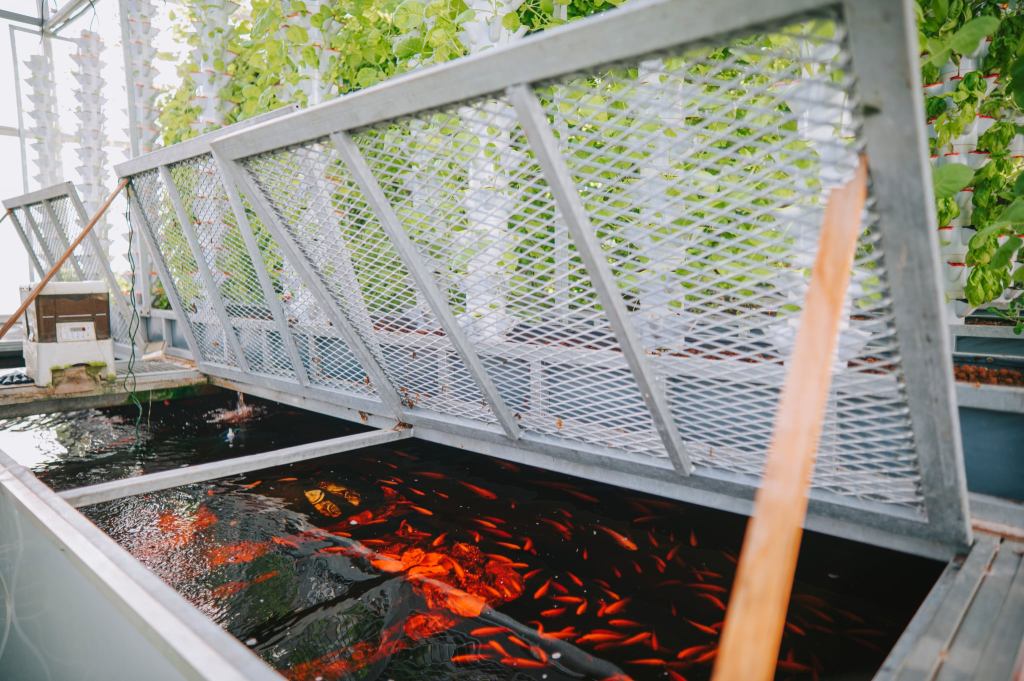
While the current outlook may seem challenging, strategic management and technological innovation can transition aquaculture toward greater sustainability, specifically through the implementation of aquaponic systems. Yes, a sustainable aquaponics system provides a practical response to the environmental and economic challenges associated with small-scale aquaculture in rural Cambodia. The system integrates fish farming with plant cultivation through a closed-loop water treatment and reuse process. Instead of discharging fish pond wastewater into the surrounding environment, water is circulated through a sequence of treatment units where solid waste is removed. Then the dissolved nutrients are biologically converted, and treated water is reused for crop production. This allows aquaculture and agriculture to operate as a single, interconnected system rather than as separate activities.
How Does the Aquaponics System Work?
In this system, fish are raised in earthen or lined ponds, generating wastewater rich in organic matter and nitrogen-based compounds from fish excretion and uneaten feed. The wastewater first passes through sedimentation units where heavier solids, such as fecal matter and feed residues, are separated. It then flows into a biological oxidation tank where ammonia is converted into less toxic nitrogen forms through microbial activity under aerated conditions. A final filtration stage using locally available lava rock further stabilizes water quality before the water is delivered to crop production units.
Two hydroponic crop cultivation options are suggested. The first is nutrient film or floating raft hydroponics for households where consistent commercial feed is used and the second is soil-based grow beds for situations where feed quality and nutrient inputs are more variable. Nutrient-film grows plants by continuously recirculating a thin film of nutrient-rich water (2-3 mm deep) over bare roots in sloped channels. Floating-raft grows plants in net pots on a polystyrene raft that floats directly on top of a nutrient-rich water solution. Soil-based grow beds combine nutrient-rich soil with controlled watering techniques.
The aquaponics system produces both animal protein and fresh vegetables within the same footprint. Fish provide a reliable source of dietary protein, while leafy greens and vegetables grown using treated wastewater contribute to household nutrition and potential surplus income. Because water is continuously reused, the system requires significantly less freshwater than conventional fish farming or irrigated agriculture, making it suitable for rural areas facing seasonal water scarcity.
Interconnected Rather Than Additional Labor?
A common concern is whether combining aquaculture and crop production creates double the work across separate agricultural departments or household responsibilities. In practice, the system reduces, not increases, fragmentation. Farm households in Cambodia commonly engage in multiple livelihood activities such as tending fish ponds, growing vegetables, and cultivating rice. The aquaponics approach does not add a new enterprise but instead creates productive linkages between activities already being performed.
The labor requirements remain comparable to conventional separate operations, but work becomes more interconnected. Instead of disposing of wastewater and separately irrigating crops, a single managed flow accomplishes both. Daily tasks like feeding fish, monitoring water levels, and harvesting vegetables can occur within the same integrated system rather than as isolated activities in different locations. For small-scale operators, this consolidation can actually reduce total labor time and movement between separate production areas.
Does the System Offer Large-Scale Flexibility?
At larger commercial scales, the cost-benefit ratio requires further experimentation and calculation. Large farms often manage multiple ponds and discharge substantial quantities of water on a regular basis, making full recirculation inefficient compared to simpler nutrient reuse pathways. While small household operations benefit most from closed-loop systems that maximize nutrient capture and minimize water use within limited space, large farms with substantial land areas and higher discharge volumes can adopt simplified nutrient reuse strategies.
In such contexts, large-scale aquaculture operators can partner with neighboring rice farmers to adapt nutrient reuse by discharging treated fish wastewater directly into the cropland. Prior to discharge, a simple sedimentation step is recommended to trap suspended solids and reduce organic loads, thus preventing excessive sludge accumulation. While aeration and nitrification could further convert ammonia into nitrate, flooded agricultural fields already function as biological treatment systems where soil microorganisms and plant root zones naturally transform and assimilate nitrogen compounds. The key economic advantage remains the same: converting waste nutrients into an agricultural valuable rather than treating them as a disposal problem. However, the optimal technical approach will differ depending on the operational scale.
What are some of the System’s Cost-Benefits?
As for any agricultural innovation, the decision to adopt integrated aquaculture-agriculture systems requires careful consideration of costs and benefits specific to each operation’s context.
Aquaponic systems require a significant upfront investment in construction materials, such as tanks, pipes, growing beds, and filtration media. While these are largely one-time capital expenditures, the systems also incur recurring expenses for electricity and other operational needs. However, these extra costs are offset by multiple savings: reduced fertilizer purchases, lower water consumption, and a decreased risk of water-related conflicts or regulatory issues, all of which provide cumulative annual benefits.
Furthermore, the organic vegetable market in Cambodia is experiencing a rapid “breakthrough” phase. Driven by increasing health consciousness and food safety concerns among the citizens of cities like Phnom Penh, this demand has incentivized farmers to adopt organic cultivation methods to command price premiums.
Cambodia has significantly strengthened its wastewater regulations, most notably with the 2024 Law on Wastewater Treatment Facilities, which aims to reduce pollution by 50% by 2030 according to the Ministry of Environment. Early adoption of water treatment systems, even simple, low-cost approaches, positions farmers ahead of future regulatory requirements, allowing them to avoid sudden mandatory compliance costs or unforeseen operational disruptions.
What are some of the System’s Social Equity Benefits?
Beyond environmental benefits, this collaborative model promotes social equity by enhancing the productivity of female-managed homestead gardens and reducing the labor burden associated with traditional vegetable growing, thereby addressing gender-driven time poverty in rural communities. In Cambodia, women play a large role in agriculture. In fact, over 52% of rural women carry out paid agricultural work. On the other hand, 20.9% of rural women and 9.7% of rural men carry out unpaid agricultural work. In effect, women represent a significantly higher share of unpaid family workers compared to men (MoWA 2024).
This gender gap often causes women to carry the “double burden” of both agricultural labor and domestic responsibilities, which limits their ability to pursue education. By eliminating the need for expensive and potentially harmful chemical fertilizers, the aquaculture-hydroponics system provides financial savings, reduces labor requirements, and frees up time that can be invested in children’s education or essential rest, thereby significantly improving women’s overall quality of life.
Cambodia’s national policies increasingly focus on helping women transition from subsistence farming to competitive, high-value organic businesses. Through the Neary Rattanak V and VI strategic plans (MoWA 2024), the government has prioritized women’s economic empowerment by providing them with a solid financial support system. The opportunities on offer empower women to move from subsistence farming to business ownership, broadening their perspectives and encouraging them to explore new innovations within the agricultural sector.
Aquaculture + Hydroponics = Aquaponics: Cambodia’s Next Dynamic Food Source?
Every solution inherently carries both benefits and trade-offs. Therefore, a multi-dimensional approach is essential to ensure protection of both livelihoods and environment. While aquaculture serves as a rapid response to the decline of wild fish populations, it can also lead to unintended environmental consequences if left unmanaged. Innovative models like aquaponics offer a viable path forward by mitigating these risks. Ultimately, the transition toward sustainable food systems in Cambodia will require a process of continuous experimentation, learning, and adaptation to ensure long-term resilience.
 AQUADAPT