By Kantaphan Punnaanan and Dr. Pichaya In-na
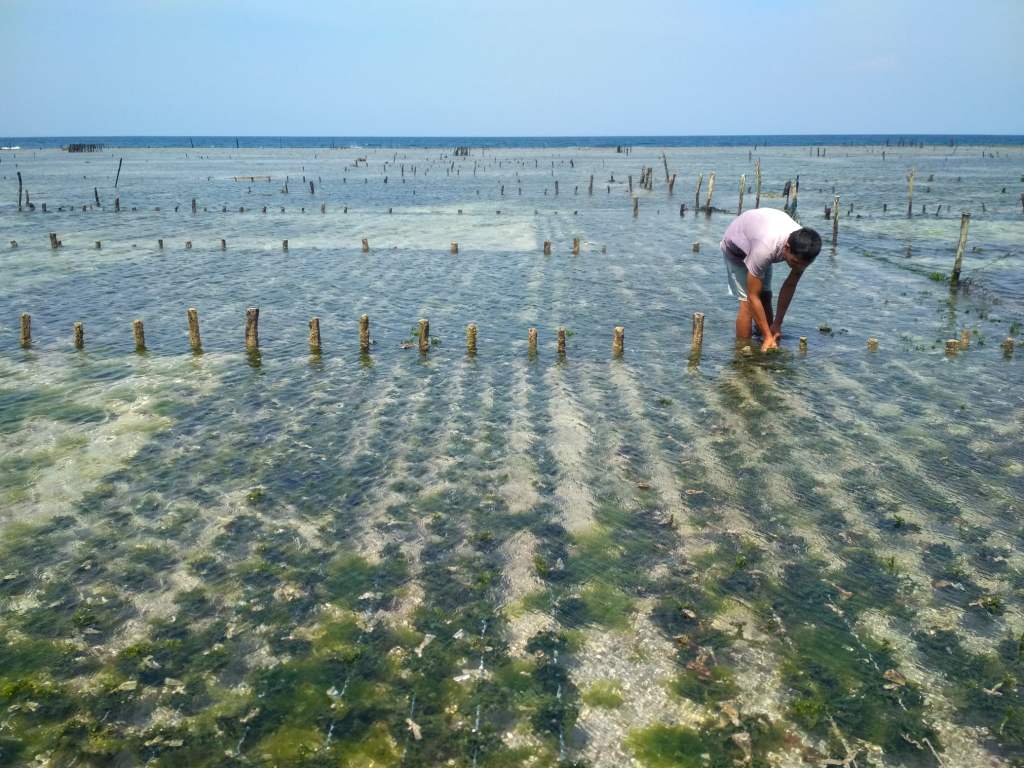
The world faces a climate crisis fueled by an excessive amount of CO2 in the atmosphere. Planting more trees isn’t going to solve the crisis on its own. This is where Ulva spp. comes into the picture. Better known as sea lettuce, these common green seaweeds are grown in Southeast Asia for food consumption. They have the potential to sequester carbon dioxide (CO2) from various industrial sectors and simultaneously provide incomes to farmers. This article points out why Ulva is an appropriate approach for sequestering CO2, how countries in Southeast Asia (particularly Thailand) have geographical advantages for seaweed cultivation, and what are some of the challenges ahead to the scaling up of this aquaculture-based climate solution.
Seaweed Farming in Southeast Asia
Southeast Asia produces about a third of the world’s farmed seaweed (Valderrama 2015; FAO 2022). The region’s prominence in seaweed production positions it uniquely to leverage algal cultivation for carbon mitigation strategies. With their established infrastructure, favorable climatic conditions, and extensive coastlines, Southeast Asian nations have a natural advantage in scaling up seaweed farming for decarbonization purposes (Rehman 2024).
In addition, seaweed farming has been a lifeline for millions of people in coastal communities. It doesn’t require huge investments to get started, the barrier to entry is relatively low, and it can provide a steady income (Sievanen 2005). The products go into all sorts of markets: food additives, human consumption, animal feed, cosmetics, medicines, and increasingly, biofuels and bioplastics. There have been some ups and downs, whereby production dropped about 14% between 2021-2022 (FAO 2023), but the overall trend is upward, especially as people recognize seaweed’s potential for climate action and regional decarbonization efforts (Rehman 2024).
Seaweed is known for growing rapidly and requiring little input (Mata 2016; Fernand 2017). Many seaweed species grow 10-30 times faster than terrestrial crops (Chung 2011). Some can double their weight in just a few days. They don’t compete with agriculture for land consumption, they don’t need irrigation, and they don’t require synthetic fertilizers; they just absorb nutrients directly from seawater (Chopin 2001). Better yet, when grown near fish or shrimp farms, they clean up the excess nutrients those operations produce (Neori 2004; Abreu 2011).
Seaweed and CO2 Sequestration
Macroalgae (the scientific term for seaweed) can be thought of as underwater carbon vacuum cleaners. Through photosynthesis, seaweeds suck up dissolved inorganic carbon from seawater, mainly as CO2 and bicarbonate (Raven 2014). When they do this, they lower the CO2 concentration in the water, which then pulls in more CO2 from the atmosphere to maintain equilibrium (Krause-Jensen 2016). Algal-based decarbonization strategies represent a promising frontier for the region, where both the need and the opportunity for marine carbon sequestration are substantial (Rehman 2024).
Why Ulva is a Special Candidate for CO2 Capture
Among all the seaweed varieties available for cultivation, green macroalgae, particularly the Ulva genus, are standouts. Ulva has some of the highest photosynthetic rates ever measured in multicellular organisms. There are documented cases of Ulva meridionalis quadrupling its biomass in a single day under the right conditions (Hiraoka 2020).
Ulva acts like a biological vacuum cleaner with four linked mechanisms. First, Ulva has a carbon concentrating mechanism, a sophisticated biological machinery (like a secret weapon) which efficiently draws both CO2 and bicarbonate from seawater, even when CO2 levels are low. Second, Ulva uses energy-powered pumps to actively pull bicarbonate (a carbon compound in seawater) into its cells. Third, an enzyme called carbonic anhydrase cuts bicarbonate into CO2 and water at the cell surface, where the algae create an acidic zone to speed up the process. Finally, once inside the cell, Ulva concentrates the carbon in a tiny compartment packed with photosynthetic machinery, preventing it from escaping.
Together, these four systems can achieve roughly 100 times more carbon inside the cell than exists in surrounding seawater, enabling Ulva to grow explosively and form massive green-tide blooms (Raven 2005; Xu 2012). From estimations, it was suggested that large-scale Ulva farming could sequester around 3.85 million tonnes of CO2 equivalent annually (Lehahn 2016).
Furthermore, the carbon storage isn’t just in the biomass itself. Ulva releases dissolved organic carbon (DOC) that can persist in the ocean for centuries when pieces of Ulva sink to the seafloor and are buried. This removal of DOC, in the form of carbonic acid, from seawater helps raise the pH locally, which can help counter ocean acidification in farming areas (Krause-Jensen 2016).
Cultural and Nutritional Significance of Ulva
Ulva has been eaten for centuries in Southeast Asian cuisines (Hofmann 2024). It’s sometimes called the “wheat of the sea” because of its nutritional value and potential for feeding large populations (Fleurence 1999). It contains 15-30% protein, essential amino acids, lots of vitamins (especially C and B complexes), and minerals like iron, calcium, and iodine (Msuya 2008). In the context of Southeast Asia’s growing population and food security concerns, developing Ulva as a food source aligns with both nutritional needs and decarbonization objectives (Rehman 2024).
Agricultural Benefits of Ulva
Adding Ulva to fish feed can improve growth and health whilst replacing some of the fishmeal derived from wild-caught fish and reducing CO2 emissions due to the hydrocarbons used to power the fishing boats. For land animals, researchers are testing Ulva as a supplement for chickens, pigs, and cows (Angell 2016). There’s even some evidence Ulva-supplemented feed might reduce methane emissions from cattle, which would be another climate win (Park 2025).
Farmers have been using seaweed as fertilizer for centuries (Khan 2009). Ulva contains nitrogen, phosphorus, potassium, and trace minerals that plants need. Unlike synthetic fertilizers, which are made from natural gas and release GHGs during their manufacture and their application, seaweed breaks down slowly and improves soil structure (Arioli 2015). These agricultural benefits could further contribute to the region’s decarbonization strategies (Rehman 2024).
Ulva Cultivation in Thailand: A Case Study for Decarbonization
Thailand’s Phetchaburi Coastal Aquaculture Research and Development Centre established successful Ulva cultivation in late 2010 (Paopun 2023; Kansandee 2024). From these beginnings, commercial operations have since prospered for over a decade. Thailand could therefore utilize Ulva cultivation as a strategic approach to combine economic development with climate mitigation. The country’s extensive coastal areas and established aquaculture sectors provide an ideal foundation for expanding green seaweed production.
Two species of seaweed in particular, Ulva rigida and Ulva lactuca, already grow naturally along Thai shores, especially where freshwater mixes with seawater in estuarine and coastal zones. Ulva rigida grows naturally at sites near shorelines influenced by freshwater such as the Phetchaburi Coastal Aquaculture Research and Development Centre (Paopun 2023). Ulva lactuca occurs in sublittoral waters and on rocky substrates throughout Thailand’s coastal regions (Prathep 2005). This is a good sign, indicating that the environmental conditions are right.
In addition, Thai farmers are experimenting with different growing methods. Some use coastal ponds where they can control water quality and nutrient levels (Blouin 2011). Others set up floating cages or nets in open water, a method which requires less infrastructure but needs more space.
Social Considerations of Ulva Cultivation
An interesting approach worth exploring further is Integrated Multi-Trophic Aquaculture (IMTA), where Ulva is grown alongside fish or shrimp. The seaweed absorbs nutrients from excess fish feed and from fish waste, thus cleaning the water whilst growing rapidly (Cruz-Suárez 2010). This type of Ulva-fish or Ulva-shrimp co-cultivation would seem to be particularly suited to small family-owned or community-run farms. In these, the operational burdens are often shared across genders and ages.
Yet realizing inclusive benefits requires intentional effort. Evidence from seaweed farming and small-scale aquaculture communities worldwide reveals that without deliberate intervention, IMTA systems can inadvertently entrench gender disparities, where men control decisions and high-value sales while women do the hard work, and marginalized groups (youth, landless households) remain excluded (Adam 2024). Key barriers include women’s limited tenure security and credit access, male-dominated extension services, and cultural norms restricting participation.
Overcoming these demands action at multiple levels: household-level dialogues to negotiate equitable roles and income control; secure access to resources via community agreements and affordable loans; norm-change efforts that celebrate local women IMTA farmers and engage men as allies; gender-responsive extension through female facilitators and peer-farmer training; and sex-disaggregated monitoring of progress on roles, income, and nutrition outcomes (Njogu 2024).
Success stories from Bangladesh, Madagascar, and the Philippines demonstrate that when these elements align alongside government support for women entrepreneurs and their access to markets, family IMTA becomes a genuine opportunity for food security and resilience across all household members, not just a technology transfer that bypasses the poorest (UNCTAD 2024).
Challenges to Ulva Cultivation for CO2 Sequestration in Southeast Asia
Firstly, Ulva taxonomy is complicated. Many species look similar, making it hard to identify what is being grown without genetic testing. Different species have different growth rates and stress tolerances, so getting the identification right matters. As farms get bigger, disease becomes more of a worry. Monoculture at scale is vulnerable to pathogens and pests (Loureiro 2015). In addition, there hasn’t been much selective breeding with Ulva. Developing improved varieties could boost productivity and disease resistance.
Another important issue to consider are blooms. In nutrient-polluted waters, Ulva can form “green tides” that cause oxygen depletion and other ecological issues (Smetacek 2013). Thus, there is a need to create preventive protocols and, possibly, to develop automated nutrient monitoring and warning techniques before environmental problems crop up.
Climate change threatens Ulva farming (Duarte 2022). Ocean warming affects how seaweed grows, and extreme heat waves can kill crops. Whilst some research suggests higher CO2 might help Ulva grow faster, the ecological effects are not fully understood (Koch 2013). More frequent and intense storms can destroy farming infrastructure and wipe out harvests. Thus, cultivation approaches that can withstand extreme conditions need to be designed.
On the market side, most of the world isn’t accustomed to consuming seaweed. Creating demand requires education, product development, and marketing. Seaweed prices can be volatile, so having different crops can help stabilize farm incomes. In addition, the carbon credit market for seaweed farming has not been developed in the region yet. Methods to measure and verify carbon sequestration by Ulva cultivation are needed so that farmers can be compensated for the climate benefits they provide.
Lastly, harmonized carbon accounting standards, shared research infrastructure, and coordinated policy frameworks would strengthen the region’s collective capacity to leverage Ulva cultivation for climate mitigation (Rehman 2024).
Conclusion
Ulva cultivation has great potential as an aquaculture-based climate solution. It can improve coastal livelihoods, enhance food security, and build circular economies. For Southeast Asia in particular, the opportunity to lead in algal decarbonization could position the region as both a climate nature-based innovator and economic beneficiary.
That being said, further work on Ulva is needed. This includes better understanding of Ulva genetics and breeding, development of resilient cultivation systems, creation of robust carbon accounting frameworks, promotion of markets, development of supportive policies, and support for continued research into ecological impacts and long-term carbon storage.
With additional investment, coordination, and commitment to scaling up, Ulva promises to address some of our biggest challenges on land, while growing quietly beneath the waves.
 AQUADAPT