By Pham Nguyen Tuan An
Every 48 hours, Mrs. Hong helps her husband process 30 kg of fresh sardines to feed 70,000 babylon snails across seven intensive ponds. She is also the one who scrambles for investment money, takes shifts guarding the ponds and cooks for the family.
Yet at home, she is told she “can’t be the main one”.
Aquaculture, like much of Vietnam’s agriculture, is still shaped by gendered assumptions and unequal power. In the household of Mrs. Hong, the “invisible” woman among intensive snail ponds, and in the household of Mrs. Nam, another “invisible” woman who, incidentally, practices nature-based solutions (NbS) in her family’s aquaculture, the daily struggle to make a living is also a daily negotiation of who is seen, who decides, and who owns what.
In many small-scale aquaculture households, women remain the quiet force behind ponds worth hundreds of millions of dongs: present for the work, but absent for the recognition. Viewed through a gender lens, their stories point to what a more equitable path could look like for Vietnamese families who depend on agriculture to survive.
A Glass Ceiling Over an Intensive Pond
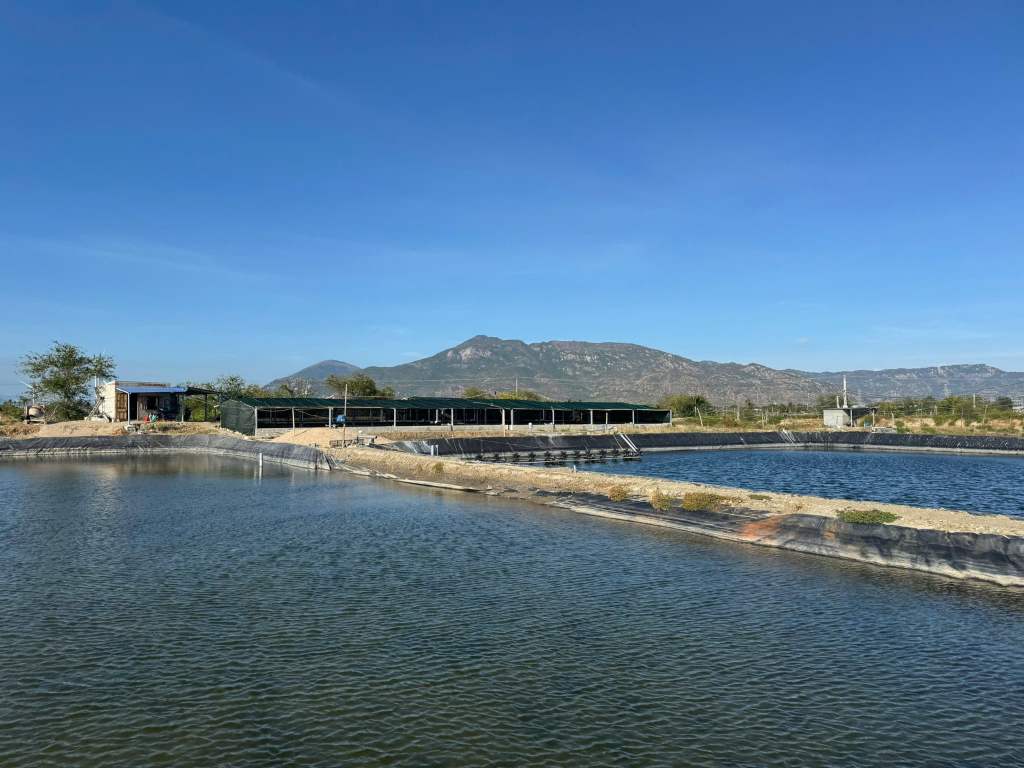
Under a sun that feels almost scorching, Mrs. Nguyen Thu Hong (53), from the Ninh Hai Commune in Khanh Hoa Province, moves to the relentless rhythm of her family’s seven intensive babylon-snail ponds.
Each pond spans about 100 sq m and requires an investment of up to 50 million VND (2,000 USD). To raise that kind of money, the family had to borrow from multiple sources. Her husband was the one who proposed the idea, but it was Mrs. Hong who had to make the numbers work.
Every two days, the household buys and prepares 30 kg of fresh sardines as feed for about 10,000 snails per pond. Twelve hours after feeding, Mrs. Hong and family painstakingly filter the water and pick out every small fish bone to protect water quality and prevent disease, the constant fear in intensive aquaculture.
Someone has to watch the ponds in shifts, day and night. When she is not at the ponds, Mrs. Hong goes home to cook, then brings the meals out to whoever is on duty.
She works both directly and indirectly in the farm operation. Still, her daughter, Ms. Lien, describes her mother’s place plainly: “My mum can’t be the main one… This work is too technical”.
In the family’s story, Mrs. Hong is often filed under “support”. Her husband is the “starter”, the one credited with the idea. He taught himself the techniques on YouTube and serves as the main manager of the snail ponds.
It is a familiar pattern in aquaculture communities: technical knowledge is treated as unquestionably men’s territory, while women’s essential management work (financing, logistics, day-to-day monitoring) is taken for granted.
Scholars describe this kind of pattern as a “sociology of absence”, a systematic overlooking of the knowledge and lived experiences of less powerful groups (Tallent 2023). In intensive systems like Mrs. Hong’s, women’s contributions, the ability to mobilize funds, run operations behind the scenes, and spot risk through daily observation, are often ignored.
Studies have noted that while men may take on heavier tasks such as construction or harvest, women’s roles in managing ponds and keeping financial records can be just as foundational to sustaining the family’s livelihood (St. Louis 2020). But because these roles are frequently “domesticated” (folded into household duties) they tend to be undervalued in formal policy frameworks (Gopal 2020).
From there, other problems follow.
In Mrs. Hong’s home, as in many others, the husband holds title to the main assets such as land and housing. When ownership of land and water surfaces sits largely with men, women face legal and customary barriers in controlling resources they also helped build (Kawarazuka 2010).
Without ownership, their autonomy shrinks. Accessing credit becomes harder. So does accessing extension services and training, activities that can significantly improve farmers’ skills, but which are often designed without social inclusion in mind.
Moreover, research and statistics may present data on income, education and access to information, but without clear gender breakdowns. The result is a persistent “blind spot” for policymakers. The challenges faced by women in agricultural households remain easy to miss, and easier still to sideline.
A Nature-based Route to Inclusion
About 500 km away, on Con Son islet in Can Tho City’s Bui Huu Nghia ward, Mrs. Nguyen Thi Nam (77) lives by a very different rhythm.
Her pond, more than 40 years old, is not an intensive “battlefield” under constant pressure. It is, in her words, a gift from the calm Hau River.
The man-made pond was dug in the late 1980s. Fish enter in two ways. One is through a small opening (about 10 cm wide) connected to the main river, where fish swim in through “ống bọng”, a funnel-shaped trap that lets fish follow the tide into the pond but prevents them from swimming back out. The second is more deliberate because her son fishes in the river and releases his catch into the pond.
There is no industrial feed. The fish grow on algae, aquatic organisms and scraps from the family kitchen. Output may be lower than in intensive systems, but food quality is more assured. For a low-income household in the late 20th century, those fish were an important source of protein, quietly improving daily nutrition.
Then Con Son changed.
In 2015, the islet became a famous eco-tourism destination, and the value of Mrs. Nam’s “nature-based” fish rose sharply. Tourists were willing to pay between 300,000 and 500,000 VND (11.50 to 19.00 USD) for a fried giant gourami, four to five times the market price.
“Tourists come to my orchard to eat star apples, and sometimes they stay for lunch”, she says. “Then I catch the fish and prepare it in front of them so they feel assured it’s fresh. That’s also what many visitors want”.
Here, gender roles are also clear, but the model creates different kinds of space. Men dig the pond and catch fish. Women like Mrs. Nam and her three daughters keep the pond clean and turn the catch into higher-value food products for visitors.
This arrangement suggests why NbS approaches can meet sustainability goals: they strengthen household food security and income and they depend less on costly inputs.
Viewed through a gender lens, Mrs. Nam’s story also points out a practical route to inclusion for women and older people. As the young people move to the cities and the elderly remain in the rural areas, labor-intensive, high-input aquaculture can become too punishing for those left behind.
NbS models, by contrast, reduce the physical burden by working with natural ecological processes. Instead of work being heavy tasks like dredging pond mud or hauling sacks of feed, work shifts towards observation, judgement and experience. Mrs. Nam’s tide-reading and fish-handling practices reflect a kind of fine-grained knowledge that modern technologies do not easily replace.
Research has also found that integrating local knowledge into NbS frameworks is key to long-term effectiveness. Projects which overlook women’s practical experience risk producing solutions that look good on paper but fail on the ground (Diep 2022).
When the goal is genuine empowerment, “inclusive technologies” matter. Then, labor-saving affordable tools, such as small backyard ponds or low-input feed solutions, allow women to participate without trading off caregiving responsibilities.
By recognising women as holders of expertise, not just helpers, small-scale aquaculture can become a more sustainable livelihood for rural families.
Whether it is Mrs. Hong’s financial juggling or Mrs. Nam’s intimate understanding of the river’s tides, these women are not merely supporting an industry. They are the current that keeps it alive.
Note from the author: Names have been changed to avoid affecting the individual’s work and family.
 AQUADAPT