By Tran Duc Thinh
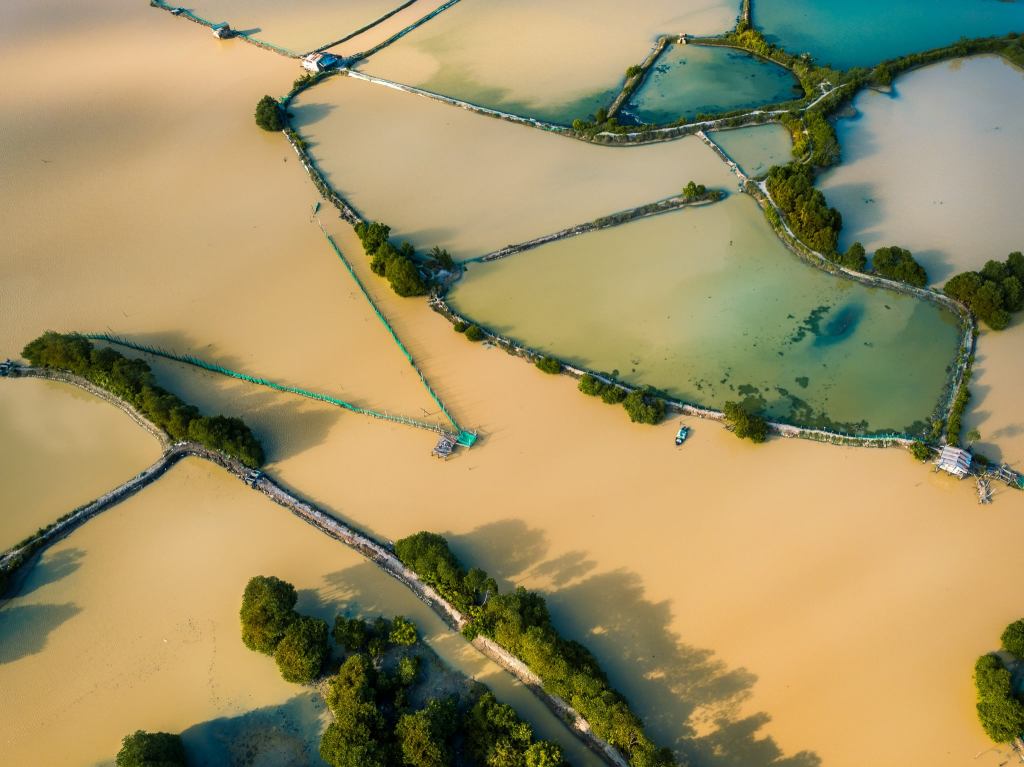
The sun had not yet risen when Sau went to check her family’s shrimp pond in Tra Vinh province. She observed the water color, measured salinity with a handheld device, then made a decision, a decision against her husband’s wishes, not to stock the pond at the density the two of them had argued over through the previous night.
“My husband wanted to switch to intensive industrial farming right away. We nearly argued the whole farm hut apart,” she recounted to a researcher (Anh Vu 2012).
Her caution, forged from years of daily pond observation, proved to be sound: that season, intensive farms in the area were devastated by disease, while her family’s pond delivered a modest but steady harvest.
In truth, Sau’s story is far from uncommon. It reflects a vast, near-invisible reality: the knowledge, labor, and judgement of hundreds of thousands of women like her underpin the daily operation of small-scale aquaculture throughout the Mekong Delta. Yet a bitter irony persists: policy documents rarely mention them, aquaculture extension programs seldom invite them, and land-use certificates in most communes rarely name them.
Placed in that context, this essay seeks a more honest recognition of the fact that women’s roles are not simply a matter of social equity. As the Mekong Delta faces accelerating subsidence, salinization, and warming at some of the fastest rates in the world, the ecological knowledge that these women hold is one of the most undervalued, and therefore underutilized, adaptive assets this region possesses.
A Delta in A Vise
The Mekong Delta is Vietnam’s largest aquaculture basin, contributing approximately 70% of the national output, at more than 3.1 million tonnes per year. Its signature farming systems include shrimp integrated with mangroves in Ca Mau and Bac Lieu, rice-shrimp rotation in Kien Giang and Ben Tre, and pangasius catfish ponds along the Tien and Hau rivers. These systems have sustained millions of families across generations. In practice, the systems are Nature-based Solutions in the truest sense of the term: they rely on tidal rhythms, mangrove cover, seasonal flood cycles, and biodiversity rather than chemicals or mechanization (Nguyen 2020).
Today, however, this fertile delta is being squeezed in the jaws of a vise. On one side, climate change: with a mean temperature increase of approximately 0.5°C over the past half-century and projections of a further 1.5°C rise by 2050 (Do 2022), the immediate consequences are saltwater intrusion pushing 40-60 kilometres inland during the dry season and increasingly erratic, extreme rainfall. On the other side, land subsidence: decades of groundwater over-extraction have caused parts of the Mekong Delta to sink by 1-3 centimetres per year; far faster than the rate of sea-level rise.
More alarming still, Vietnam has lost roughly half of its mangrove cover over the past three decades, largely through conversion to shrimp ponds and aquaculture enclosures (Tinh 2022); a deeply regrettable trade-off, given that mangroves are the very natural embankments which protect those remaining ponds. The result is that the familiar cycles of farming (when will floods arrive? when will salinity peak? by how many degrees will the pond water warm?) have shifted and become difficult to predict. It is precisely at this juncture that the role of those who hold direct, daily observational knowledge has never been more important.
What Women Actually Do
Ask any resident of a shrimp-farming village in Ca Mau or Bac Lieu who it is that goes to the pond every morning, and the answer almost always points to a woman. According to Duy and colleagues (2022), in family-scale shrimp and pangasius operations, women typically carry out the majority of daily management tasks: they monitor water color and odor, they track stock health, they manage feed, they keep accounts, they coordinate with input suppliers, and they sort and pre-process the harvest before sale. More specifically, research on household pangasius farming in Can Tho found that although men are formally recognized as the decision-makers, it is women who perform the greater part of the day-to-day management work (Ninh 2022).
Beyond this, women shrimp farmers in the Mekong Delta tend to be more cautious in their production decisions, a pattern clearly evident, in their preference for extensive, lower-risk models with stable returns over intensive systems that promise higher profits but are more prone to collapse (Anh Vu 2012). This is not mere timidity. It reflects a clear-eyed assessment of household vulnerability. Women, who typically bear responsibility for household food security and debt repayment yet have little say in major decisions, understand that a single hasty choice can sweep away a family’s only means of livelihood.
At a still deeper level, women accumulate over many years a sophisticated body of informal ecological knowledge: reading the environmental signals such as water color and smell, the behavior of wild fish near the pond bank, and the appearance of indicator organisms; understanding the relationships between salinity, temperature, and shrimp stress; and adjusting stocking and harvest schedules in response to seasonal patterns and weather changes. This attentive ecological observation is, in fact, the very essence of nature-based aquaculture: working in concert with natural cycles, managing risk through ecological diversity, and building resilience rather than maximizing short-term yield.
Why Do These Hands Remain Invisible?
Despite these very real contributions, women’s presence continues to be obscured by multiple layers of constraint; some visible, some not.
The most fundamental barrier lies in the legal system. Agriculture land-use certificates in most Mekong Delta communes are still registered in the husband’s name alone; a deeply entrenched custom, long embedded in community practice, even as the law has long permitted joint registration. Without her name on the certificate, a woman cannot obtain an independent bank loan, cannot become a formal cooperative member, and cannot access extension services that require proof of land ownership (Nguyen 2020). The enduring consequence is stark: when a husband dies, divorces, or leaves to work elsewhere, the woman farming that land may find herself with no legal standing whatsoever.
Compounding this legal barrier is a systematic exclusion from mainstream technical knowledge. Aquaculture extension programs are typically held when women are occupied with domestic responsibilities, at locations distant from home, and are designed on the unspoken assumption that the man is the “farm operator” in need of training (Duy 2022). The practical consequences are significant: women are less likely to receive early disease warnings, less likely to learn about improved stress-tolerant varieties, and less likely to understand certification requirements that could raise the price of their produce. As a result, in a self-perpetuating cycle, the knowledge gaps caused by exclusion are then used as justification for continued exclusion.
The inevitable outcome of these two barriers is women’s absence from decision-making spaces. Village management committees, cooperative boards, and provincial aquaculture planning forums, the arenas where consequential choices are made, remain overwhelmingly male domains. Ethnic minority women, particularly Khmer women in Tra Vinh and Soc Trang, further face the double barriers of language and discrimination (Anh Vu 2012). As well, and most troubling of all, older women, those who hold the deepest reserves of local ecological knowledge, are almost entirely absent from formal consultation processes.
Climate Change: When Women’s Roles Become More Urgent Than Ever
The greatest paradox in the climate change challenge facing the Mekong Delta lies in this: even as aquaculture livelihoods across the region come under severe threat, women, precisely those who hold the deepest and most continuous body of local practical knowledge, are not receiving the recognition commensurate with their actual role. Put differently, rather than being placed at the centre of the response and adaptation strategies, they are pushed into a position of vulnerability, given insufficient voice and provided with insufficient access to the resources that matter most.
In practice, the field experience that women accumulate over many years of aquaculture work confers irreplaceable adaptive advantages in the face of increasingly unpredictable climate shocks. The clearest example is this: when saltwater intrusion upends the traditional seasonal calendar, or when shrimp die en masse for no apparent reason, the capacity for observation and judgement, refined through daily caregiving labor, enables women to identify risks early and adjust their production practices accordingly (Nguyen 2020). Moreover, the preference of many women shrimp farmers in Ca Mau and Tra Vinh for extensive, mangrove-integrated, low-chemical models closely aligns with the direction that mangrove restoration programs and eco-shrimp certification schemes actively promote. This indirectly affirms that their role is not only adaptive in nature but also consistent with long-term sustainable development goals.
Yet, paradoxically, these adaptive capacities are rarely translated into access to resources or voice in decision-making, leaving women at a structural disadvantage when crises strike. Research by Nguyen and colleagues (2020) on mangrove-shrimp farming systems in Ben Tre found that while farmers have the capacity to sustain this model, they nonetheless lack the motivation to do so because they cannot access the necessary support resources. For women, these barriers are higher still: without land-use rights in their name, they cannot borrow from banks when ponds are damaged; limited access to early warning information means they cannot respond in time; and near-total absence from planning meetings means they are scarcely considered in recovery programs. Female-headed households, simultaneously the hardest hit by climate-related disasters and the least supported group, lay bare the contradiction between women’s substantive role and their lack of power in responding to climate change.
Making These Hands Visible and Seen
Today’s evidence suggests that change is not entirely out of reach. Several recent projects supporting sustainable mangrove-shrimp certification in Ca Mau and Tra Vinh have incorporated components of gender equality and women’s financial empowerment as mandatory requirements (Tinh 2022). This is the right direction and must be scaled up and institutionalized. Four priority areas for action are worth considering.
Legal Reform on Land Rights: Accelerate joint registration on aquaculture land-use certificates; train land administration officials in gender-equitable practice; establish legal aid services for rural women, particularly widows and female-headed households. Eco-shrimp certification programs should require that women in the household be formally recognised as co-holders of the certification (Do 2022).
Redesign Extension Training Programs: Hold sessions locally and at flexible hours; deploy female extension workers and peer-learning methodologies; clearly designate female household members as the primary target of technical training on water quality management, disease prevention, and climate adaptation (Duy 2022; Ninh 2022).
Integrate Women’s Knowledge into Climate Adaptation Planning: Systematically collect women’s local ecological knowledge and incorporate it as a formal data source in provincial and commune-level aquaculture adaptation plans. Gender-disaggregated seasonal calendars, field surveys involving women farmers, and focus group discussions with women should be standard components of planning processes (Nguyen 2020).
Expand Financial Access and Governance Inclusion: Develop microcredit products tailored to women aquaculture farmers; distribute climate risk insurance through the Vietnam Women’s Union network; set meaningful, not merely nominal, membership and leadership targets for women in cooperatives, ensuring a genuine female voice in decision-making processes (Anh Vu 2012).
Alongside these four areas, investment in research is equally important. Start with collecting sex-disaggregated data across aquaculture surveys, value chain analyses, and climate impact assessments. Beyond that, the documentation and validation of women’s ecological knowledge must be treated as a serious, transferable body of practice, not merely as anecdotal folklore. This is the evidence base on which better-designed policy and extension programming must be built (Ninh 2022).
The Water Does Not Wait
Throughout the countless seasonal rises and falls of the Mekong’s waters, the nature-based aquaculture systems of the Delta have survived centuries of flood, drought, and market upheaval in no small part because of the accumulated ecological knowledge of those who tend the systems; and the greater part of that wisdom has flowed through the hands of women (Anh Vu 2012; Nguyen 2020).
Seen from that vantage point, it is difficult to accept that, as the Mekong Delta confronts a climatic future capable of straining every available adaptive resource, decisions, whether deliberate or not, continue to allow half of that expertise to be squandered as unrecognized, purely self-taught, and excluded from governance. This is simply a choice. But the consequences that may follow, for individual households, for an entire aquaculture sector upon which millions depend, and above all for the resilience of the ecosystem itself, could well be consequences that are catastrophic.
For that reason, properly recognizing women’s roles is the first step, and one that should not be deferred. Sau goes to her pond before dawn and she knows immediately what must be done. The question then is whether the policies, programs, and institutions shaping the future of this delta will, in the end, listen to her.
And, keep this in mind: the water she knows so deeply will not wait for an answer to that question.
 AQUADAPT