By Vinij Tansakul
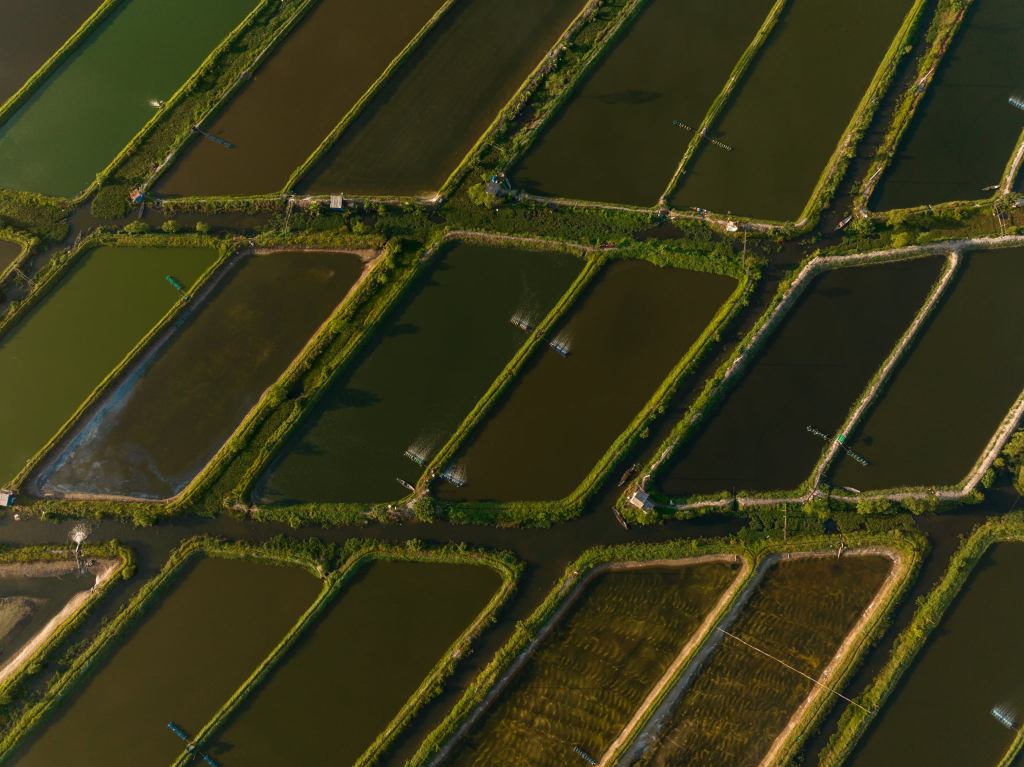
As climate change intensifies every year, Southeast Asia’s aquaculture sector faces unprecedented structural challenges. This is particularly evident in the Mekong Delta and the coastal zones of the Gulf of Thailand, which serve as the region’s vital seafood production hubs. Data from the Vietnam Water Resources Science Institute, cited in The Fish Site (Beijnen 2024), indicates that salinity intrusion in the Mekong River Basin has expanded from a historical distance of approximately 20 kilometers from the river mouth to more than 70 kilometers inland today. This phenomenon causes agricultural crop damages valued at around USD 3 billion annually. Concurrently, land in the Mekong Delta subsides at an average rate of approximately 4.3 centimeters per year, a deeply concerning figure given that most of the area sits less than one meter above sea level.
These damage indications clearly demonstrate that high-density intensive monoculture, which relies heavily on external inputs such as antibiotics, chemicals, and electricity to manage environmental conditions, is hitting both physical and economic dead ends. Upgrading the industry toward sustainability requires a paradigm shift toward Nature-based Solutions (NbS) in aquaculture.
When Conventional Success Becomes a Risk
For decades, Southeast Asia’s aquaculture industry predominantly relied on the monoculture model, rearing shrimp or fish in closed, high-density ponds with a heavy usage of external inputs. Although this method yields high-volume outputs in the short term, it remains vulnerable to climate variability. When pond ecosystems lack biodiversity, the system’s adaptive capacity and recovery potential diminish. Consequently, farmers are left to bear the financial risks alone whenever disease outbreaks or sudden water quality shifts occur.
Transitioning to the “New Playbook” begins with shifting the perspective from viewing a culture pond as a “protein factory” to managing it as a “micro-ecosystem”. The clearest examples of this transformation are in the Mekong Delta, where farmers have widely adopted rice-shrimp and mangrove-shrimp co-culture systems. These systems not only enable farmers to survive volatile climate conditions but also to transform their farms into active guardians of the ecosystem.
Nature-Based Aquaculture at the Core of the New Playbook
A Nature-based Solutions (NbS) concept allows for the analysis of aquaculture’s positive impacts through the lens of Social-Ecological Systems (SES) and across three interconnected and interdependent dimensions: ecological, bioeconomic, and social dynamics.
Ecological Dimension and Biochemical Resilience
Integrating ecological structures into aquaculture, such as happening in rice-shrimp or mangrove-shrimp systems, triggers bioremediation mechanisms. In these systems, plants and autochthonous microbiota actively absorb excess nutrients from aquaculture feed, thereby reducing the risk of eutrophication in surrounding water bodies. Furthermore, mangrove-shrimp systems function as vital sinks for blue carbon sequestration.
However, field survey data reveals a worrying trend: the Mekong Basin has lost approximately 83,000 hectares of mangrove forests since 1973, with shrimp farm expansion driving a continuous loss of around 2,150 hectares per year. This is why restoration initiatives like Mangroves and Markets, and the Dutch Fund for Climate and Development (DFCD) have mandated that shrimp farms seeking organic certification must maintain at least 50% mangrove canopy cover across their total farm area within a 5-year timeframe. This initiative, which targets a total greenhouse gas sequestration of approximately 10 million tons annually, with around 1.5 million tons derived from additional mangrove reforestation, is expected to directly benefit over 12,000 farmers.
Bioeconomic Dimension
From a business perspective, transitioning to nature-based systems is not merely an eco-friendly gesture; it delivers tangible economic viability. Data from pilot sites in the Mekong Delta indicates that the rice-shrimp system yields around 5 to 8 tons of rice per hectare and 300 to 1,000 kilograms of shrimp per hectare per production cycle. The average annual income for farmers practicing this system ranges from approximately USD 9,800 (VND 257,549,000) to USD 40,000 (VND 1,051,240,000) per hectare, depending on seasonal success and market prices. Meanwhile, recent field data from Ca Mau Province, Vietnam, found that certain farmer groups achieved a net income of around VND 80 to 100 million (USD 3,044 to 3,805) per hectare per year from rice-shrimp farming, reflecting variations based on local conditions and seasonal variations.
The key factor driving the cost-effectiveness of this rice-shrimp system is the reduction in external input costs. Shrimp waste and organic detritus from the shrimp cycle serve as natural fertilizers for the subsequent rice crop. Concurrently, fragrant rice varieties grown under this system command prices roughly 80% higher than conventional rice. Furthermore, organic-certified shrimp products sourced from integrated mangrove systems can fetch a price premium of 20% to 30% in the global market. In the long term, this transition opens opportunities for farmers to access voluntary carbon markets, providing a supplementary income stream that helps diversify financial risks against commodity price volatility.
Social Dynamics and Gender Equity Dimension
An often overlooked yet equally vital dimension is the role of women farmers in farm management. According to studies in the Mekong River Basin, women who manage the ponds daily often observe subtle water quality changes firsthand due to direct experience, but also directly bear the financial consequences when aquaculture diseases strike. Empowering women with access to farm management knowledge and technology is therefore not just a matter of equity, but a strategic mechanism that significantly enhances the adaptive capacity of households and communities against extreme climate events.
In-Depth Case Study: The Rice-Shrimp System in the Mekong Delta
The rice-shrimp system represents the most concrete manifestation of adapting to natural cycles. Instead of fighting salinity intrusion, farmers convert fluctuating salinity levels into a biological asset. During the rainy season, when freshwater floods the landscape, farmers cultivate rice often with salt-tolerant varieties whose roots improve soil structure and absorb residual nutrients. As the dry season approaches and saltwater intrudes, the same plot is transformed into a marine shrimp or giant tiger prawn culture pond instead of a field trying to grow an unsustainable dry-season rice crop.
In terms of scientific mechanisms, the rice stubble left behind after harvest decomposes into organic matter that fosters the growth of plankton and periphyton, providing an excellent natural protein source for the shrimp. Simultaneously, shrimp feces and residual organic nutrients from the aquaculture cycle are bound within the soil matrix, acting as natural fertilizers for the next rice crop. This closed-loop nutrient cycling significantly reduces reliance on chemical fertilizers and antibiotics, transforming historically vulnerable hazard-prone zones into highly secure production systems. The table below summarizes the structural differences between the two models.
| Comparative Dimension | Intensive Monoculture Model | Nature-based Solutions (NbS) Model |
|---|---|---|
| Systemic Sustainability | Low: High reliance on external inputs; highly vulnerable to disease outbreaks. | High: Utilizes ecological mechanisms to regulate system balance. |
| Chemical/Antibiotic Use | High: Required to control diseases under high-density conditions. | Low: Environmental design naturally mitigates disease vectors from the source. |
| Income Sources | Vulnerable: Single primary product; highly exposed to market price volatility. | Diversified: Organic rice, premium shrimp, and future carbon credits. |
| Climate Extremes Resilience | Low: System lacks biodiversity to absorb environmental shocks. | Higher: Possesses natural ecological recovery mechanisms, though still requires sound management. |
Complementary Technologies for Small and Medium-Scale Farms: RAS and Biofloc
“Smart Aquaculture” does not necessarily imply high-level artificial intelligence; rather, it refers to applying technologies tailored to the context of smallholder farmers.
Recirculating Aquaculture Systems (RAS) are closed-loop technologies that manage water quality through mechanical filtration, biological filtration utilizing nitrifying bacteria, and water treatments before recycling it back into the culture ponds. This system drastically minimizes water consumption and shields operations from external water quality fluctuations caused by droughts or floods. On the other hand, Biofloc Technology relies on microbial aggregates to convert feed waste into microbial protein that aquatic species can re-consume, reducing feed costs and extending the lifecycle of the pond water.
RAS also provides a pathway toward carbon-neutral aquaculture. Studies indicate that when integrated with renewable energy and aquaponics, RAS can generate mutual benefits between the food production and energy sectors. Nonetheless, a major constraint of RAS for small and medium farms is the operational electricity costs required 24/7, alongside the technical skill gap for farmers who must transition from natural observers to bioprocess engineering controllers. This is an area requiring synchronized policy support.
From Concept to Practice: Challenges and Driving Mechanisms
Transitioning to nature-based systems is not an overnight process; it demands systematic support from all stakeholders. Drawing from pilot experiences in the region, practical challenges can be categorized into three main areas, along with actionable driving mechanisms as summarized in the table below.
| Challenge | Practical Constraints | Actionable Driving Mechanisms |
|---|---|---|
| Initial Capital Expenditure (CAPEX) | Smallholders lack access to capital or low-interest financing for system upgrades. | Green credit lines, co-payment subsidies, and Pay-As-You-Go* models with tech providers. |
| Technical Skill Gap | Farmers are accustomed to experience-based observation and lack bioengineering skills. | Peer-to-peer knowledge sharing, demonstration farms, and hands-on field training programs. |
| Infrastructure Risks | Remote areas suffer from unstable power grids, impacting systems requiring continuous energy. | Shared community-scale infrastructure and alternative energy integration with backup systems. |
For farmers wishing to begin, the most critical starting point is to conduct a “Farm-level Risk Assessment” to evaluate localized water or climate vulnerabilities and select the model best suited to their context, whether the rice-shrimp system, the mangrove-shrimp system, or the energy-efficient RAS. This process ensures that the implementation plan is clear and fully aligned with the household’s actual available resources.
Strategic Roadmap to Implementation
This transition does not rely solely on ecological understanding when moving from theory to execution. It demands driving mechanisms that synergize the strengths of diverse sectors to ensure that the shift toward Nature-based Solutions (NbS) yields tangible and long-term sustainable outcomes. The following strategic pathways are proposed for stakeholders at various levels.
Holistic Management Transition: Farmers should shift their mindset from a yield-centric focus to a system-centric approach that balances income with ecological health. This begins with a “Farm-level Risk Assessment” to evaluate their natural capital and select the most appropriate model (e.g. rice-shrimp or mangrove-shrimp systems), using localized climate data as the primary baseline for species selection and stocking cycles.
Participatory Learning Networks: Government and industry together should support peer-to-peer learning networks by establishing model farms that serve as community learning centers to lower the psychological barrier and risk aversion associated with new technologies or methods. Government specifically should promote active leadership roles for women farmers in daily water quality monitoring and farm management, as these serve as linchpins for enhancing system precision and productivity.
Green Finance and Market Access: Governments and financial institutions must accelerate the development of low-interest green credit facilities for farmers transitioning to NbS or organic farming. Concurrently, the private sector must co-create market platforms that offer price premiums for certified environmentally sustainable products, establishing economic incentives that outcompete conventional monoculture.
Landscape-Scale Infrastructure Support: Government and industry together should develop infrastructure that facilitates ecosystem-based farming, such as landscape-scale water management systems and household-scale energy-saving technologies. This will alleviate fixed cost burdens on smallholders and bolster production security when facing extreme weather events.
Conclusion: From Crisis Survival to Sustainability Leadership
Ecological, bioeconomic, and social dimensions are not isolated elements; they are interdependent cogs within a unified production system. A healthy ecosystem directly underpins long-term income security, while the knowledge and roles of farmers, particularly of women, serve as the driving engine to keep the entire system moving forward sustainably. The cost of failing to adapt today is not merely a temporary drop in yield; it could mean the permanent loss of productive land when conventional ecosystems cross the tipping point and can no longer recover.
Developing a sustainable aquaculture industry in the era of climate change is therefore not an isolated technological challenge, but a fundamental shift in human mindset. We must evolve from viewing nature as an obstacle to overcome to treating nature as our most resilient ally, through an understanding of its core mechanisms. If the industry can successfully scale up these pilot models into formal policy frameworks, it will establish a vital shield ensuring the competitiveness of Thai and ASEAN aquaculture amid rapid climate shifts. Ultimately, this will transform the sector from being a mere protein production source into becoming an indispensable cornerstone of global food security.

