By Dr. Apinun Suvarnaraksha
Freshwater ecosystems represent some of the most biologically diverse environments on Earth. They, thanks to this diversity, provide the essential ecosystem services that support human livelihoods (Dudgeon 2006). Among the organisms inhabiting these ecosystems, native fish species play a particularly important role in maintaining ecological balance and supporting food security. Fish contribute significantly to global nutrition by providing high-quality protein and essential micronutrients, especially for rural and low-income populations (FAO 2020).
In Northern Thailand, many rural communities rely heavily on freshwater resources for subsistence and income generation. This dependency is particularly evident in remote highland regions such as Omkoi District in Chiang Mai Province, Thailand, where access to markets and alternative sources of protein are often limited. In these communities, fish obtained from natural streams and rivers traditionally constitute an important component of local diets.
However, rapid environmental changes and increased human activities have resulted in significant degradation of freshwater habitats. Agricultural expansion, deforestation, and agrochemical use have altered aquatic ecosystems and contributed to declining fish populations (Allan 2005). Furthermore, unsustainable fishing practices and introduction of non-native species have intensified pressure on native fish communities (Cowx 2002).
To address these challenges, approaches to sustainable resource management that integrate biodiversity conservation with community development have gained increasing attention. In Omkoi District, initiatives which promote small-scale fish farming and native fish conservation have been implemented to improve food security and thus reduce pressure on natural fisheries. These initiatives highlight the potential of community-based aquaculture to serve as a complementary strategy for both conservation and rural development (Suvarnaraksha 2017). This review explores the importance of native fish conservation and sustainable utilization in highland ecosystems, with particular emphasis on Omkoi District, Chiang Mai Province.
Importance of Native Fish in Freshwater Ecosystems
Native fish species constitute an essential component of freshwater biodiversity and play vital roles in ecosystem functioning. They participate in complex food webs and contribute to regulating populations of aquatic organisms, thereby maintaining ecological stability (Kottelat 2013). Many fish species feed on algae, aquatic insects, and detritus, which helps control excessive biological growth and maintain water quality.
Beyond ecological functions, native fish species provide important socio-economic benefits. Fish are widely recognized as a highly nutritious food source rich in protein, essential fatty acids, and micronutrients (FAO 2020). For rural communities, particularly those in remote areas, fish represent one of the most accessible and affordable animal protein sources.
In highland regions such as Omkoi District, where agricultural productivity may be constrained by mountainous terrain and limited infrastructure, fish farming offers a practical solution for improving household food security. Studies conducted in Northern Thailand have demonstrated that small-scale pond aquaculture can significantly enhance the availability of protein for rural households (Poldee 2013).
Native fish species are often well adapted to local environmental conditions, including temperature variations, water flow patterns, and seasonal fluctuations. These adaptations make them particularly suitable for aquaculture in their native habitats, as they typically require fewer external inputs and exhibit greater resilience to environmental stress compared with introduced species (Welcomme 2001).
In addition to their ecological and nutritional values, native fish species also possess cultural significance in many rural communities. Traditional fishing practices, local culinary traditions, and indigenous ecological knowledge reflect the close relationship between freshwater ecosystems and local communities.
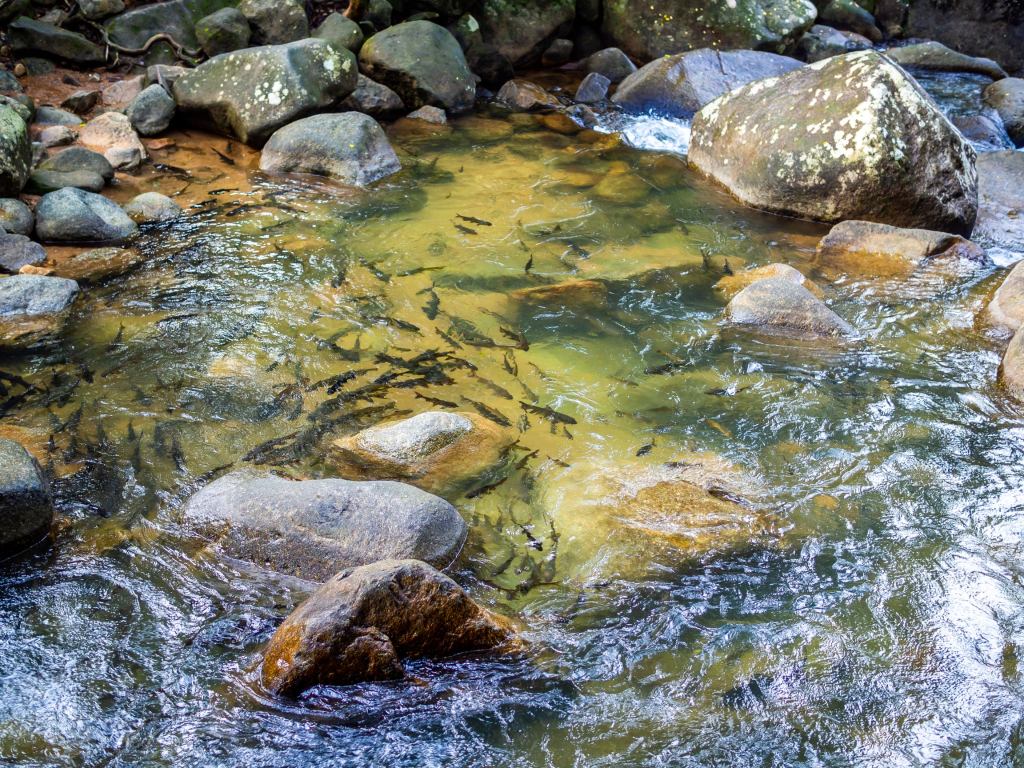
The freshwater ecosystems of Omkoi District support a variety of native fish species that contribute to local biodiversity and community livelihoods. Surveys conducted in streams and tributaries of the Wa River basin identified several native fish taxa belonging to multiple families, particularly the Cyprinidae family (Suvarnaraksha 2017).
Among the most ecologically and economically important species is the Thai brook trout (Neolissochilus stracheyi), locally known as “Pla Phluang”. This species is widely recognized as a native highland fish with significant potential for conservation-oriented aquaculture. In addition, several small cyprinid species have been reported, including Devario regina, Scaphiodonichthys burmanicus, and Rasbora paviana, which commonly inhabit headwater streams (Poldee 2013).
Catfish species belonging to the family Sisoridae, such as Glyptothorax trilineatus, Oreoglanis omkoiense, and Exostoma berdmorei, are also present in rocky stream habitats. These species are typically adapted to fast-flowing mountain streams and play important ecological roles in benthic food webs.
Other species recorded in the area include Schistura menanensis, a loach species adapted to shallow streams, and Channa gachua, a snakehead species capable of surviving in small pools and slow-moving waters.
As well, several aquaculture species have been introduced to improve food security for local communities. These include common carp (Cyprinus carpio), Thai silver barb (Barbonymus gonionotus), and mrigal carp (Cirrhinus cirrhosus), which are commonly cultured in polyculture pond systems to increase protein availability for rural households.
In summary, several native fish species have been recorded in freshwater streams of Omkoi District, Chiang Mai Province. These species belong to several families, including Cyprinidae, Sisoridae, Balitoridae, and Channidae. The most important native species observed in the area include Neolissochilus stracheyi, Devario regina, and Glyptothorax trilineatus. In addition, several cultured fish species such as Cyprinus carpio, Barbonymus gonionotus, and Cirrhinus cirrhosus have been introduced for aquaculture to improve food security in local communities.
Traditional Subsistence Fishing Practices
In many villages of Omkoi District, small-scale subsistence fishing remains an important activity for household food provision. Field observations indicate that freshwater fish collected from natural streams are primarily used for family consumption rather than commercial purposes. In several communities, women play a significant role in these fishing activities. Fish are often collected from nearby mountain streams during nighttime, when fish are easier to capture in shallow waters or along stream margins. Traditional fishing methods typically involve the use of simple tools such as hand nets, small traps, or baskets.
The fish harvested from these streams are generally small-sized species commonly found in headwater ecosystems. Typical catches include mountain loaches (Schistura spp.), bamboo danio (Devario regina), small cyprinids, and other benthic fish species that inhabit shallow rocky streams. These species are usually gathered in small quantities and prepared as daily household food. Although this fishing activity is mainly conducted for subsistence and reflects long-standing traditional practices, frequent harvesting of small-bodied fish species may affect local fish populations in small headwater streams where population sizes are relatively limited.
An understanding of these traditional fishing practices is important to the development of effective conservation strategies. As well, the recognition of the role of local community members, particularly of women, in subsistence fisheries can help integrate traditional ecological knowledge into community-based conservation programs. Such approaches can promote sustainable resource use, maintain cultural practices and improve food security for rural highland communities.
Threats to Native Fish Populations
Despite their ecological and socio-economic importance, native fish populations are increasingly threatened by a range of anthropogenic pressures.
Habitat Degradation: Deforestation and agricultural expansion represent two of the most serious threats to freshwater biodiversity, as they often lead to increased soil erosion and then to sediment accumulation in rivers and streams. Excessive sedimentation can cover spawning substrates and reduce habitat quality for aquatic organisms (Allan 2005). Furthermore, agricultural runoff containing fertilizers and pesticides can significantly degrade water quality. These contaminants may disrupt aquatic food webs and impair fish reproduction and growth.
Overfishing: Overexploitation of fish resources is another major factor which contributes to declining fish populations. In many rural areas, fishing is primarily conducted for household consumption. However, when fishing intensity exceeds the reproductive capacity of fish populations, long-term population declines may occur (Cowx 2002). Destructive fishing techniques such as electrofishing, poisoning, or blocking waterways can also cause severe ecological damage by eliminating juvenile fish and disrupting breeding cycles.
Non-Native Species: Introduction of non-native fish species can negatively impact native fish populations through competition for food and habitat, predation, and disease transmission. Invasive species often possess biological advantages that allow them to outcompete indigenous species, resulting in reduced biodiversity (Kottelat 2013).
Sustainable Utilization of Native Fish
Sustainable utilization refers to the responsible management of natural resources in ways that ensure their long-term availability while supporting human livelihoods (FAO 2020). In the context of freshwater fisheries, sustainable utilization aims to balance resource use with ecosystem conservation.
Community-Based Aquaculture: This has emerged as an effective strategy for improving food security while reducing pressure on natural fish stocks. By encouraging households to raise fish in small ponds, communities can produce a stable supply of protein throughout the year. In Omkoi District, training programs have been implemented to introduce villagers to basic aquaculture techniques such as pond preparation, feeding strategies, and fish breeding. These programs have enabled local households to cultivate fish for both household consumption and local markets (Suvarnaraksha 2017).
Polyculture System: In this system multiple fish species are raised within the same pond. This approach allows different species to exploit distinct ecological niches, thereby improving productivity and resource efficiency (Edwards 2015). For instance, herbivorous species can feed on aquatic vegetation while omnivorous species consume insects and organic matter. Such complementary feeding relationships enhance nutrient utilization and contribute to improved fish production.
Conservation-Oriented Aquaculture: Another important approach involves breeding native fish species for conservation purposes. Hatchery programs can produce juvenile fish that are subsequently released into natural waterways to replenish declining populations. This strategy not only supports biodiversity conservation but also provides opportunities for community involvement in resource management.
Conclusion
The integration of conservation and sustainable utilization strategies represents a promising approach for managing freshwater resources in rural highland regions. The experience of Omkoi District demonstrates that community-based aquaculture can effectively enhance food security and at the same time reduce pressure on natural fish populations: a typical case of balancing conservation objectives with socio-economic development.
However, successful implementation requires strong collaboration among local communities, researchers, and governmental agencies. Education, capacity building, and integration of traditional ecological knowledge are essential components of sustainable fisheries management.
Future conservation efforts should focus on strengthening habitat protection, improving aquaculture technologies for native species, and enhancing community engagement in resource management.

