By Paveena Tapaneeyaworawong, Maliwan Kutako, Patchari Yocawibun, Parichat Chumtong, Sirinart Techa, Kallaya Sritunyalucksana, and Sorawit Powtongsook
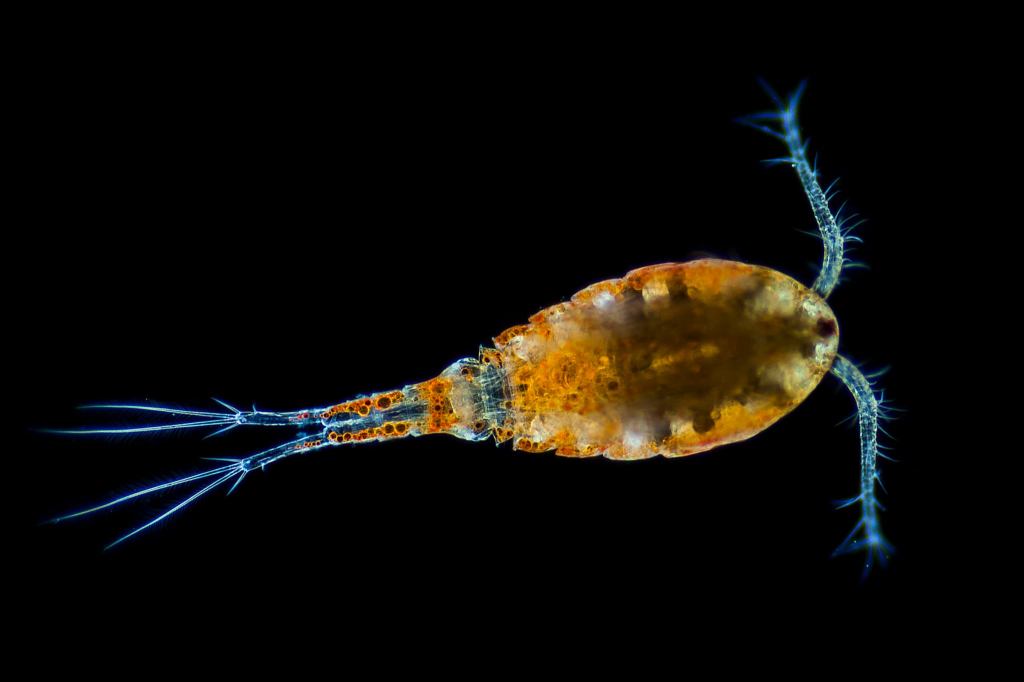
Copepods, small crustacean zooplankton, serve as a trophic link in aquatic ecosystems between primary producers, mainly phytoplankton, and higher-level consumers, such as small fish larvae. This important group is further subdivided into three major groups: calanoids, cyclopoids, and harpacticoids which are found in freshwater, brackish water, and marine environments. Copepods vary greatly in size, possess high nutritional value, tolerate salinity well, and adapt easily to environmental conditions, making them suitable for use in hatcheries and large-scale culture systems (Vasudevan 2013).
A particularly notable species in our research collection, Apocyclops royi, is a cyclopoid copepod native to Thailand that was first isolated from an irrigation canal in Chanthaburi Province. This species is rich in unsaturated fatty acids, synthesizes long-chain fatty acids from short-chain precursors, and therefore produces essential long-chain fatty acids on its own. A. royi grows in a broad size range, especially at the nauplius stage, measuring between 50 and 250 micrometers. In addition, A. royi has a short life cycle, with the nauplius stage lasting only 7-8 days before reaching adulthood.
Live feed is especially important in larviculture for economically valuable species such as grouper, which often experience low larval survival because newly hatched larvae have very small mouth openings and limited access to suitably sized food. Early-stage marine fish larvae generally require prey measuring about 50-100 micrometers. Because of its small size, A. royi is more suitable for rearing aquatic larvae than other commonly used live zooplankton feeds such as Artemia and rotifers (Perumal 2015).
In Thailand, rotifers and Artemia are commonly used as live zooplankton feed in fish and shrimp hatcheries. However, they are often too large for some fish larvae and may not provide enough key nutrients, particularly essential fatty acids (Sarkisian 2019). As a result, copepods are gaining research attention as an alternative live feed for the larval culture of economically important species such as grouper, seabass, and clownfish.
Preferring Copepods to Artemia
Hatchery-based marine larval rearing widely uses Artemia as live feed. However, it is costly, and its nutritional quality varies depending on harvest conditions. Artemia also lacks highly unsaturated fatty acids (HUFAs), which are essential for the growth and development of fish and shrimp larvae. It therefore must be enriched before use, adding to production costs.
In contrast, copepods provide key nutrients needed for larval development, especially HUFAs such as docosahexaenoic acid (DHA), eicosapentaenoic acid (EPA), and arachidonic acid (ARA), which are absent in rotifers and Artemia. Copepods can also synthesize these fatty acids naturally without enrichment (Ohs 2010), a trait uncommon in other live feeds. In addition to their high nutritional value and suitable size for larviculture (Perumal 2015), their jerky swimming behavior effectively stimulates feeding in carnivorous fish larvae.
Another advantage of copepods is their wide size range across developmental stages, from egg to nauplius to adult, which makes them a suitable feed for fish larvae at different growth phases. Nauplius-stage copepods are particularly useful at the start of exogenous feeding because they match the mouth gape of early-stage larvae and are easily digested (Juntarut 2015).
Researching Copepods in the Laboratory
At present, copepod culture is not widely adopted in Thailand’s aquaculture industry because of limited public knowledge and lack of simple, practical methods for farm-use and commercial production. Copepods are typically fed microalgae (phytoplankton) such as Tetraselmis sp., Chaetoceros, and Isochrysis sp. Providing sufficient feed and maintaining good water quality were the main constraints found during our research. In good quality water and with adequate feeding, copepods grow well and continuously produce nauplii.
Our research team previously cultured specific pathogen-free (SPF) A. royi in 150-liter tanks using the green microalga Tetraselmis suecica as feed. With sufficient feeding and water exchange, the culture reached densities of up to 20,000 A. royi individuals per liter. In our experiment, the rearing with A. royi of Asian seabass larvae from 6 to 21 days after hatching showed that copepods could effectively replace rotifers and Artemia. Larvae fed A. royi also had higher DHA levels than those fed rotifers and Artemia.
Furthermore, supported by Thailand Science Research and Innovation and the National Research Council of Thailand (NRCT), the research initiative “High density cultivation system of marine copepod Apocyclops royi AMBT201601 for specific pathogen free Asian sea bass larviculture” demonstrated that A. royi could be reliably produced on-farm with growth kinetics matching laboratory benchmarks.
Moving Copepod Production from Laboratory to Farm
A major challenge in large-scale open-pond copepod production is to maintain cultivation and at the same time control contamination by pathogenic microorganisms. This means that effective copepod culture requires closed systems with controlled environmental conditions, clean high-quality water, and adequate food supply. These requirements limit the adoption of copepod culture by fish hatchery farmers, in part because producing enough microalgae for copepod rearing remains somewhat difficult. In practice, farmers must manage both microalgae production and copepod culture at the same time, which increases operational complexity and labor demands. This is truly a challenge, but it can be met.
A promising option for copepod production is to use concentrated microalgae, which are batch-processed and stored for later use (Sales 2019). This reduces the need to culture fresh algae every day and therefore makes copepod production more practical and manageable. Concentrated algae can be prepared by centrifugation, filtration, or flocculation, and then stored under refrigeration. Previous studies have shown that they support copepod culture just as effectively as fresh algae.
Fostering Social Inclusion and Community Resilience
The successful transition of intensive copepod cultivation from controlled laboratory environments to active field trials marks a critical step toward democratizing aquaculture technology in Thailand. By proving the viability of localized, commercial-scale production, this model offers a robust solution to the persistent socio-economic vulnerabilities plaguing smallholder shrimp hatcheries and mud crab farms.
Crucially, low-intensity, high-density indoor systems eliminate the harsh physical labor and geographic isolation characteristic of traditional open-pond aquaculture. This structural accessibility creates viable avenues for a truly inclusive green economy; it directly positions rural women, elderly citizens, and individuals with limited mobility into high-value technological stewardship and decision-making roles.
As Thailand maneuvers through accelerating climatic and economic uncertainties, institutionalizing these community-managed live-feed systems provides a scalable blueprint for localized climate adaptation that simultaneously guarantees regional food security, safeguards smallholder livelihoods, and preserves the ecological integrity of coastal and inland watersheds.
Ensuring Thailand’s Future Larviculture
Shifting larval production away from low-quality imported frozen feeds and expensive, disease-prone, Artemia cysts directly eliminate external economic leakages, keeps operational capital within rural coastal economies and establishes an uninterrupted supply of biosecure, highly nutritious live feed.
However, further development of alternative copepod feeds is still needed, especially of products that are easy to use, affordable, and suitable for farm-scale production. Advancing these options would help support a continuous and sustainable copepod culture in the future.
In summary, copepod live feed has a strong potential to improve larval quality, biosecurity, and resilience to climate change in Thailand’s fish and shrimp larviculture.

