By Chea Sameang
Around the world, women are highly involved in aquaculture’s value chains but nevertheless face barriers in access to assets, agency, and leadership. Transformative gender‑responsive programs that provide training, group organization, and appropriate technologies could improve both their livelihoods and food security (St. Louis 2022; Adam 2024).
In Cambodia, women have played a vital but often constrained role in coastal livelihoods which are centered on mangroves and fisheries, but which intersect with integrated shrimp farming systems (Landesa). Women’s contributions support ecosystem health and family income, though social norms limit fuller participation. In the small‑scale aquaculture of southeastern and northeastern Cambodia, women perform most day‑to‑day farm tasks, such as feeding, pond management, marketing, and record‑keeping, and often contribute more than men to farm operations and household nutrition decisions (Seila 2016).
In marine finfish cage farming, women work at all value‑chain nodes as farmers, input suppliers, and traders, with a strong participation in local marketing, whereas men dominate in wholesaling and fishing for feed (i.e. “trash fish”) (Larson 2022).
For example, the impact of the Peam Krosoab Women Fisheries Processing Group (UN Cambodia 2024) where women were actively engaged in shrimp cultivation and production, extends beyond economic empowerment toward community recognition and reduced instances of domestic violence. These women’s engagement with shrimp cultivation and production helped tackle gender inequalities, served as a transformative force, and unlocked significant benefits across the entire value chain (UN Cambodia 2024).
Still, it has been unclear why barriers exist and what can be done to make women’s integration into Cambodian shrimp-mangrove systems more inclusive. This essay will attempt to analyze and introduce ways by which Cambodian women could participate and integrate into shrimp-mangrove systems that are productive and harmonious.
Aquaculture and a Gender Equity Gap to be Filled
Cambodia faced enormous economic hurdles in the early 2000s, such as widespread poverty, food insecurity, diminishing natural resources, and lack of agricultural and fishing technologies. However, the economy has improved tremendously since then, thanks in part to aquaculture development. For example, aquaculture output climbed from 14,430 tonnes in 2000 to 348,350 tonnes in 2021, with an annual growth rate of 16.37%, and is expected to reach 776,677 tonnes by 2030 (Lindgren 2025).
In Cambodia, aquaculture is classed as freshwater or marine, and is further categorized as small, medium, and large-scale (FAO Cambodia 2026). The primary techniques are cages, ponds, and pens. Several different freshwater aquaculture systems are used in over 20 provinces and cities. They include floating cage and pen culture, earthen pond culture, rice-fish co-culture, and other fish cultures in small water bodies or in aquaculture-based industrial fisheries. However, less development is focused on coastal aquaculture (Lang 2015). Aquaculture is in its infancy in Cambodia compared to other countries in the region.
As was stated previously, the role of women in the shrimp-mangrove system remains constrained when it needs to be enhanced. For example, in Cambodian wetland fisheries, women’s voices are strong in households but remain “nominal at best” in commune, district, and national‑level bodies due to unclear roles, resource constraints, and elite capture (Resurreccion 2006; Thuon 2023).
As well, women often face societal norms and perceptions that limit their participation in mangrove conservation. These norms can restrict women’s roles to domestic spheres, thereby reducing their visibility and influence in public conservation efforts (Thuon 2023). Institutionally, women lack clear and meaningful roles. Within mangrove conservation frameworks, leading to their minimal involvement in decision-making processes. As a result, Cambodia ranks 106th out of 148 countries on the World Economic Forum’s 2025 Global Gender Gap Index (WEF 2025).
However, a legal framework that recognizes the role of women in aquaculture is in place. For instance, the Strategic Planning Framework for Fisheries (SPF) 2015-2024, managed by the Ministry of Agriculture, Forestry and Fisheries (MAFF) and the Fisheries Administration (FiA), aims to ensure sustainable fisheries and aquaculture. This plan also seeks “to ensure that rural women play an active role in the sector and benefit equitably from it, and recognize the important roles played by women in fisheries” (FiA 2011). However, the implementation of such policies requires an understanding of specific value chains and the roles of young people, women and men in these value chains.
Mangrove-Shrimp Farming: A Winning Approach?
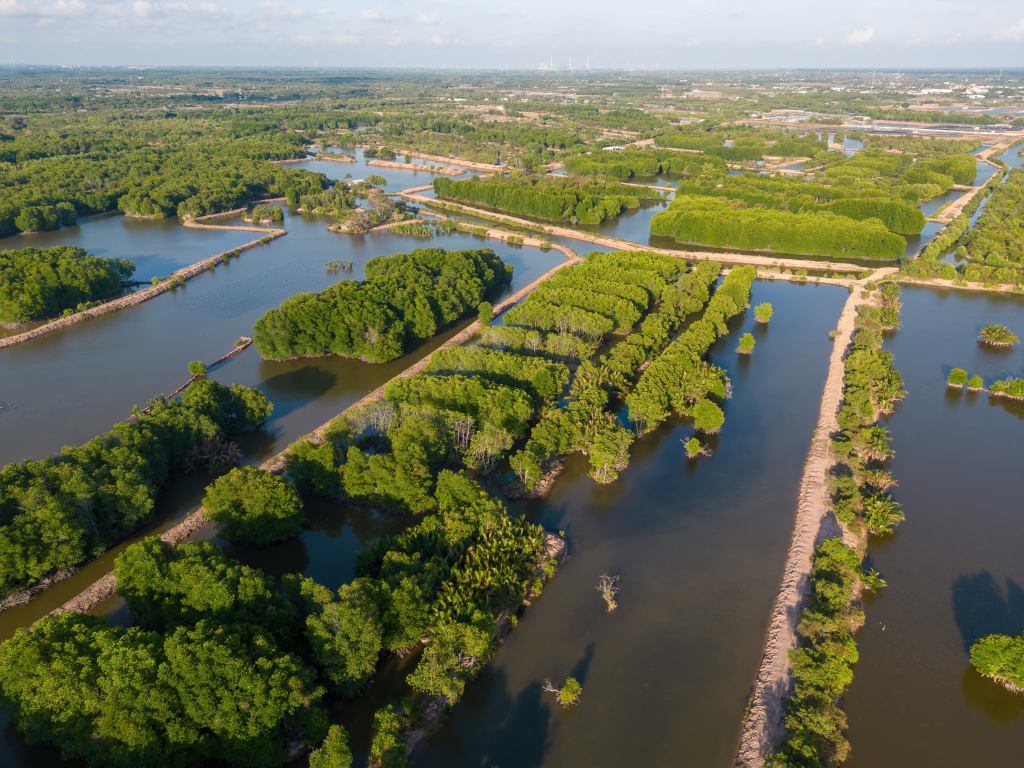
Mangrove-shrimp farming in Cambodia refers to large-scale aquaculture systems in which shrimp ponds are set within or close to mangrove forests. It takes place mainly in coastal provinces such as Koh Kong, Kampot, Kep, and Preah Sihanouk (Veettil 2019). Mangrove forests grow along Cambodia’s 440-kilometer coastline, which is spread across the four above-mentioned provinces (Nop 2017). Yet, mangroves are more than just plants or trees in the eyes of the Cambodian government and local communities. They not only enhance fish production, add economic benefits, and contribute to household incomes (Seary 2021), but they are also multifaceted tools for adapting to climate change (Lang 2015). Thus, mangroves hold significant ecological and economic resources because they provide protection against coastal erosion and serve as breeding grounds for fish, shellfish, birds, and shrimp.
Shrimp cultivation in Cambodia is smaller than in its neighbors Vietnam and Thailand, but it does have a distinct history along the country’s coastline and is periodically promoted within future aquaculture developments. However, shrimp cultivation has had a severe negative impact on mangrove habitats.
For example, Veettil (2019) concluded that the three main causes of mangrove forest destruction in Cambodia were salt farming, charcoal production and shrimp farming. As a result, the destruction of mangroves for shrimp ponds was identified, alongside salt production and charcoal, as a key driver of Cambodia’s 42% mangrove loss (1989-2017) in these four provinces. And because mangroves are carbon-rich forests, blue carbon emissions (i.e. carbon in coastal and marine ecosystems) have significantly increased as a result of this destruction of mangrove forests.
Nonetheless, the triple-win approach of integrated mangrove and shrimp farming, also known as organic aquaculture, has emerged as a promising solution to blue carbon emissions (Ahmed 2018). Globally, similar extensive “integrated mangrove aquaculture” (IMA) systems are promoted as sustainable, but are often found to compromise biodiversity and ecosystem services relative to intact mangroves and may even encourage further conversion if not tightly regulated (McSherry 2023).
In addition, a unique lesson is to be learned from a survey in Ca Mau Province, Vietnam. There, researchers surveyed 98 households. Their study found that integrating mangroves with shrimp farming in a mangrove-aquaculture system (MAS) provides multiple advantages. These include the highest benefit-cost ratio, lower investment costs making MAS suitable for low-income individuals, and additional economic and environmental benefits, such as carbon mitigation, all the while presenting less overall risk compared to other systems (Nguyen 2022).
Mangrove-Shrimp Farming: A Way Forward for Women
In the small-scale aquaculture of Cambodia, women contribute more than men across nearly all activities (Seila 2016). Thuon (2023) observed the increasing number of policies promoting women’s participation in resource management decision-making. However, the implementation of these policies remains inconsistent and ineffective at the commune, district, and national levels. This aligns with broader Cambodian patterns where aquaculture and fish culture are largely family-based and women’s labor is central but often undervalued (Joffre 2021).
Although women’s involvement in mangrove activities is still limited and underappreciated, women have a strong practical interest in mangrove preservation because mangrove ecosystems are integral to women’s daily lives. Crabs, shellfish, shrimps, and fish in shallow waters are among the mangrove-associated resources that many women in coastal community fisheries rely on to supply household food and income. For instance, according to a noteworthy case study, women on Koh Kapik Island demonstrated their strong commitment to protecting mangroves and mangrove nurseries and also shared their stories about how mangroves gave them and other women in the community a “source of income and independence” (IUCN 2025).
In addition, a 2024 report on “Gender in Community Fisheries and Mangroves Management in Cambodia” emphasized that women’s livelihood options in Community Fisheries (CFis) were more constrained than men’s, a situation which has a negative impact on women’s resilience to climate change. For this reason, government support is required to develop employment opportunities for women that fulfill their requirements and preferences (Landesa).
Interestingly, Nhem and Lee (2019) first proved and then recommended that Cambodian women must transition from passive resource users to empowered decision-makers. To achieve effective sustainable forest management, the study suggests that the “collective action” required will only be successful if women are integrated into leadership roles through capacity building, employment quotas, and increased participation in workshops and policy forums.
Conclusion
In terms of shrimp-mangrove farming in Cambodia, the existing evidence implies that women are key laborers, marketers, and household decision‑makers, but are poorly represented in formal farm, cooperative, and mangrove‑governance decisions. Designing farming systems to be equitable requires explicit inclusion of women in producer groups, co‑management institutions, training, and benefit‑sharing mechanisms. Furthermore, women play a crucial but often under-recognized role in protecting mangrove forests in Cambodia, acting as frontline stewards of coastal ecosystems through conservation activities, community advocacy, and transmission of local ecological knowledge.

