By Mai Kieu
In a coastal commune of Ca Mau’s Dong Hai district, Mr. Trinh Van Hoac stands by the edge of his shrimp ponds, watching the rhythmic churn of paddle aerators. For years, the hum of these machines was accompanied by a persistent anxiety: the rising cost of electricity.
With a 20,000 m2 farm, of which 3,000 m2 are used for two fish ponds, Mr. Hoac once faced monthly electricity bills averaging around 7 million VND (266 USD) and even exceeding 10 million VND (380 USD) during peak periods (Vietnamplus).
Now, the sun above his ponds does more than just provide light; it powers his livelihood.
Since installing a solar energy system, his monthly bills have plummeted, sometimes reaching as low as 3 million VND (114 USD). His case is a local testament to a broader national imperative: the integration of renewable energy into Vietnam’s booming aquaculture sector.
The Power Hunger of a Global Giant
Vietnam has established itself as a main player in the global seafood market, consistently ranking among the top three shrimp exporters in the world. In 2025, the nation’s shrimp export turnover reached a historic milestone of 4.6 billion USD (VASEP 2026).
This economic engine is centered primarily in the Mekong Delta, where farming methods are undergoing a rapid evolution toward semi-intensive and intensive systems.
Energy demand is a significant cost for the shrimp industry where most of the energy is consumed by water pumps and pond aerators that run 24h per day. Pond aeration constitutes about 80% of a farm’s electrical energy demand, while water pumping accounts for 10%, leaving other usages at 10% (Nguyen 2023).
For many farmers, reliance on the national grid and its associated annual price hikes results in high production costs.
Solar Potential
The Mekong Delta receives an abundance of sunlight, making it an ideal region for solar energy adoption.
Beyond the immediate benefit of reducing electricity bills by 40-50% for high-tech farms, the transition to solar is a strategic move for international trade as global consumers and regulatory bodies increasingly demand sustainable products (Vietnamplus).
Using renewable energy is now a key criterion for obtaining prestigious certifications such as those awarded by the Aquaculture Stewardship Council (ASC) and Best Aquaculture Practices (BAP). These labels act as passports for Vietnamese shrimp, allowing them to enter premium markets that prioritize environmental protection.
Power and Shade
Research has also uncovered surprising biological benefits to solar integration. A pilot project conducted by the Ca Mau Renewable Energy Investment Joint Stock Company (CMC) in the Dam Doi district provides a compelling case study (Baocamau 2024).
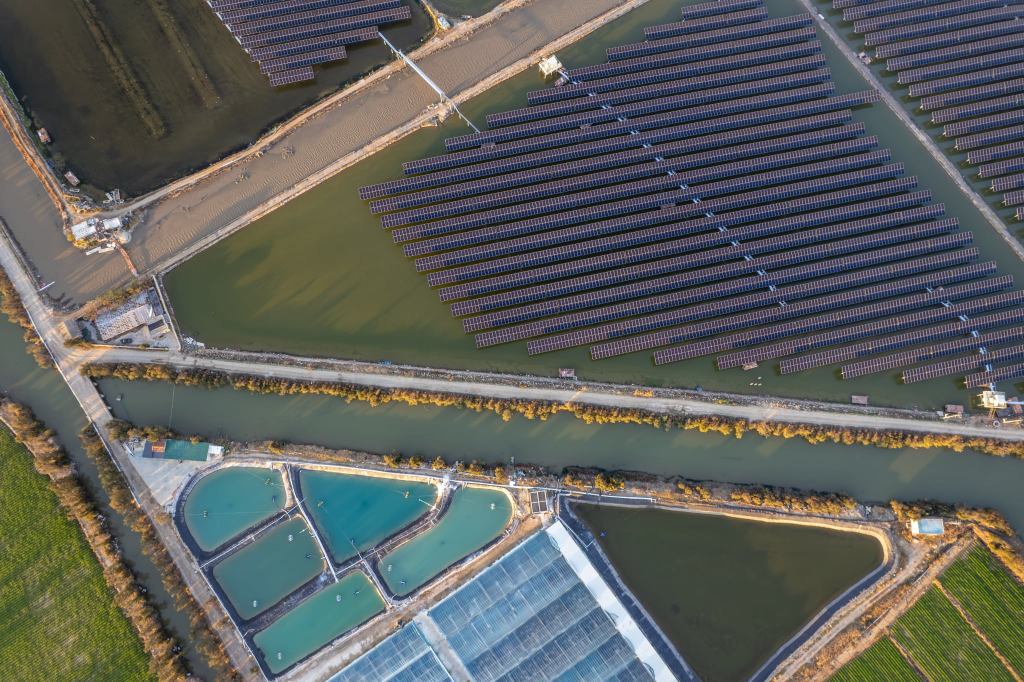
The project compared two shrimp ponds: one covered with solar panels for 40% of its area and a control pond without solar panel cover. Over a year of testing, the solar-covered pond outperformed the open one, yielding nearly 230 kg/ha/year compared to about 212 kg/ha/year.
The reason lies in environmental stability. The solar panels acted as a shield during periods of intense heat, keeping the water temperature lower by 1-2 degrees and reducing salinity levels compared to the open pond.
As climate change brings increasingly hot and dry seasons in the Mekong Delta, these panels provide a vital shade sanctuary for the shrimp, protecting them from heat stress and reducing water evaporation. This stability ensures faster growth and higher survival rates, proving that green energy can also be profitable energy.
How the System Operates: From Sunlight to Dissolved Oxygen
To understand why this model is effective, let’s take a look at the technical synergy between solar technology and aquaculture engineering. Several optimal designs of these systems have either been deployed or recommended.
The Integrated Greenhouse Model
In advanced facilities, such as the shrimp breeding research station in Ca Mau province (a project involving the Fraunhofer Institute for Solar Energy Systems), solar modules are installed directly onto the roofs of the shrimp greenhouses.
This dual-use approach optimizes land use, by producing food and energy on the same footprint. The panels capture solar radiation, which is then converted into electricity through an inverter system to power the farm’s entire infrastructure, including pumps, lights, and automated feeding systems (INS 2025).
The Smart Floating Aerator
Specific innovations have led to the creation of specialized solar-powered aeration machines.
These systems utilize PV panels that collect sunlight and convert it into electrical energy, which is then stored in a high-capacity battery system (Huynh 2022). This storage is crucial, as it allows the system to continue operating at night when oxygen demand in the pond is often at its highest.
The stored power drives a 24 VDC (Volts Direct Current) electric motor, which in turn operates a chain drive system connected to a propeller shaft. As the shaft rotates, the propellers stir the water vigorously, facilitating the transfer of oxygen from the air into the water.
Modern versions of these machines are smart as they include a Bluetooth module that communicates with a smartphone app. This allows farmers to remotely monitor voltage levels, charge status, and discharge rate, as well as to turn the aerators on or off with a simple tap on their screen.
The Hybrid Islanded System
For farms in remote coastal areas where the national grid is unstable or non-existent, researchers have proposed islanded systems (Nhut 2019).
These are sophisticated mini-grids that combine solar PV arrays with wind turbines, supported by battery storage and backup diesel generators. This configuration ensures 100% energy self-sufficiency with the lowest possible environmental impact.
Some advanced concepts even suggest using solar power to run electrolyzers that produce pure oxygen onsite. This is then injected into the ponds, a method far more efficient than traditional mechanical stirring.
Navigating the Bottlenecks
Despite its clear economic and environmental advantages, the solar-shrimp model faces several significant bottlenecks that prevent it from reaching its full potential.
The most prominent barrier is the high initial investment cost. For a small-scale farmer, the cost of high-quality panels and battery storage systems can be prohibitive. Mr. Hoac, for instance, was only able to adopt the technology because an international NGO subsidized 70% of his costs (Vietnamplus). Without such support, many farmers find it impossible to secure the necessary capital, especially since local banks often require strict collateral for loans.
Furthermore, there is a technical and regulatory mismatch. The current national grid, in many areas, is unable to handle the surplus power generated by large-scale solar installations, which means farmers cannot always sell excess energy back to the grid to recoup their investment.
Additionally, many early-stage projects suffered from poor planning. In these, the focus was placed entirely on the solar installation without properly integrating it into the specific operational needs of the shrimp farm, leading to inefficiencies.
A Roadmap for the Future
To transform these pilot successes into a national standard, several steps must be taken. First, the government needs to establish clear, unified incentive policies that specifically encourage the use of renewable energy in aquaculture. This means streamlining the legal framework for dual-use land and improving grid infrastructure to allow for better energy distribution.
Second, financial institutions should be encouraged to create green credit packages. Through recognizing solar panels and resulting future energy savings as a form of soft collateral, banks could unlock the capital needed for thousands of smallholders to transition.
Finally, technical design must be holistic. As seen in the Dong Hai and Ca Mau projects, the best results come when solar systems are designed from day one to enhance the shrimp’s environment, by stabilizing temperatures and providing shade, rather than just being an add-on power source.
The experience of farmers like Mr. Hoac proves that through applying innovative technology to practical farm needs, Vietnam can ensure that its shrimp industry remains a global leader, not just in volume, but in sustainability and resilience. The green shrimp of the Mekong Delta need no longer be a pipe dream; they then become a working reality, one solar panel at a time.

