By Tran Duc Thinh
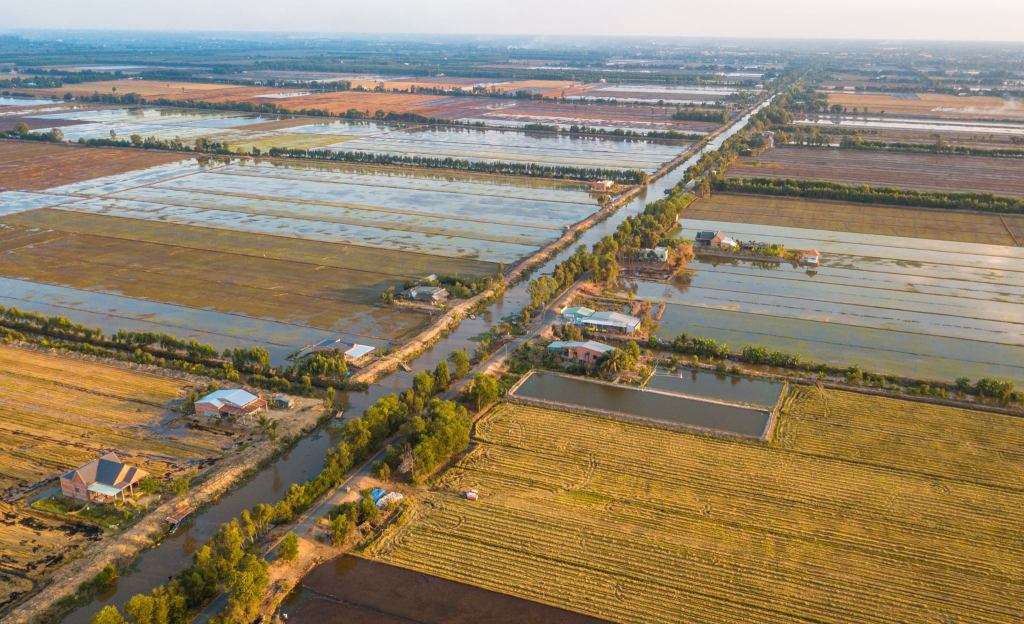
An increasingly evident paradox lies in the way the world speaks about climate change adaptation. While international forums continue to prioritize large-scale, costly, and technically complex solutions, many farming households in the Mekong Delta adapt through a decision that appears remarkably simple: to open sluice gates and allow saline water into rice fields. Their decision is not merely a technical adjustment but also illustrates a different way of looking at the relationship between humans and the environment (Smajgl 2015). And their choice makes a real difference because the Mekong Delta is one of the regions most severely affected by climate change.
Adaptation is at the core of the rice-shrimp model: instead of maintaining rice cultivation at all costs, the system accepts that fluctuations in natural conditions are an inseparable part of production. Saline intrusion is then not a “risk” to be eliminated, but an ecological signal that must be read and acted upon. This is precisely where this local model converges with the core principles of Nature-based Solutions (NbS), even though it emerged from on-the-ground practice rather than from academic conceptual frameworks.
This essay does not propose the rice-shrimp model as a “formula” that can be applied everywhere. Its objective is to analyze why such a local practice embodies many of the principles that contemporary NbS programs put forward, and to draw implications for an environmentally friendly aquaculture policy in the Mekong Delta.
When Local Knowledge Is Overlooked in Nature-based Solutions
In many current NbS programs, environmental problems are identified through scientific analysis, technical interventions are standardized, and success is measured through quantitative indicators. This approach has clear operational advantages, but it also contains a fundamental limitation: it separates solutions from the specific social and ecological contexts in which they are implemented.
The rice-shrimp model operates differently: the system is not designed from a comprehensive technical blueprint, but has gradually evolved through years of farmers’ observation, experimentation, and adjustment in response to environmental changes. Seasonal cycles of salinity and freshwater, tidal water levels, timing of the wet, dry and flood seasons are all integrated into annual production decisions. It is precisely this flexibility that allows the rice-shrimp system to achieve higher levels of sustainability than monoculture models. What matters is not only the outcome, but also the mechanism: resilience comes from learning how to operate under conditions of variability, not from trying to minimize that variability (Dang 2020).
However, in many NbS projects, such knowledge is not properly recognized. When external experts approach communities, local experience is easily reduced to “traditional practices,” whereas scientific knowledge is regarded as the primary legitimate source. As a result, solutions labeled as “nature-based” are implemented in ways that weaken the long-standing relationships between people and ecosystems. Therein lies the paradox at the very root of NbS.
Biodiversity and Livelihoods: An Underestimated Foundation
A defining characteristic of the rice-shrimp model is the high level of diversity within the system not only in the simultaneous presence of rice and shrimp but also in the complex biological network of wild fish, crabs, soil microorganisms, and different groups of phytoplankton. This diverse structure creates a capacity for self-regulation in response to environmental shocks.
Most of the energy and nutrients come from natural food chains within the fields rather than from industrial feed. This reduces input costs, limits water pollution, and lowers disease risks (Burford 2004). A separate study on phytoplankton diversity in rice-shrimp systems in Soc Trang also found relatively stable water quality and ecological structure, reflecting an ecosystem capable of maintaining internal balance (Nam 2022).
At the livelihood level, diversity carries a similar meaning. Combining multiple income sources within a single system helps farming households reduce dependence on any single product. This is particularly important as agricultural markets become increasingly volatile and climatic conditions more unpredictable. The rice-shrimp model therefore functions both as an ecological solution and as a livelihood risk-management strategy.
Gender Equality: A Structural Component of Resilience
In most development programs, gender equality is incorporated as an additional social criterion through participation targets or capacity-building activities. However, it remains detached from core technical and ecological objectives. Experience from rice-shrimp systems shows the opposite.
In actual production practices, women often play a central role in day-to-day operational decisions: monitoring salinity, water quality, and shrimp growth; handling post-harvest processing; managing cash flows; and maintaining market relationships. These high-frequency decisions require continuous observation and flexible adjustment, and they have direct impacts on the ecological condition of the system. As climate change increases uncertainty, it is precisely this capacity for timely adjustment rather than long-term strategic decisions that determines system resilience.
These findings indicate that gender equality in NbS cannot simply be understood as a matter of social justice or policy obligation. It must be recognized as a core technical or institutional element that fosters resilience. When women’s knowledge and decision-making roles are marginalized, even well-designed technical solutions risk becoming less effective because they ignore a critical part of the actual decision-making system. In the Mekong Delta, where small-scale production systems dominate, gender equality is a foundational condition for NbS to be truly sustainable and scalable.
Scaling Up: Between Policy Demands and Ecological Limits
The success of the rice-shrimp system raises a familiar structural question: how can the model be scaled up without ruining the core characteristics that made it successful in the first place? A common policy response is to standardize the model and transform it into a “technical package” with predefined inputs and outputs. This approach may work in industrial production, but it faces clear limitations when applied to complex social-ecological systems. The very process of standardization can undermine flexibility and adaptive capacity, which are precisely the foundations of the model.
The main challenges do not lie in a lack of financial resources or technical capacity, but more deeply in institutional frameworks and policy approaches. When the model is applied as a fixed solution, its ability to adjust to local conditions is significantly constrained. At the same time, farmers’ indigenous knowledge and accumulated experience are gradually replaced by standardized procedures imposed from outside (Nhuong 2025).
An alternative approach can be seen in participatory selection programs for salt-tolerant rice varieties. These programs do not seek a single “optimal” variety for the entire region, but instead create space for experimentation and adjustment based on the specific conditions of each agro-ecological sub-region. This flexible approach helps maintain biodiversity, reduce risk, and enhance adaptive capacity; principles that align closely with NbS (Tin 2021).
This suggests that scaling up NbS should not simply mean replicating a particular model, but allowing models to adapt to local contexts. Rather than imposing a uniform template, policy needs to create institutional space for diversity, experimentation, and continuous learning.
From “Solutions” to “Relationships”
The rice-shrimp system forces us to reconsider the common understanding of “solutions” within the NbS framework. Climate change and ecological degradation are not problems that can be resolved once and for all through a single intervention. They are cumulative and non-linear processes that require continuous adaptive relationships between humans and the natural environment. In this Delta, where sea-level rise, saline intrusion, and land subsidence occur simultaneously and interact, approaches based on controlling and stabilizing nature increasingly reveal their limitations (Smajgl 2015).
More importantly, the rice-shrimp system shows that NbS are not only about relationships between humans and nature, but also about relationships among people through local institutions, knowledge networks, and forms of social cooperation. The system’s adaptive capacity depends on whether these relationships are maintained and strengthened. When development programs focus solely on technical outputs while overlooking this social foundation, NbS risk being reduced to formalistic “solutions” lacking long-term adaptive capacity.
Conclusion: From Technical Models to Adaptive Capacity
Analysis of the rice-shrimp system in the Mekong Delta reveals three core lessons. First, resilience does not lie in optimizing a fixed production state, but in the capacity to continuously adjust among different ecological states. Second, the greatest challenges in scaling up do not lie in technology or resources, but in policy and institutional approaches: excessive standardization risks eroding the very factors that made the model successful. Third, gender equality is not a supplementary factor but a fundamental component of resilience. When women’s knowledge and decision-making roles are recognized, system adaptability improves markedly.
The normative conclusion from these analyses is that NbS policy should focus not on identifying or replicating an “optimal solution,” but on creating and maintaining social and ecological relationships that allow systems to learn, adjust, and adapt over time. Recognizing and valuing these ecosystem services is an indispensable foundation for a sustainable policy.
In a Mekong Delta that is changing rapidly and unpredictably, adaptive capacity does not come from better control of nature, but from the ability to live with change through flexible, equitable, and self-adjusting relationships. This is the core message that the Mekong Delta’s rice-shrimp system contributes to broader discussions on nature-based solutions in the twenty-first century.
 AQUADAPT