By Pham Nguyen Tuan An
As the last rays of sun fall over the orange groves in Vinh Xuan commune, Vinh Long province, Mr. Pham Van Toan (74) stands quietly in his small garden. A veteran who walks with a permanent limp due to war wounds, Mr. Toan represents thousands of people with disabilities (PWDs) in the Mekong Delta who remain on the periphery of the region’s economic engine: aquaculture. Although the industry offers significantly higher profits than gardening, its physical, infrastructural, and mechanical barriers have ensured that the door remains firmly shut for people like him.
This reality points to a troubling “blind spot” in policy governance and development planning. In the story of Vietnam’s surging aquaculture growth, people with disabilities are almost invisible.
When ‘Safety First’ Acts as a Barrier
The absence of PWDs in the aquaculture sector does not stem merely from physical limitations or harsh working conditions. It is rooted more deeply in long-standing stereotypical views about PWDs’ capacity to work.
A study on employment support for PWDs in Vietnam showed that livelihood programs tended to steer them toward occupations considered “safe” and easier to manage, such as handicrafts, tailoring, embroidery, massage, or home-based work. By contrast, sectors tied to production, agriculture, aquaculture, and outdoor labor received far less favorable attention in formal support programs, partly due to barriers in the infrastructure, limited resources, social perceptions, and persistent assumptions about the capacities of PWDs (GIZ 2019).
According to the 2023 National Survey on PWDs, the employment rate for PWDs of working age is only 23.5%, starkly lower than that for people without disabilities at 76.3%. Ironically, the Mekong Delta, the country’s largest aquaculture hub, is also the region with the highest disability rate at 7.54% for people aged 2 and over.
Mrs. Nguyen Thi Minh, who has spent over 20 years working in social affairs in Vinh Long, notes that most livelihood programs prioritize “safe” jobs with low physical demands.
“Aquaculture is tied to water, machinery, and numerous risks, so local officials are often hesitant to encourage PWDs to participate. Consequently, support models usually revolve around sewing or weaving to ensure their safety,” she explains.
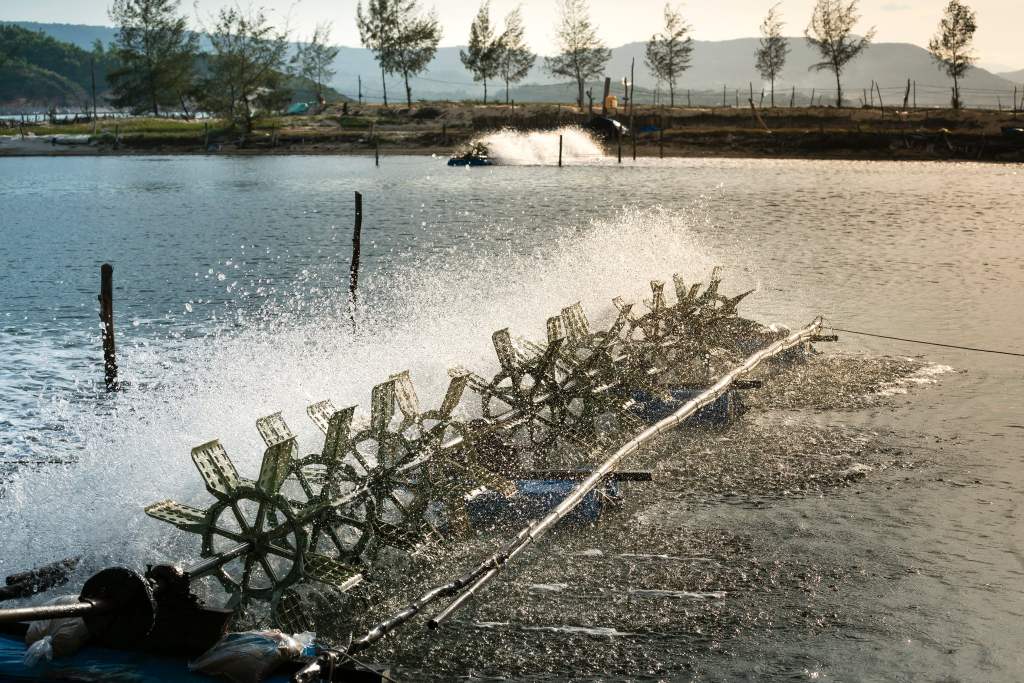
This concern is not unfounded; it is reinforced by reality. Narrow, muddy pond banks and electrical aeration systems operating continuously in water pose constant risks of serious accidents. Throughout Vietnam, labor accidents related to aerators in intensive ponds are a recurring tragedy (Dong 2018; Luy 2020; Da 2022). However, rather than asking how to make the working environment more accessible, most policies simply exclude PWDs from the “game” altogether.
This exclusion extends to the media. Mrs. Mai Ngoc, a journalist with 10 years of experience covering environment and sustainability, admits that PWDs in aquaculture were once a “blind spot” in her professional mindset.
“We only have the authority to reflect what exists, not to proactively create reality,” she says. “The lack of PWDs in this field means the media cannot tell their stories. From there, society assumes they don’t belong in that sector. It’s a cycle”.
A Nature-Based Route to Inclusion
All is not lost. Nature-based Solutions (NbS) offer a different path. Unlike intensive systems that rely heavily on machinery and grueling physical labor, NbS systems like the shrimp-forest or rice-fish systems operate more in tune with natural ecological cycles. These systems reduce physical pressures and expands opportunities for diverse groups of workers.
In these systems, a farmer’s value is no longer measured by muscle alone, but by his or her keen observation, local experience, and environmental understanding. This is exactly what Mr. Pham Van Toan thinks about when he looks at the ponds surrounding him.
“Since I was young, I’ve only dared to stay in the orchard. With my injured leg, how could I carry sacks of feed or run those loud machines by the pond? But if there was a way to work that was less dependent on physical strength, I think I could still do it. I’ve lived here for decades; I understand the tides and the soil better than anyone,” he shares.
Mr. Toan’s story suggests that what PWDs lack is often not a capacity for work, but a production system designed for their inclusion. Successful examples prove this: Mr. Chu Ngoc De, a veteran who lost part of his left arm at work, earns with his family over 100 million VND (3,800 USD) annually after expenses, farming tiger shrimp and raising crabs and seaweed; he also serves as Vice Director of the Hoang Phu Cooperative which in late 2024 had 730 members. In Nghe An, Mr. Hoang Kim Vi, despite a leg disability, launched a successful ecological poultry and goat livestock project which won him two entrepreneurship awards in a Provincial Youth Union competition (Nghe An 2023; Hoa 2024).
Change Is on the Way
The issue remains that, regarding PWDs, Vietnam has yet to truly shift from a “charity” mindset to an “investment” mindset, which at some point it will have to do. As the aquaculture industry faces labor shortages due to urban migration, ignoring the rural PWD workforce would be a significant waste of social resources.
It is clear that things have to change. Inclusion policies must go beyond symbolic gestures. Aquaculture infrastructure needs to be designed for accessibility with safe walkways around ponds and automated control systems for the aerators. Preferential credit programs should offer specific packages to households with PWDs so they can invest in nature-based production systems, rather than just provide minimal monthly allowances.
More importantly, the media must change how it tells their stories. PWDs should not appear merely as “overcoming adversity” figures, but as productive agents who master technology and indigenous knowledge. Only when social inclusion is viewed as a core component of environmental governance will the “invisible barriers” surrounding fish and shrimp ponds finally be dismantled.

