By Tran Duc Thinh
There is a particular hour in the Mekong Delta, just after the tide turns, when the canals fill and the ponds along them begin to breathe. It is usually a woman who is out first, checking the water color, deciding whether to open the sluice gate. She has done this since dawn broke, and she will do it again tomorrow. Ask who owns the pond, though, and the usual answer is her husband’s name, the one on the land-use certificate. This is worth pausing on, because the law does not actually require this. Vietnam’s land legislation has, for well over a decade, stated the opposite. The gap between what the certificate says and what the law says is, in miniature, the story of women in Vietnam’s aquaculture economy: not an absence of rights, but a persistent failure to exercise the rights already granted.
A Sector Transformed, a Landscape Under Strain
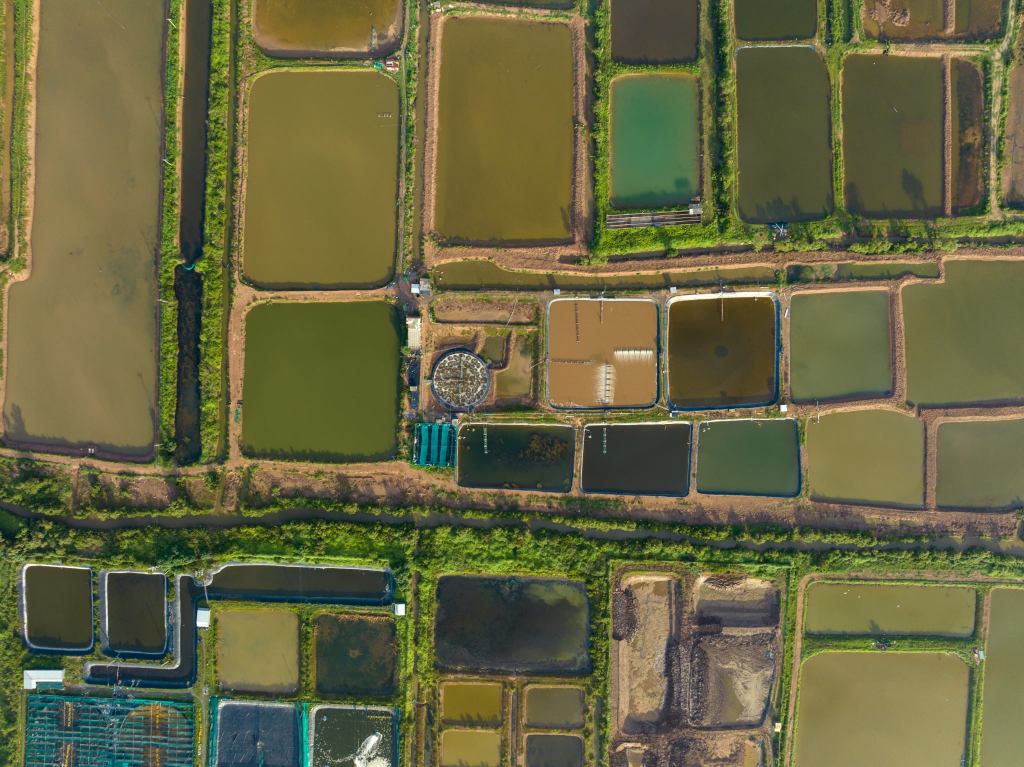
Three or four decades ago, aquaculture along the Mekong Delta was still, in many communities, a supplementary activity: a household dug a pond beside its rice field, half as hobby and half as hedge against a bad rice season. Today is a different story. Brackish-water shrimp farming now makes up a large share of the Delta’s aquaculture area, and the region hosts thousands of hatcheries and hundreds of processing plants feeding export markets in the United States, the European Union, and Japan. What was once a household sideline has become, in many provinces, not only the primary source of cash income, but also the primary source of financial risk.
That risk is compounding. Rising sea levels and reduced upstream flow have deepened dry-season salinity intrusion across the delta. Under a modest 50-centimeter sea-level-rise scenario, roughly 180,000 hectares of shrimp-farming area are projected to face increased salinity, forcing farmers to adjust stocking calendars and infrastructure (Kam 2016). The 2015-2016 drought was a preview of what this looks like in a bad year: nine of the Delta’s thirteen provinces suffered severe salinity intrusion, and close to 79,000 hectares of aquaculture, mostly brackish shrimp, were affected (Apel 2020). Farmers with capital moved quickly into intensive shrimp systems; farmers without it were left running lower-return, higher-risk traditional rotations. As well, working-aged men increasingly migrated to industrial zones for wage labor and left the day-to-day pond management, that is feeding schedules, water-quality checks, and disease monitoring, to those who remained at home. That, overwhelmingly, meant women.
A Role That Was Never Absent, Only Unacknowledged
It would be inaccurate to say women “entered” aquaculture recently. What has shifted is their visibility. Research on Vietnam’s fish-farming regions describes a striking north-south divergence. In northern Vietnam, women have moved into nearly every stage of production, including owning and managing hatcheries, while in the south a cultural taboo still keeps women out of hatchery work even as they own and run farms and processing businesses in large numbers (Bosma 2019). This pattern repeats itself globally in a more familiar shape: men tend to dominate pond preparation and stocking, while women concentrate in harvesting, post-harvest handling, processing, and marketing, i.e. at the labor-intensive, lower-margin end of the chain (Kruijssen 2018).
The land certificate is where this role separation becomes structural rather than anecdotal. Since the 2013 Land Law and reaffirmed without substantive change in the 2024 Land Law, any land-use right that constitutes joint marital property must, by default, carry both spouses’ names on the certificate (Land Law No. 31/2024/QH15, Art. 135). A couple may agree to name a single representative instead, but that is an opt-out, not a rule. In other words, the entitlement to be recognized as a co-holder of the pond has existed on paper for over a decade. What has not caught up is registration practice: certificates issued before the legislation, informal renewals that default to whichever name was already there, and a lingering assumption at the commune level that the “Household Head,” meaning head of household, is the man, even when he is the one absent, working in an industrial zone two provinces away.
At the global scale, this underlying asymmetry holds regardless of the legal architecture: women make up an estimated 24 percent of the primary fisheries and aquaculture workforce but 62 percent of the post-harvest, processing workforce, precisely the segment that captures the least value and offers the least job security (FAO 2024). This is not, at its root, a story of exclusion by law. It is a story of position: women are present everywhere in the chain, just rarely at the nodes where prices are set, credit is approved, or certificates are issued, even where the rules no longer bar them from those roles.
Three Pressures Converge on the Same Shoulders
The obstacles facing women in this sector rarely arrive one at a time. Three tend to compound, and the third is the one that quietly overrides the other two.
Climate volatility falls hardest on those with the least capacity to absorb a bad season. Household-level research in the Delta’s shrimp-farming areas consistently finds lower adaptive capacity there than in diversified rice systems, largely a function of weaker access to financial capital and formal government support (Trang 2025).
Shifting farming practices, such as the move from extensive to intensive shrimp systems or from rice-fish rotation to year-round brackish culture, raise the capital threshold for entry just as they raise the returns. And, sure enough, it is credit-constrained households that get pushed toward the lower-capital, lower-return end of these transitions.
The third pressure is the one that determines who absorbs the first two: whose name is on the paperwork. Vietnam’s agricultural credit framework is, on the face of it, gender-neutral and reasonably generous. Under a 2025 decree effective 1 July 2025, individuals and households can access collateral-free loans of up to VND 300 million (USD 11,500), cooperatives and cooperative unions up to VND 5 billion (USD 191,350), a substantial increase from the ceilings set a decade earlier (Decree No. 156/2025/ND-CP). Since 2003, the Vietnam Women’s Union has held the largest entrusted-lending relationship with the Bank for Social Policies of any mass organization in the country, channeling collateral-free credit to women through village-level Savings and Credit Groups (Decree No. 78/2002/ND-CP; Vietnam Women’s Union 2026). Neither instrument names a man as the default applicant. But a household loan is, in practice, applied for by whoever is registered as its head, and that registration still defaults, informally, to the man’s name far more often than the formal rules require. The credit ceiling raised on paper changes little if the person managing the pond is not the person that the bank’s file recognizes as eligible to borrow against it.
Cooperative governance follows the same pattern. Vietnam’s 2023 Law on Cooperatives states plainly that membership must not discriminate on the basis of sex, and that democratic participation in a cooperative’s management is guaranteed regardless of the size of a member’s capital contribution: a member’s vote does not scale with how much he or she have invested (Law on Cooperatives No. 17/2023/QH15, Art. 8). On paper, this should make cooperatives one of the more equal spaces in the value chain. In practice, leadership nomination still tends to follow informal seniority and visibility rather than the one-member-one-vote principle which the law actually guarantees, and women, who are concentrated, as noted above, in processing and marketing rather than in “core” production roles that attract nomination, are proposed for leadership far less often than the law permits.
Stack these obstacles together and a pattern emerges that is easy to miss if you look at any single farm: the woman managing a pond day-to-day is often the same woman who could, by law, co-hold its title, borrow against it without collateral, and vote as an equal in her cooperative. But she does none of these things, not because the door is closed, but because no one has told her, or the loan officer, or the cooperative’s nominating committee, that it is open.
What It Costs To Leave This Unaddressed
It is tempting to frame this purely as a fairness issue, and it is one. But treating it only as a fairness issue understates the stakes, and misdiagnoses where the fix needs to happen. This is not primarily a case of missing rights that need to be legislated into existence. It is a case of granted rights sitting unused. This means the cost of inaction is not the cost of an absent policy but is the cost of policy that has already been paid for, in legislative time and institutional design, and is not being drawn on.
That cost shows up first in adaptive capacity. A workforce excluded in practice from credit and decision-making adapts more slowly, and, in a sector exposed to salinity intrusion, disease outbreaks and volatile export markets, slow adaptation means lost ponds and wasted seasons. When the people who spend the most hours observing pond conditions have no standing to act on what they see, no title to borrow against and no vote that counts, farms lose access to exactly the frontline knowledge that early adaptation depends on.
Left uncorrected, this dynamic does not stay confined to individual households. It compounds into slower productivity growth for the sector, weaker resilience to the salinity and temperature shocks already documented across the Delta, and, at the household level, economic fragility that pushes yet more working-age members toward migration, further hollowing out the labor base the sector depends on. Instability, in other words, does not stop at the edge of the pond, and it is happening despite a legal architecture that was already built, on paper, to prevent it.
Toward a More Substantive Form of Inclusion
None of these problems call for a new declaration about women’s importance. Nor do they, in the main, call for new laws either. What is missing is the harder, more specific work of closing the gap between entitlement and practice at the point where paperwork gets filled out.
That starts with land registration drives at commune level. These, timed to coincide with certificate renewals or land-use plan updates, should actively apply the existing joint-titling rule rather than defaulting to whichever name is already on file. This means treating joint registration as the default outcome it is meant to be, not a request a wife has to make. It continues with credit officers and Women’s Union chapters explicitly linking loan eligibility to joint household registration, so that the current collateral-free ceiling is accessible to the person running the pond, not only to the person listed as household head. It requires cooperatives to treat their non-discrimination and equal-vote provisions as an operating instruction, not a preamble, which means deliberately nominating women for leadership and oversight positions in proportion to their actual participation in the value chain, rather than assuming that equal voting rights will translate into equal representation on their own. And it requires that sector-level gender action plans move past general commitments toward funded, monitored and accountable targets. This is a gap that research on Vietnam’s own sectoral gender plans has already identified as their weakest point (Bosma 2019).
None of this is radical. None of it requires a new ministry, more legislation, or another enquiry. The solution is more or less a question of bookkeeping: making the paperwork catch up to the legal position that has, in most of the respects that matter, already been settled. The women managing ponds, negotiating with buyers, and holding processing lines together at five in the morning are not waiting to be granted a place in the aquaculture economy. The law, in its own terms, already grants it. The unfinished task is simply to make sure the certificate, the loan file, and the cooperative’s membership roll say what the statute books already do, not as a favor extended to women but as the most direct route available to a sector that will need every ounce of adaptive capacity it can gather, from everyone already doing the work.

