By Dr. Krittima Kasamawut and Dr. Praneet Ngamsnae
Freshwater ecosystems constitute an important foundation for food security, biodiversity conservation, and livelihoods of rural communities, particularly for those which depend on rivers, wetlands, ponds, and reservoirs. Native fish resources therefore possess ecological, economic, and social values. However, the harvesting of commercially valuable species through reliance primarily on wild capture can increase pressure on natural populations and result in unstable production volumes and inconsistent product quality.
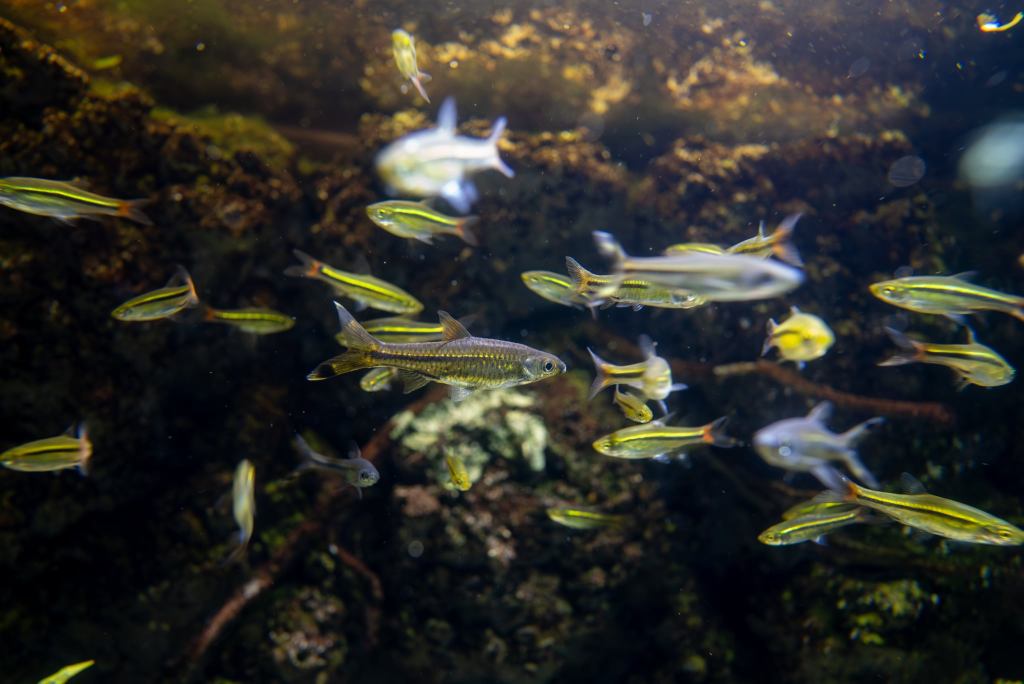
This observation applies in particular to the Scissortail Rasbora (Rasbora trilineata), a native freshwater fish in Thailand. Its distinctive body shape, coloration, and schooling behavior make it a promising candidate for development as an ornamental fish for both domestic and international markets. Thailand’s Surin Province is one of the areas where this species occurs naturally in several freshwater habitats. Surin also happens to be the home ground of researcher Kasamawut (2024) who investigated broodstock collection, reproductive biology, and adaptation to captive culture systems.
The key issue in this particular case is not simply to increase production, but to transform a native fish resource into an economic resource without degrading its natural resource base or biodiversity. Kasamawut’s study demonstrated that the life cycle of the Scissortail Rasbora can be maintained under captive culture without continued dependence on wild broodstock. This achievement of the domestication process outlined by Kasamawut (2024) corresponds to Level 4 according to the domestication framework of Teletchea and Fontaine (2014). Such progress is important not only for commercial production, but also for reducing fishing pressure on wild populations and creating alternative economic opportunities for local communities.
With this in mind, our article proposes that the domestication of native fish species should be viewed as a mechanism for linking biodiversity conservation, aquaculture development, and community-based economic development through an application of the Nature-based Solutions (NbS) concept. NbS emphasizes sustainable management and use of nature to address societal challenges while simultaneously generating benefits for people and biodiversity (IUCN). Within this framework, native fish aquaculture can be considered an NbS only when it reduces dependence on natural populations, maintains genetic diversity, promotes appropriate resource use, and generates equitable benefits for local communities.
This approach is consistent with the Kunming-Montreal Global Biodiversity Framework (GBF), particularly its emphasis on reducing extinction risks, maintaining genetic diversity, ensuring sustainable use of species, promoting biodiversity-friendly agricultural and aquaculture systems, and strengthening participation and equitable benefit sharing. It also conforms to SDGs 8, 10, and 12. The Scissortail Rasbora case can therefore be developed as a framework of “Domestication for Conservation and Socially Inclusive Economy”, linking biodiversity conservation with sustainable resource utilization.
Biological, Market, and Domestication Potential
The Scissortail Rasbora is distinguished by its deeply forked caudal fin resembling a pair of scissors, black markings around the caudal fin, and yellow coloration that enhances its visual appeal. Its schooling behavior makes it particularly suitable for planted aquaria and ornamental fish markets. In addition, the species is relatively peaceful, can be kept with other fish species, and can adapt to a range of environmental and water-quality conditions. These characteristics provide an important biological basis for its market potential.
Thailand plays an important role in the global ornamental fish market. The Department of Fisheries (2022) reported that Thailand ranked fifth globally among ornamental fish exporters, accounting for approximately 7.38% of the market and exporting more than 22 million fish annually. The Scissortail Rasbora therefore has considerable potential to be developed as a distinctive native species capable of generating extra income. Nevertheless, the dependence on wild-caught fish creates difficulties in controlling production volume, product quality, and supply continuity. Development of captive production is consequently important for establishing a stable supply chain, facilitating quality certification and traceability, and developing a brand associated with the identity of Surin Province.
The central mechanism underlying this transition is domestication, which transforms a species from a “resource dependent on nature” into a “resource that can be responsibly produced.” Once the complete life cycle can be maintained under captive conditions without continuous supplementation of wild broodstock, market demand can increasingly be met through farm-produced fish rather than through additional exploitation of natural populations.
Research by Kasamawut (2024) demonstrated that the Scissortail Rasbora can be produced throughout its life cycle within a captive culture system. This represents an important advancement toward commercial development. However, domestication should not be considered solely in terms of increasing production efficiency. Rather, it should constitute a process that integrates production with conservation, genetic management, and the reduction of dependence on natural resources.
Domestication for Conservation and Nature-based Aquaculture
Native fish aquaculture can contribute to conservation when farm production reduces demand for wild capture. At the same time, potential negative impacts associated with aquaculture must nevertheless be carefully prevented, including escapees, interbreeding with wild populations, loss of genetic diversity, and disease transmission. Consequently, expansion of production must be accompanied by appropriate biosecurity, genetic management, and monitoring of natural populations.
In the case of the Scissortail Rasbora, the domestication process began with the collection of broodstock from several freshwater locations in Surin Province. This approach provided an important foundation for maintaining the genetic diversity of the initial captive population. Cytogenetic information indicating a chromosome number of 2n = 50 (Donsakul 2005), together with the development of a karyotype, could also serve as baseline information for future genetic management and selective breeding.
In the context of Nature-based Aquaculture, aquaculture practices should be consistent with the biological characteristics and natural environmental requirements of the species. For this reason, Kasamawut’s research incorporated environmental conditions that supported natural reproductive behavior. These included aquatic plants, crevices, shelter materials, and feed incorporating Moina macrocopa, as well as locally available ingredients. Such practices reflect the integration of biological knowledge, local resources, and aquaculture technology.
Nevertheless, native fish culture should not automatically be classified as an NbS. To qualify as Nature-based Aquaculture, the production system must demonstrate clear outcomes in terms of reducing pressure on natural populations, maintaining biodiversity, improving resource-use efficiency, and generating equitable benefits for people. Continuous monitoring of ecological impacts is also necessary. Nature-based Aquaculture does not imply the rejection of technology; rather, it involves the application of technology within a framework in which nature and ecosystem processes provide the guiding principles.
The development of captive broodstock systems, documentation of strain origins, establishment of strain registries, and implementation of traceability from broodstock to final products should become integral components of the production system. Conservation should not be treated as an activity separate from business development, but as part of the value chain that differentiates responsibly farmed products and enhances their value.
Socially Inclusive Economy
Social inclusion should be regarded as a core development outcome. Small-scale farmers, youth, women, older people, and groups with limited access to resources should have opportunities to participate in appropriate activities, including live-feed production, fish nursery management, grading, packaging, data management, digital marketing, and learning-oriented tourism. Such an approach is consistent with SDGs 8 and 10, which emphasize inclusive economic growth, decent employment, and reduction of inequality.
The development of the Scissortail Rasbora can be made sustainable only when the benefits generated by research and technology are accessible to local communities and do not remain confined to laboratories, universities, or large-scale commercial enterprises. The activities undertaken by Kasamawut (2024) included knowledge transfer to farmers, establishment of farmer groups, support for meeting Good Aquaculture Practices (GAqP) standards, and distribution of F1 fish (first generation offspring) to participating farmers. These activities represent an important starting point for establishing a participatory production system.
In the context of a socially inclusive economy, success should not be measured solely by production value. It is equally important to ask “Who benefits?” and “To what extent do economic benefits remain within the local area?” The Scissortail Rasbora can potentially support the development of a value chain encompassing broodstock, fry production, aquatic feeds, grow-out culture, farm standards, transportation, digital marketing, and export. If local communities participate in these processes, the resulting economic value can circulate within the local economy and strengthen community resilience.
The ultimate objective should therefore be to integrate income generation with biodiversity conservation and to treat native species as local biological capital rather than to merely seek an increase in the number of farms or in the total production volume.
Linkages With the Kunming-Montreal Global Biodiversity Framework and SDGs
The development of the Scissortail Rasbora can be linked to several targets of the Kunming-Montreal Global Biodiversity Framework (GBF). Target 4 emphasizes reducing extinction risk and maintaining genetic diversity, while Target 5 focuses on the sustainable and safe use, harvesting, and trade of species. Target 9 promotes the sustainable use of wild species to generate economic, social, and environmental benefits, whereas Target 10 emphasizes the sustainable and biodiversity-friendly management of agricultural and aquaculture areas.
In this context, domestication reduces pressure on wild populations, while genetic management supports the maintenance of genetic diversity. Production systems that do not depend on wild capture are consistent with the principles of sustainable species use. Meanwhile, farmer participation and benefit sharing are linked to the principles reflected in Targets 13 and 14.
With respect to the Sustainable Development Goals (SDGs), this approach supports SDG 8 through employment generation and entrepreneurship; SDG 10 through the creation of inclusive economic opportunities; SDG 12 through responsible production and resource use; and SDG 15 through the conservation of biodiversity and freshwater ecosystems. SDG 14 can also be linked at the conceptual level through the principle of sustainable use of aquatic resources, although its primary focus is on marine ecosystems.
The Scissortail Rasbora case therefore demonstrates that economic, conservation, and social objectives can be designed to reinforce one another when appropriate governance mechanisms are in place.
Policy Recommendations and Development Framework, 2026-2031
The transition from research to area-based development should move beyond the concept of a “fish culture project” toward the establishment of a “native fish economic ecosystem.” To this end, several key policy directions are proposed.
First, domestication of promising native aquatic species should be promoted with support for biological studies, breeding, genetic management, nutrition, aquatic animal health, and marketing.
Second, standards for native species aquaculture should be developed to cover product quality, biosecurity, traceability, and impacts on biodiversity. Such standards would help distinguish responsibly farmed products from products derived from wild capture.
Third, genetic and wild-population databases should be established alongside production databases. This would ensure that increasing farm production worked in conjunction with conservation of natural populations rather than be regarded as a substitute for conservation.
Fourth, producer groups and networks should be promoted to strengthen bargaining power, reduce production costs, establish common standards, and improve access to markets.
Fifth, a collaborative innovation ecosystem should be established among universities, government agencies, the private sector, and local communities. Universities can provide scientific knowledge and technology; communities can serve as the foundation for production and local knowledge; the private sector can support markets and supply chains; and government agencies can establish standards, regulations, and financial mechanisms.
Implementation of the 2026-2031 Development Framework
This implementation features the following three strategic phases.
Phase 1 (2026-2027) should tackle genetic and seed security by developing fish seed production centers, captive broodstock systems, and databases of genetic resources and natural populations.
Phase 2 (2028-2029) should focus on commercial expansion, including the development of production standards, traceability systems, and the “Surin Scissortail Rasbora” brand, together with the application of digital marketing and e-commerce.
Phase 3 (2030-2031) should move toward precision production through the application of sensors and artificial intelligence (AI) for water-quality management, feeding, fish health, and data analysis.
The success of this strategy should not be evaluated solely by the number of fish produced or their export value. Instead, assessment should integrate indicators of wild population status, genetic diversity, environmental quality, farmer income, participation of different social groups, and economic value retained within local communities.
Limitations and Areas for Further Research
Although the domestication of the Scissortail Rasbora has considerable potential, successful farm-level domestication does not automatically guarantee conservation outcomes at the ecosystem level. Future research should therefore assess the extent to which increasing the proportion of farm-produced fish actually reduces fishing pressure on wild populations and should monitor changes in natural populations over the long term.
Further studies should examine genetic diversity among populations originating from different freshwater habitats, risks associated with escapees, disease transmission, and effects of selective breeding on adaptive capacity. If strains are developed to enhance coloration or other commercially desirable characteristics, appropriate governance mechanisms will be required to prevent the loss of genetic diversity.
From a social perspective, benefit distribution throughout the value chain should be assessed through indicators such as the proportion of income retained within communities, the number of involved households, the participation by women and youth, and the access to knowledge, technology, finance, and markets. These indicators will provide important evidence for determining whether the system can genuinely develop into an Inclusive Blue Economy.
Conclusion
The case of the Scissortail Rasbora (Rasbora trilineata) in Surin Province demonstrates a promising approach to linking biodiversity conservation with economic development and sustainable aquaculture. The critical transformation lies not simply in reproducing the species in captivity, but in changing the perception of the native fish from a resource dependent on wild capture into a “bioeconomic resource” capable of generating value while reducing pressure on natural populations.
As a Nature-based Solution, the value of this approach lies in designing aquaculture systems that are consistent with the biological characteristics of the species, utilizing local resources and knowledge, and generate benefits for both people and ecosystems. Nevertheless, classifying such a system as a fully developed NbS requires empirical evidence concerning biodiversity, ecosystem integrity, and human well-being. These three essential points should therefore constitute important priorities for future research.
From a social economy standpoint, the species’ true value does not lie merely in the price of an individual fish. Rather, value emerges from a value chain connecting science, technology, communities, markets, and conservation. If small-scale farmers and different community groups obtain fair access to broodstock, knowledge, technology, finance, standards, and markets, the development of the Scissortail Rasbora has the potential to generate a “Socially Inclusive Economy” consistent with the principles of the GBF and the SDGs.
The most important lesson from Kasamawut’s research in Surin Province is therefore not simply the development of the Scissortail Rasbora as an export commodity. It is the transformation of a “natural item” into “natural capital” capable of generating economic value, provided that resource utilization does not undermine the ecological resource base and that benefits are shared equitably.
The concept of “Domestication for Conservation and Socially Inclusive Economy” can consequently be developed as a potential framework for other native aquatic species in Thailand and the Mekong Basin, particularly species possessing distinctive characteristics and economic potential while facing pressures from exploitation or ecosystem change. If research, conservation, aquaculture, community participation, and public policy can operate as an integrated system, native fish species once perceived simply as declining natural resources can become economic resources that simultaneously support nature conservation and community prosperity.

