By Thu Thi Vo and Dr. Hue Thi Van Le
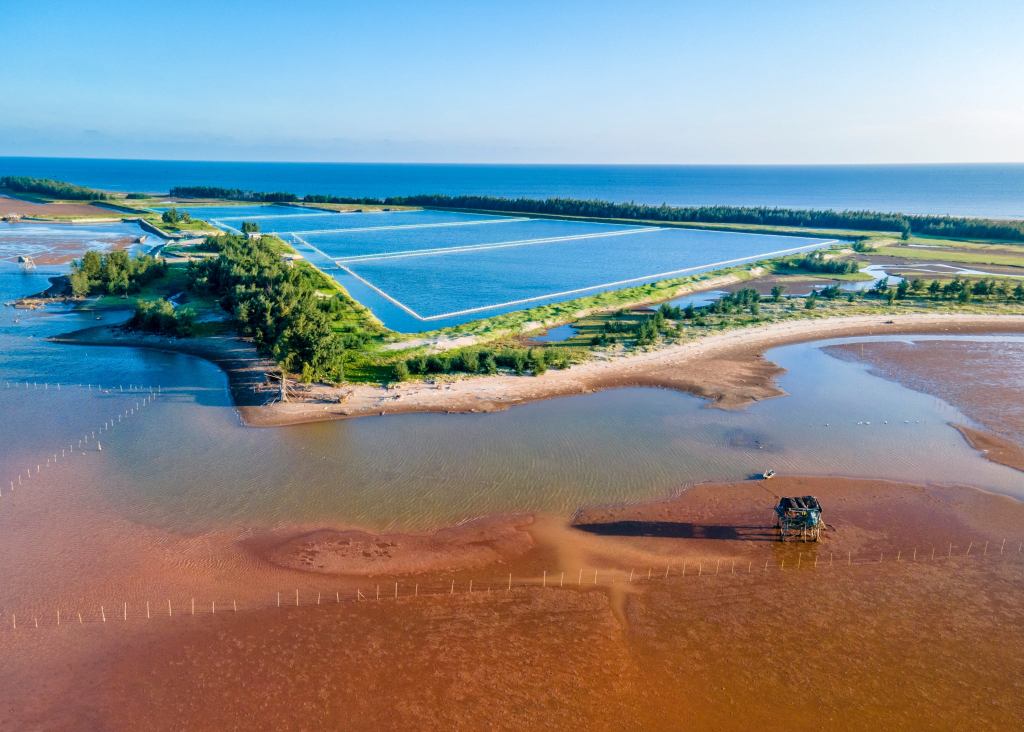
Vietnam possesses a coastline of approximately 3,260 kilometers, a maritime territory of 226,000 km2, and exclusive rights over nearly one million km2 of marine space, thus providing highly favorable conditions for the development of aquaculture (Do 2006; Tran 2023). Among aquaculture products, shrimp plays a dominant role, contributing 41% of Vietnam’s total seafood export in 2025 earnings and representing the largest export commodity within the aquaculture sector (VietnamPlus 2026). Shrimp farming in Vietnam is concentrated primarily in two regions: the Red River Delta in the north and the Mekong River Delta in the south.
Shrimp farming in the Red River Delta began in the 1970s (Mai 2023) and has since evolved through multiple stages, resulting in the emergence of diverse shrimp farming systems. This essay provides an overview of the main types of shrimp farming systems currently practiced in the Red River Delta and examines gender participation in aquaculture development using a Gender Equality, Disability, and Social Inclusion (GEDSI) approach.
At present, three main shrimp farming systems are practiced in the Red River Delta: extensive farming (mangrove-shrimp farming), industrial shrimp farming, and high-technology shrimp farming. These systems differ significantly in pond structure, farming methods, technologies applied, shrimp stocking density, and integration of other aquatic species within the ponds. The following paragraphs examine the farming practices of the different shrimp farming systems as well as the gender roles in each system.
Mangrove-Shrimp Farming
Mangrove-shrimp farming emerged during the 1970s in natural mangrove areas of Nam Dinh province (now part of Ninh Binh province following the administrative merger in July 2025). During the 1980s, construction of the Central dyke in Giao Thuy district marked the expansion of mangrove-shrimp farming (Bosma 2014). From the 1980s to the early 1990s, the government implemented policies to encourage shrimp farming development. This led to large-scale mangrove clearance; by 2001, 63% of mangrove areas present in 1986 had been replaced by shrimp ponds in Giao Thuy district, Nam Dinh province (Beland 2006).
In response, the government introduced several policies to strengthen mangrove protection. Under the Law on Forest Protection and Development (2004), coastal mangroves were classified as “Protection Forests”, which meant that human activities there required official permission from governmental agencies. Additionally, the forest allocation program, implemented since 2001, grants local communities long-term contracts (up to 50 years) to protect mangroves, by requiring the maintenance of forest cover within shrimp ponds, in exchange for livelihood benefits. These policies have been strongly enforced in Xuan Thuy National Park, Ninh Binh province (formerly Nam Dinh province), where land-use regulations prohibit the conversion of extensive shrimp farms into industrial or high-technology systems. As a result, mangrove-shrimp farming systems remain prevalent in the area.
In the Red River Delta, mangrove-shrimp farming follows a riparian model, in which mangroves are planted along pond ridges and are interspersed within ditches and shrimp ponds, while remaining enclosed by embankments (Mai 2023). This system relies heavily on natural processes, with water exchanged according to tidal cycles, bringing natural aquatic species such as crabs, fish, and seaweed into the ponds. Farmers stock shrimp at low densities and provide feed only during the first 20 days of larval development. After this period, no supplementary feed is added, and shrimp survival depends entirely on naturally available food sources. Given these characteristics, its reliance on natural resources, its limited external inputs, and its protection of mangrove forests within the pond, the mangrove-shrimp model is considered a typical Nature-based Solution (NbS).
Typically, shrimp farmers cultivate two shrimp crops per year. The main crop begins between late January and early February and continues until August or September according to the lunar calendar. From May to September, heavy rainfall and increased freshwater inflows limit shrimp farming activities. The second crop is cultivated from September to February of the following year, and aquatic products are marketed during the Tet (Lunar New Year) holiday.
This farming model offers several advantages, such as low investment costs, diversified income sources, reduced production risks, and environmental sustainability. However, its limitations include limited farming techniques, inadequate infrastructure, climate change impacts, and low overall productivity (Mai 2023). For example, a villager in Giao Minh commune, Ninh Binh province, reported that he shared a 26-hectare shrimp pond with five other people, generating a gross annual income of 700-800 million Vietnamese dong (approximately 28,570-32,650 USD) , or roughly 27-31 million Vietnamese dong (1,100-1,260 USD) per hectare per year. In other words, each person earned around 200 million Vietnamese dong (8,163 USD) per year (labor costs not included).
Although these income levels are lower than those of more intensive systems, farmers emphasize that mangrove-shrimp farming provides stable returns over time and produces higher-quality shrimp, which are perceived as tastier, safer for consumption, and able to command higher market prices than shrimp from industrial and high-technology farms.
Gender roles in mangrove-shrimp farming differ markedly. Women’s participation is more limited than men’s, as the production system requires minimal daily management and largely operates autonomously. As one male shrimp farmer from Giao Minh commune, Ninh Binh province, noted: “I do not stay at the shrimp pond every day. I sometimes visit the pond to check on it or open the water gates as the tide rises.” According to key informants, women do not attend any of the training courses on shrimp farming techniques provided by district aquaculture extension workers, simply because they are busy with household duties and therefore do not have time to do so.
Men are primarily responsible for shrimp pond management, including pond protection, water-gate operation, and major investment decisions such as pond improvement or stocking of shrimp larvae. In contrast, women typically participate only during harvest periods, mainly by assisting with yield monitoring. Because investment costs are relatively low, households rarely depend on loans for shrimp growing.
Industrial Shrimp Farming
As aquaculture development intensified and local farmers sought greater economic benefits, alternative production models were adopted to increase incomes. Industrial shrimp farming represents the second major farming system in the Red River Delta and is most commonly found in Hung Yen province (formerly the Thai Binh province). This model typically sees rice fields that are no longer productive converted into shrimp ponds. The pond bottoms are lined with polyester sheets to retain water, and waste collection pits are installed to remove uneaten feed and shrimp waste. Continuous aeration systems are required to maintain adequate oxygen levels throughout the day.
According to local farmers in Hung Phu commune, Hung Yen province, this model began spreading around 2015 after the Nam Phu Company successfully implemented industrial shrimp farming in the area. Farmers subsequently learned from this example and adopted similar practices. Compared to mangrove-shrimp farming, industrial shrimp ponds are much smaller, averaging approximately 1,000 m2 per pond. While the system still relies on seawater intake and natural aquatic organisms, shrimp and fish are stocked at much higher densities.
Industrial shrimp farming yields higher income than mangrove-shrimp farming but also entails higher investment costs and greater risks. Farmers reported that profits can be substantial during favorable seasons, but losses are common during periods of disease outbreaks or environmental pollution. One farmer from Hung Phu commune stated, “From 2015 to 2017, I was able to harvest about 70% of the shrimp stocked in the pond, but in 2024 I lost all due to water pollution.” Water pollution is attributed to untreated wastewater discharged by upstream industrial parks and by high-technology and industrial shrimp ponds into rivers and to pesticide runoff from surrounding rice fields.
From a gender perspective, women play an active supporting role in industrial shrimp production. They assist with pond protection, monitor pumping systems, clear vegetation, and manage income from shrimp sales. When health conditions allow, women also participate in physically demanding tasks, such as cleaning ponds between production cycles. However, men remain the primary decision-makers in relation to production activities and investment, while women mainly provide support and advice.
In terms of access to finance, women in industrial shrimp farming are often responsible for borrowing small amounts of money from relatives or neighbors. As one woman in Giao Hoa commune, Ninh Binh province, explained, “Women have a better reputation than men; when men borrow money, they may spend it on drinking.” However, these loans are usually limited in value. When larger amounts are required, such as around 200 million VND (8,163 USD) or higher, both husband and wife must borrow together from relatives or banks.
Notably, women are also absent from the training courses on shrimp farming techniques offered by district aquaculture extension workers and feed companies. As one male shrimp farmer in Hung Yen province bluntly put it: “Women do not know anything.”
High-Technology Shrimp Farming
Some farmers with sufficient financial resources have transitioned from industrial to high-technology shrimp farming systems, a model that has emerged only in the last nine years and requires significantly greater investment. This model incorporates advanced technologies to control water quality, temperature, and aeration, thereby improving production efficiency and biosecurity.
High-technology systems are fully enclosed, with barriers constructed around ponds and protective covers installed to shield shrimp from rainwater, bird droppings, and excessive sunlight. A separate water storage pond allows sediments to settle before water is pumped into the main pond. Chlorine treatment is applied to prevent disease transmission. Despite these advantages, the high initial investment, ranging from 300 to 400 million Vietnamese dong (11,500 to 16,000 USD) per pond of 1,000-2,000 m2, renders this model inaccessible to many farmers.
This system primarily focuses on cultivating white-leg shrimp or Penaeus vannamei, which is a species highly susceptible to disease and thus requires strict adherence to technical protocols. Income fluctuates depending on shrimp survival and growth rates. In cases of disease outbreaks, shrimp must be sold prematurely at lower prices, reducing profitability. However, when conditions are favorable, a single pond can generate revenues of up to one billion Vietnamese dong (40,000 USD). As one shrimp farmer from Giao Hoa commune, Ninh Binh province, observed, “While the income from the high-technology model is the highest among shrimp farming systems, the risks are also among the greatest.” Similarly, a representative from the former Giao Thien Farmers’ Union noted that although many farmers initially succeeded with this model, most have since experienced failure, and are consequently left deeply in debt.
In high-technology shrimp farming, gendered participation in aquaculture practices is clearly seen. Men constitute the majority of the workforce and are responsible for all technical tasks, such as managing the electricity, aeration, and water filtration systems, conducting daily water quality testing, and monitoring the shrimp’s health. Farmers believe that only men have sufficient knowledge and technical skills to operate high-investment systems. Meanwhile, women are excluded from technical work, and in some cases, even from feeding shrimp, especially when they have recently returned from a funeral or are menstruating. Farmers believe that such presence can bring bad luck or disease to shrimp. These practices reflect traditional beliefs that associate women with bad luck in high-investment production areas.
Regarding financial management, women participate in monitoring harvested yields during sales and managing the income. Nevertheless, key financial and production decisions are still predominantly made by men. Given the high level of investment required, loans are mainly obtained from banks, and both husband and wife are required to sign loan agreements.
As in the industrial model, women in high-technology shrimp households do not attend any of the training courses on shrimp farming techniques provided by district aquaculture extension workers or feed companies. A woman responsible for feeding shrimp in Giao Hoa commune said that although she did not attend any training, she learned from her experience and she believed that “I have a knack for raising shrimp, so they grow quickly and get fat.”
Conclusion
Shrimp farming in the Red River Delta has undergone a significant transformation since its emergence in the 1970s, evolving from nature-based mangrove-shrimp systems to more intensive industrial and high-technology farming models. This transition reflects broader trends in aquaculture development, characterized by increasing levels of investment, technological application, productivity, and risk. While mangrove-shrimp farming remains environmentally sustainable and economically stable, it generates relatively low returns. In contrast, industrial and high-technology systems offer higher income potential but expose farmers to greater financial vulnerability due to disease outbreaks, environmental pollution, and high capital requirements.
Across all shrimp farming systems, gender roles remain clearly differentiated. Men predominantly control decision-making, investment, and technical operations, particularly in intensive farming systems. Women’s participation is largely supportive, focusing on harvesting, daily maintenance tasks, and household financial management. Despite their limited visibility in production implementation and decisions, and limited access to training on shrimp farming techniques, women play a crucial role in sustaining shrimp farming livelihoods, especially through financial management and access to informal credit networks. Furthermore, the findings reveal that cultural beliefs significantly influence gender participation in shrimp farming. Specifically, women are excluded from technical work and, in some cases, from feeding shrimp during menstruation or after attending funerals, reflecting traditional beliefs that associate women with bad luck.
Applying a GEDSI perspective highlights the need for more inclusive policies and capacity-building initiatives that recognize and strengthen women’s contributions, promote equitable participation, and thus enhance the long-term sustainability and resilience of shrimp farming in the Red River Delta.

