By Thuan Sarzynski
In 2025, the world volume of fisheries from aquaculture once again surpassed the volume from natural catches. Of the 104.1 million tonnes of cultivated fisheries, 5.6 million tonnes were shrimps, the most popular seafood in the USA and Europe. The world’s top producers of cultured shrimps, Ecuador, China, India, Vietnam and Indonesia, accounted for three-quarters of the global production in 2023. Vietnam itself supplies 20% of the world production and mainly exports to the USA, Europe, Japan and Australia.
A Risky and Attractive Business With High Impact on the Environment
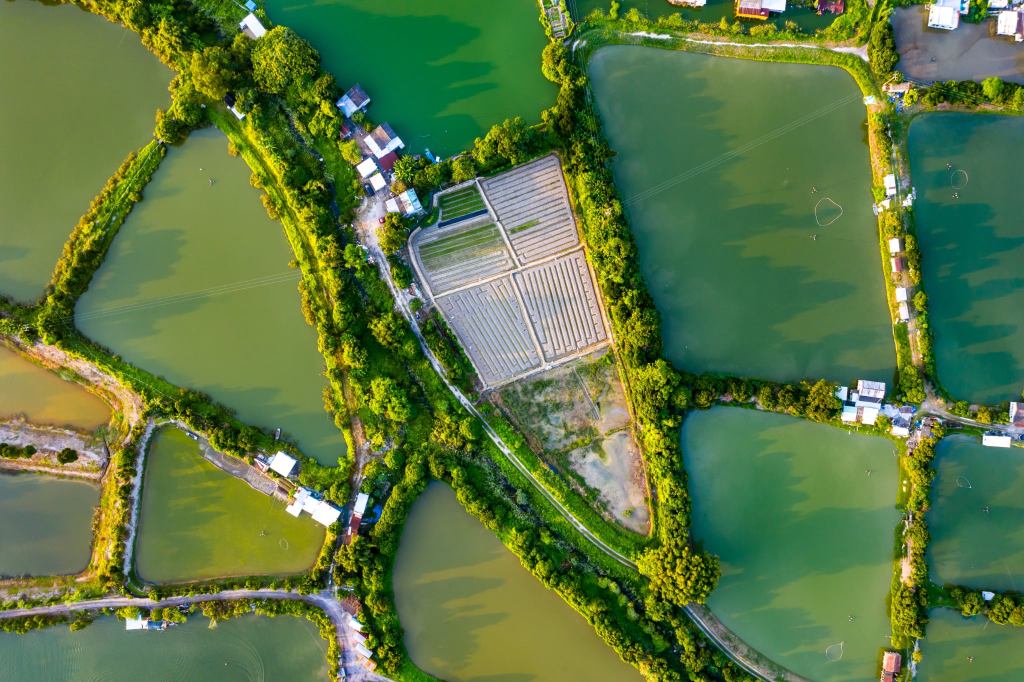
The highest density of shrimp farms in the world is located in Vietnam, where this high-risk high-return business has attracted thousands of farmers who started in aquaculture some decades ago. This shift from rice to aquaculture has increased farmers’ incomes tenfold. However, the learning curve has been steep, and many have failed to create the right environmental conditions for shrimps in their newly established ponds. Shrimp aquaculture requires brackish water with a specific range of salinity. Too much salt or pollutants can kill all the shrimps in a pond and leave farmers stranded without an income.
“The shrimp farming industry is currently facing many difficulties in terms of diseases and water sources. Most shrimp farmers get water from their rivers, canals, and this water source is currently very polluted, so the risk of water quality as well as pathogens is very high,” explained Nguyen Hoai An, the director of the Binh Minh fishery development company, who manages a network of shrimp hatcheries across the Mekong Delta.
To cope with polluted water, farmers control water quality and exclude salty water from their ponds to ensure the shrimp’s safety. Companies such as Binh Minh have provided training and technology to support farmers which led to the expansion of shrimp farming.
In 2024, shrimp farms covered a total area of 737,000 hectares in the Mekong Delta, producing 1.3 million tons of this 10-leg seafood. Shrimp farming expansion has not only replaced rice paddies but also encroached on the mangrove in the Mekong, removing the coastal natural protection against waves and typhoons. This erosion of the ground worsened salty water intrusion, which went deeper into the Delta. The mangrove area in the Delta has halved over the last 50 years, leaving only 100,000 ha of natural habitat. In recent years, efforts of NGOs and the Vietnamese government have slowed down mangrove deforestation by developing mangrove-shrimp models where at least half the farm is maintained under mangrove cover.
A Sustainable Model and International Certification to Improve Supply Chain Standards
In the mangrove-shrimp model, about 50-70% of the farm area is covered with mangroves that host a variety of crabs and fish whose capture diversifies farmers’ incomes. The diversity adds resilience and stability to the system and brings farmers into a higher value market through food certification. In Ca Mau, at the southern tip of the Mekong Delta, 15% of ponds or 22,000 ha were mangrove-shrimp models, which in 2025 were certified as such. Despite the environmental benefits of the mangrove-shrimp system, the most popular model in the Delta is the low-intensity monoculture shrimp system, where farmers maintain a natural stocking density of 1-3 shrimp fry per square meter, which does not need supplementary feed. Average profit from this model is about 21,000 USD per hectare, which is 20% higher than for the integrated mangrove-shrimp model.
The mangrove-shrimp model is eligible for sustainability certification, which provides a price premium to farmers. Many shrimp certification programs exist, and their standards are quite similar. For example, the most commonly used standard is the Aquaculture Stewardship Council’s, which includes these seven key points: legality, biodiversity conservation, community impact monitoring, farm operation, crustacean welfare, shrimp traceability, and efficient resource use.
Nguyen Duy Thanh, an agricultural expert from the Ca Mau Fisheries Sub-department, describes the certification benefits this way: “Certified shrimp not only fetch higher prices and give access to demanding markets, but the model also promotes forest conservation and environmental awareness among farmers.” Certification premiums are usually 0.20 USD/kg, and a top organic certification like Naturland’s can yield a 20-30% increase above the standard price. In 2024, nearly 16% of all farmed shrimps were certified, which contributed to improved social, economic, and environmental standards in the supply chain (Cheney 2024).
Beyond Certification, Better Feed
One tonne (t) of shrimp requires nearly 2t of feed formulation. Since 2023, feed costs have more than doubled due to the cancelled harvest of wild anchovies in Peru, which raised the cost of fishmeal to 2,600 USD/t and fish oil to 6,000 USD/t (Villarreal 2023). As feed represents about 50% of the production costs for a farmer, its price increase heavily reduced farmers’ margins. Alternatives exist and are entering the industry. For example, Entobel, a start-up valued at 30 million USD, processes black soldier flies into H-meal and H-oil, a sustainable equivalent for fishmeal and fish oil (Entobel). “The reason we started [Entobel] was because fishmeal was an ecological disaster, overfishing disrupts a biological cycle happening between the atmosphere and the ocean,” explained Gaetan Crielaard CEO and founder of the company. Gaetan hopes that the industry will acknowledge the negative environmental impact of fishmeal and that Entobel can stimulate the adoption of insect-based feed for aquaculture.
Next, Technological Improvements and Better Care
Technology and AI uses have also grown in the shrimp industry. For example, simple infrared LED lights encourage shrimps to feed and gain weight at night. More complex technologies, like Aquaeasy’s interconnected sensors, can control water quality and automatically feed the shrimps at the best time to improve their feed conversion ratio (Seabina 2022). For disease detection, Rynan Technologies has developed a plastic container connected with sensors that measure shrimp weight and determine the types of bacteria in each pond. Rynan Technologies even includes geolocation and mangrove restoration in their pond design to streamline access to certification programs and thereby increase farmers’ incomes (Rynan).
Then, Better Waste Management
Beyond controlling the model used and the management of the shrimp farm, another way for the industry to become more sustainable is to use shrimp waste in food or agriculture. Shrimp waste can represent a third of the total shrimp weight. The shell, legs and meat left after processing are rich in amino acids, antioxidants, minerals, lipids, and chitin-based biopolymers. Vnfoods, a Vietnamese company, has developed value chains and treatments of the shrimp “co-product”, which they treat as a valuable resource (VNF). Value is in the eyes of the beholder, and what some see as waste becomes valuable to companies pioneering the circular economy. Vnfoods purchases this resource from shrimp processing factories, transports it in a cold storage truck to conserve its quality, and then processes it into food ingredients like shrimp powder, shrimp oil, feedstock complements, and agricultural bio-nutrients.
And Last, Better Together in the Shrimp Industry
In shrimp farming, women are always the little hands doing the work. But it’s often their husbands who have the power to make key decisions in farm management, for example about shrimp stocking density, feedstock type, and certification registration. With the growing threat of climate change, women can become key forces of adaptation for their community. Future initiatives should aim at empowering women through business training in farm finances and through raised awareness of rights, shared land titles and administrative responsibilities, all of which are especially important for farm certification (Do 2022; Tinh 2022). Capacity building initiatives about technological and AI innovation should train women users as they are often the main farm operators. Moreover, innovation funds should target women-led startups for better gender inclusion in the industry.
Conclusion
Sustainability in aquaculture’s shrimp sector has borne many colors. At first, sustainability came with the realization that the environment should be protected and deforestation avoided. Then, sustainability grew to mean a formal list of social and environmental safeguards which growers had to comply with in exchange for a higher income. Finally, sustainability encouraged pioneers to grow new, innovative models which outcompeted the old, established businesses. Today, a sustainable future is possible when the right products are purchased, those with low harm for the environment and high value for the people.

