By Nguyen Thi Quynh Nga
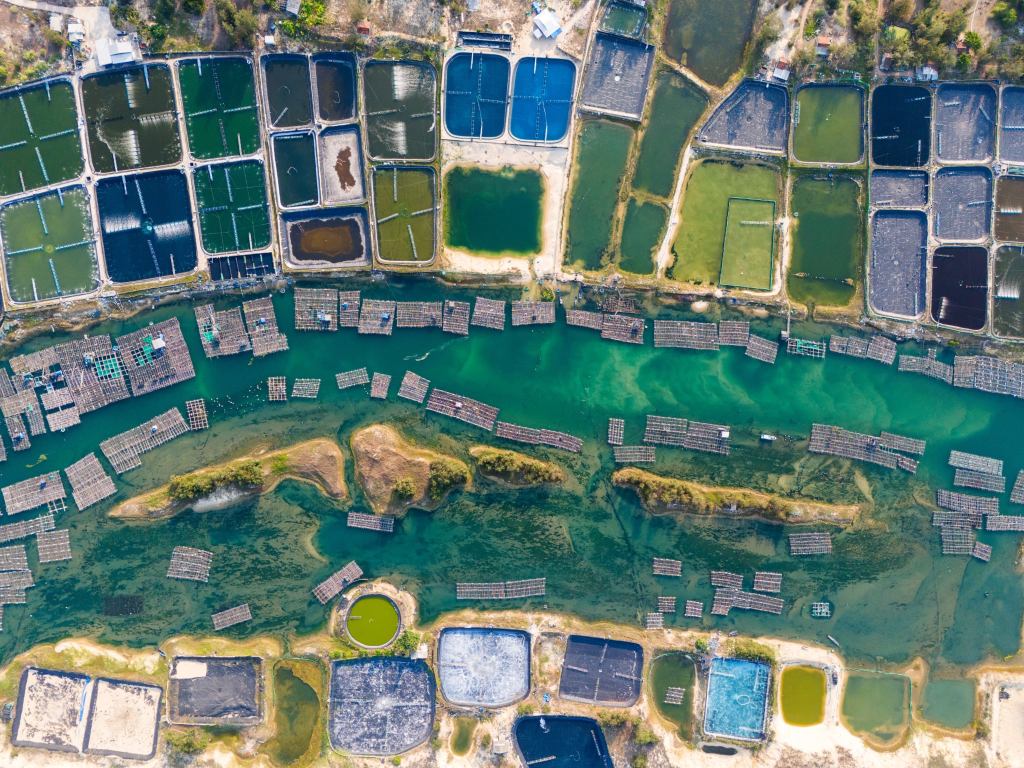
Aquaculture today plays an important role as it provides food for humans, creates jobs and promotes economic growth. Vietnam, with its natural conditions favorable for rapid sectoral development, is one of the world’s major aquaculture producers and exporters. In 2025, Vietnam’s aquaculture output increased by 5.1%, met domestic consumption and export demand, and generated employment and income for millions of workers in coastal areas, the Mekong Delta, and other regions (NSO 2026). However, this growth faced climate challenges and also brought on environmental damage.
Global climate change intensifies extreme weather events such as heat waves, storms, droughts, salinity intrusions, and thus places pressure on aquaculture. At the same time, aquaculture contributes to water pollution, organic waste discharge, and ecosystem degradation. Intensive systems consume large amounts of energy, rely on industrial feed, emit greenhouse gases, and create an urgent need to transition toward more sustainable models. In this context, adopting environmentally friendly aquaculture solutions opens new opportunities for Vietnam to both adapt to climate change and sustain economic growth.
Climate Policy for Aquaculture in Vietnam
Vietnam has issued several policy documents to guide the fisheries sector toward sustainability and climate adaptation. The Law on Fisheries (Consolidated Document No. 01/VBHN-VPQH, dated 16 September 2024) stipulates that activities must be based on resource stock assessments and linked to biodiversity protection and restoration. The goal is to ensure sustainable development, climate change adaptation, disaster prevention, disease control, and environmental protection.
Decision No. 1422/QD-TTg, dated 19 November 2024 of the Prime Minister on the National Climate Adaptation Plan for the period 2021-2030 with a vision to 2050, identified the tasks required to achieve climate-resilient aquaculture models. The items to be investigated include rice-fish systems, aquaculture under drought and salinity conditions, development of aquatic veterinary services, disease control and environmental monitoring, restructure from capture fisheries to aquaculture, multi-species and multi-layer farming (IAQ), biosecure aquaculture (BSS), as well as mangrove ecosystem restoration through community-based forestry-fishery integration.
Decision No. 896/QD-TTg, on 26 July 2022, approved the National Climate Change Strategy to 2050 and set the twin goals of developing sustainable aquaculture value chains and building smart aquaculture models to enhance the resilience of natural and social systems.
These policies demonstrate that Vietnam is integrating aquaculture development with reduction of greenhouse gas emissions and adaptation to climate change, in other words protecting the environment while maintaining the sector’s vital role in the national economy.
Aquaculture Systems in Vietnam
Solutions to climate change adaptation in Vietnamese aquaculture focus on three groups: high technology systems, ecological models, and local management techniques. These solutions aim to maintain water quality, reduce disease risks, and protect biodiversity. They are currently applied widely in coastal provinces, including the Mekong Delta.
The high-technology group includes recirculating aquaculture systems (RAS), Biofloc technology, and multi-stage intensive farming, which save water, maintain high stocking densities, and reduce pollution. For example, farming of whiteleg shrimp in HDPE-lined tanks with water recirculating systems has been implemented in southern and central Vietnam. This model reduces disease risk and saves significant amounts of water, though initial investment costs are high. Biofloc technology uses microorganisms to process organic waste in ponds, which improves water quality and reduces feed costs. Production capacity is reported to increase by 5-10%, shrimp size is about 2 g larger than in conventional systems, feed conversion ratio (FCR) is low (1.0-1.3), and production costs decrease by 10-15% (VNUA 2023). Intensive farming yields much higher productivity than traditional methods, but relies entirely on industrial feed and high stocking densities (20-40 shrimp/m2 for black tiger shrimp; 60-150 shrimp/m2 and higher for whiteleg shrimp, depending on technology and conditions).
Ecological models such as rice-shrimp and mangrove-shrimp systems leverage ecosystem interactions. They not only reduce emissions but also increase farmers’ income. Rice-shrimp systems are applied in riverine and canal areas, while mangrove-shrimp systems are used in coastal mangrove forests. Rice-shrimp systems reduce greenhouse gas emissions compared to rice monoculture and provide dual income sources for farmers. Mangrove-shrimp systems not only generate economic benefits but also contribute to restoration and protection of mangroves, which are ecosystems with high carbon sequestration capacity. New models such as crab farming in plastic boxes and mud-free eel farming are also being tested to minimize environmental impacts.
Local management techniques include adjustments to farming calendars, selection of saline-tolerant breeds, shade over ponds to reduce temperature, continuous aeration, and addition of probiotics. Seasonal adjustments based on temperature and salinity intrusion, use of disease-free and saline-tolerant shrimp breeds, and measures such as shading ponds with nets and lime application to stabilize pH, all help reduce disease risks. Nutritional management involves reducing feed during heat stress and supplementing with vitamin C and probiotics to enhance animal resilience. Cage culture in rivers and lakes and switch to species with high salinity tolerance are also effective adaptation strategies.
Greenhouse Gas Emissions from Aquaculture
Research shows that aquaculture contributes about 0.49% of global anthropogenic greenhouse gas emissions, equivalent to 263 million tons of CO2e annually (Subhashree Devasena 2022; Li 2025). Although lower than the emissions from cattle farming, aquaculture’s emissions are rising rapidly (Zhang 2024).
Aquaculture generates three main greenhouse gases: carbon dioxide (CO2), methane (CH4), and nitrous oxide (N2O). According to IPCC AR6 (2024), CH4 has a global warming potential (GWP) of 27 (biogenic) or 29.8 (fossil), while N2O has a GWP of 273 over a 100-year horizon (IPCC 2024). CO2 arises mainly from energy use (electricity, fossil fuels for pumps, aerators, lighting, and feed supply chains). CH4 is produced by anaerobic decomposition of organic residues, while N2O results from microbial nitrification and denitrification processes.
Life cycle assessment (LCA) indicates that feed production is the largest emission source, accounting for 57-90% of total emissions (Hammer 2022). Farm operations also contribute significantly, especially in intensive systems where electricity for aeration and pumping dominates (Xu 2022; Li 2025). Post-harvest activities such as processing, refrigeration, and transport further add to the carbon footprint (Hammer 2022).
Emission intensity varies by species and system. Bivalves and seaweed have low emissions because they require no artificial feed and sequester carbon (Xu 2022; Zhang 2024). Intensive systems for shrimp and finfish, in contrast, have high emissions due to energy and feed demands. Recirculating aquaculture systems (RAS) provide strong environmental control but consume large amounts of energy, leading to high carbon footprints unless renewable energy is used. Integrated rice-fish systems reduce CH4 and N2O compared to rice monoculture. Conversion of mangrove ecosystems into shrimp ponds releases massive emissions, of up to 1,603 kg CO2e per kg of shrimp produced (Ngarava 2023).
Greenhouse gas emissions also vary by region. China is one of the largest aquaculture producers, contributing about 46% of the sector’s global emissions, equivalent to 112 million tons of CO2e (Xu 2022). However, the emission intensity per ton of product in China is lower than the global average due to its high proportion of bivalve farming which accounts for 30% of its aquaculture output compared to the global average of 21% (Xu 2022). On the other hand, Sub-Saharan Africa contributes negligibly to global emissions as its aquaculture industry is still in its early stages (Ngarava 2023).
Carbon Market Potential
Environmentally friendly aquaculture models open opportunities for Vietnam to participate in carbon markets. Mangrove-shrimp, rice-shrimp, and mangrove restoration can generate carbon credits if measured and verified under international standards. These credits can be traded and thus provide additional income for coastal communities. RAS with renewable energy and Biofloc systems with emissions reduction may also qualify as mitigation activities. Some international projects that have demonstrated feasibility include the following.
Kelp Blue (Namibia): Offshore kelp farming where one km2 absorbs about 2,000 tons of CO2 annually, which is six times more efficient than tropical forests (Invest International).
Ocean Rainforest (Faroe Islands, Denmark): Industrial-scale seaweed farming which generates credits through EU partnerships. One ton of seaweed stores about 27 kg of carbon (approximately 99 kg CO2e) (Ocean Rainforest 2024).
Running Tide (USA): Seaweed grown and sunk into the ocean for long-term CO2 storage, with credits sold to major corporations such as Shopify and Stripe.
These three pioneering projects provide practical evidence of carbon credit commercialization from aquaculture and “blue carbon”. Vietnam can learn from these experiences in three key areas: expand large‑scale seaweed farming, standardize carbon credit systems according to international rules, and link with the global voluntary carbon market. This pathway to commercialization can both reduce emissions and create new income opportunities for coastal communities.
Recommendations
First, Vietnam should establish a clear legal framework and a transparent system for carbon measurement, reporting, and verification (MRV). Communities must have the right to own and benefit from carbon credits. This is essential for carbon credits from aquaculture to be recognized internationally and traded globally. Moreover, Vietnam is currently piloting a domestic carbon credit trading platform under the Law on Environmental Protection (2020). This initiative opens opportunities for aquaculture enterprises to participate in carbon trading within the country.
Second, Vietnam has already issued policies to promote sustainable ecological models such as mangrove-shrimp, rice-shrimp, and seaweed farming. These models reduce emissions, increase household income, and support ecosystem restoration. In addition, the adoption of green technologies and renewable energy in recirculating aquaculture systems (RAS) and Biofloc technology can lower dependence on fossil fuels, improve efficiency, and reduce greenhouse gas emissions.
Third, Vietnam should consider financial assistance mechanisms for small‑scale farmers through training programs, targeted funding and preferential policies. This would help them access new technologies and join the carbon market.
Finally, community capacity building is essential. Training in sustainable aquaculture practices and environmental management, plus strengthening local cooperatives, will ensure broad and effective participation in the transition toward environmentally friendly aquaculture.
Social Inclusion Considerations
Beyond environmental and economic aspects, the development of environmentally friendly aquaculture and participation in carbon markets can also address gender equality and social inclusion (GESI). Women and marginalized groups are active in aquaculture value chains, especially in small‑scale farming, post‑harvest processing, and community management. Ensuring their access to training, financial support, and participation in decision‑making processes can improve both the fairness and the effectiveness of climate‑resilient aquaculture models. Integrating GESI principles into policies and projects not only promotes social equity but also strengthens community resilience and increases the long‑term success of sustainable aquaculture and carbon market participation.
Conclusion
Vietnam’s aquaculture sector faces both significant opportunities and challenges thanks to climate change. As a key economic industry, aquaculture provides food and employment for millions, yet it is also a notable source of greenhouse gas emissions. The adoption of environmentally friendly models such as recirculating aquaculture systems (RAS), Biofloc technology, rice-shrimp and mangrove-shrimp farming, can reduce emissions, protect ecosystems, create opportunities to participate in carbon markets, and thereby generate additional income for coastal communities.
International experiences from large-scale seaweed farming projects demonstrate the strong potential for carbon credit commercialization and therefore offer a feasible pathway for Vietnam. To realize this potential, the country must establish a transparent legal framework, implement internationally recognized measurement, reporting, and verification (MRV) systems, provide financial support for small-scale farmers, and strengthen community capacity. Integrating gender equality and social inclusion is also essential to ensure fair and effective participation.
In this way, sustainable aquaculture not only contributes to emission reduction and climate adaptation but also enhances the global competitiveness of Vietnam’s seafood products.

