By Nguyen Thi Thu Thao and Kobboon Kaewpila
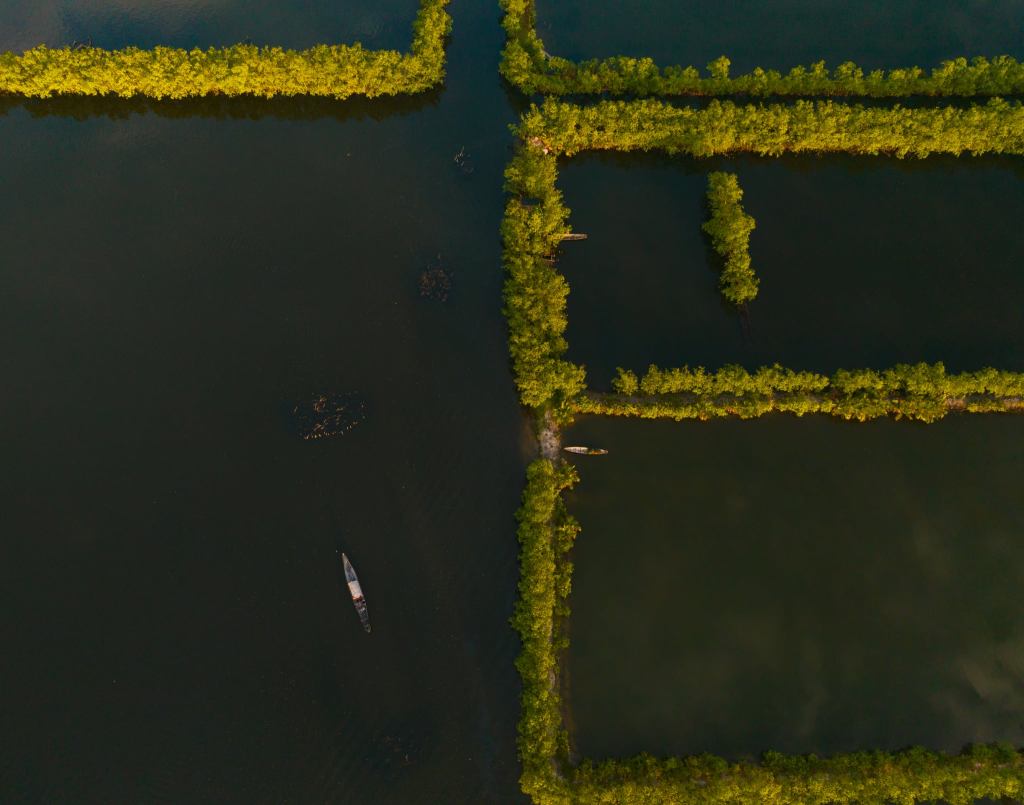
Mangrove-shrimp aquaculture has emerged as a prominent model in Vietnam’s coastal development strategy, often presented as a system that aligns environmental sustainability with rural livelihoods. In provinces such as Ca Mau, Bac Lieu, and Soc Trang, integrated mangrove-shrimp systems have been widely adopted by smallholder farmers due to their low-input requirement and compatibility with coastal ecosystems.
Existing studies consistently highlight the livelihood contributions and environmental benefits of mangrove-shrimp models. However, a critical dimension remains underexplored: whether these systems can provide a sufficient and stable living income, with earnings resilient enough to support a decent standard of living. Although many studies document income levels and livelihood improvements, few explicitly assess whether these outcomes meet living income thresholds.
Addressing this gap requires comprehensive and systematic assessments of the sufficiency, stability, and resilience of the income derived from mangrove-shrimp systems.
Livelihood Contributions of Mangrove-Shrimp Systems
The role of mangrove-shrimp aquaculture in supporting rural livelihoods is well established. One of its advantages is its low-input, low-risk production model, which reduces dependence on external inputs such as commercial feed, chemicals, and antibiotics. This makes it particularly accessible to smallholder farmers who lack the capital required for intensive aquaculture systems.
Studies provide evidence of its economic viability at the household level. For example, research conducted in Soc Trang province indicates that farmers operating mangrove-shrimp systems incur relatively low production costs of approximately 3.6 million VND (136 USD) per hectare per year, while generating net incomes of around 24 million VND (911 USD) per hectare per year (Phuong 2017). Although modest, this income is achieved with limited financial risk, which makes the system attractive for risk-averse households.
In addition to direct income generation, mangrove-shrimp systems contribute to livelihood diversification. Farmers typically harvest a combination of shrimp, crab, and other aquatic species, thus creating multiple income streams. By reducing reliance on a single product, this diversification enhances resilience and provides a buffer against market and environmental shocks.
The environmental sustainability of the system further strengthens its role in supporting livelihoods. Mangroves provide essential ecosystem services, such as water filtration, habitat provision, and coastal protection. These services not only sustain shrimp production but also reduce the need for costly interventions.
Taken together, these characteristics explain why mangrove-shrimp systems are widely considered a sustainable livelihood option. However, livelihood support does not necessarily equate to living income. This raises questions about whether the level of income generated is sufficient in the long term.
The Living Income Gap
To understand the limitations of existing assessments, it is important to distinguish between livelihood support and living income. Livelihood is generally understood as the capabilities, assets, and activities that enable people to make a living (Chambers 1992), and is often assessed through economic outcomes such as income or profitability. On the other hand, living income is about whether households earn enough to meet basic needs, maintain a decent standard of living, and withstand economic or environmental shocks (LICOP).
This distinction highlights a critical gap. In many cases, research shows that farmers earn income but does not clearly indicate whether that income is high enough. While mangrove-shrimp systems are frequently evaluated in terms of their economic efficiency or sustainability, they are rarely assessed against benchmarks of income sufficiency or long-term resilience. As a result, it remains unclear whether the income generated by these systems is adequate in absolute terms, rather than simply beneficial relative to alternative livelihoods.
Moreover, living income is inherently multidimensional. It involves not only the level of income but also its stability, predictability, and resilience over time. These dimensions are particularly relevant in the context of aquaculture, where production is influenced by environmental variability, market fluctuations, and policy constraints.
The absence of such multidimensional assessments limits the ability to fully understand the economic outcomes of mangrove-shrimp systems.
What We Know and What Remains Unclear
Vietnam’s Mekong Delta provides a valuable context for examining both the strengths and limitations of mangrove-shrimp systems. Studies confirm that these systems generate income and support livelihoods across a wide range of coastal communities. However, they also reveal important nuances regarding income levels and variability.
For instance, although the relatively low costs of production contribute to positive net returns, overall income levels remain modest. The previously cited figure of approximately 24 million VND per hectare per year illustrates that while farmers generate a profit, the size of the income may be limited, particularly for households with multiple dependents or limited land holdings.
At the same time, the income results are influenced by external factors. For example, policy frameworks governing mangrove conservation, such as prescribed ratios of forest cover to aquaculture area, play a significant role in shaping production and income potential. Studies indicate that farmers often adjust these ratios in practice to balance conservation requirements with economic needs (Anh 2024). This highlights the dynamic tension between ecological and economic objectives within the system.
Environmental variability also affects income stability. Factors such as salinity intrusion, water quality, and disease outbreaks influence productivity, leading to fluctuations in income across seasons and years (Nguyen 2020). While diversification within the system can mitigate some risks, it does not eliminate them entirely.
These findings suggest that while mangrove-shrimp systems provide a foundation for income generation, a comprehensive understanding of whether they deliver a living income requires more detailed and systematic analysis.
Rethinking the Gap: Measurement and Evaluation
The gap between livelihood support and living income in mangrove-shrimp systems should not be interpreted as evidence that the model is economically inadequate. Instead, it reflects a broader issue in how income is conceptualized and measured within existing research.
Current studies tend to focus on relative performance indicators, such as profitability or efficiency, rather than absolute benchmarks of income sufficiency. This makes it difficult to assess whether farmers can meet essential needs or achieve long-term economic security. Incorporating living income benchmarks into future research would provide a more meaningful basis for evaluating outcomes.
In addition, the temporal dimension of income needs to be better captured. Short-term studies may overlook fluctuations and long-term trends that are critical for an understanding of resilience. Longitudinal research could provide insights into how income from mangrove-shrimp systems evolves over time and responds to environmental and market changes.
Another important consideration is the heterogeneity of households. Income outcomes may vary significantly depending on factors such as land size, access to markets, and participation in certification schemes. For example, farmers engaged in eco-certification programs may receive price premiums that enhance income, yet access to such programs is not universal. Understanding these variations is essential for assessing the broader applicability of living income.
Finally, integrating qualitative dimensions of well-being such as perceptions of income adequacy, financial security, and livelihood satisfaction can complement quantitative measures. This would allow for a more holistic assessment of living income that reflects both economic and social realities.
By expanding the scope of analysis in these ways, future research can move beyond simple income metrics and provide a more comprehensive understanding of how well mangrove-shrimp systems perform when it comes to living income.
Recommendations
To address the living income gap in mangrove-shrimp systems will require coordinated efforts in both research and policy.
First, studies should adopt living income frameworks and benchmarks to evaluate income outcomes more systematically. This includes assessing whether household earnings are sufficient to meet basic needs, as well as examining income stability and resilience over time.
Second, comparative studies that track income dynamics across different farming systems and regions should be undertaken. Such studies can help identify the conditions under which mangrove-shrimp systems are most effective at supporting living income.
Third, greater attention should be given to market access and value chain dynamics, particularly in relation to certification schemes and eco-labeling. Understanding how these mechanisms influence income can inform strategies to enhance economic outcomes without compromising environmental sustainability.
Finally, policymakers should support data collection and monitoring systems that enable a more accurate assessment of income data. This includes integrating socio-economic indicators into existing aquaculture and environmental programs.
Importantly, these recommendations do not imply a need to replace or fundamentally alter mangrove-shrimp systems. Rather, they emphasize the importance of better understanding and strengthening the economic dimensions of an already promising model.
Conclusion
Nature-based solution models, in general, and Vietnam’s mangrove-shrimp systems, in particular, represent a compelling example of how environmental sustainability and livelihood support can be integrated within a production system. Its low-input nature, ecological benefits, and capacity for diversification make it a valuable option for smallholder farmers in coastal regions.
However, while this model supports livelihoods, some uncertainty remains around its ability to deliver a living income. Existing research largely demonstrates that mangrove-shrimp farming can generate income, yet it rarely evaluates whether these earnings are sufficient, stable, and resilient enough to ensure a decent standard of living over time.
Addressing this gap requires a shift toward more comprehensive and multidimensional approaches to income assessment that incorporate benchmarks of sufficiency, stability, and resilience alongside broader measures of well-being. Future research will provide a clearer understanding of whether mangrove-shrimp systems are not only environmentally sustainable, but are also capable of supplying economically secure and resilient livelihoods for aquaculture farmers in the long term.

